
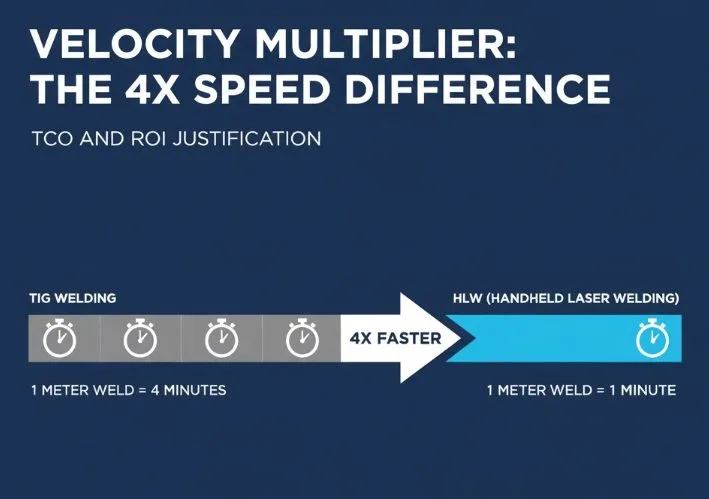
Handheld laser welding is the most significant technological upgrade for kitchen and bathroom manufacturers today. By switching from traditional Gas Tungsten Arc Welding (TIG), facilities can increase welding speeds from 0.8 meters per minute to over 3.2 meters per minute on 3 mm stainless steel. This shift addresses the industry’s most critical pain points: heat-induced warping, high post-weld grinding costs, and a shrinking pool of skilled welders.
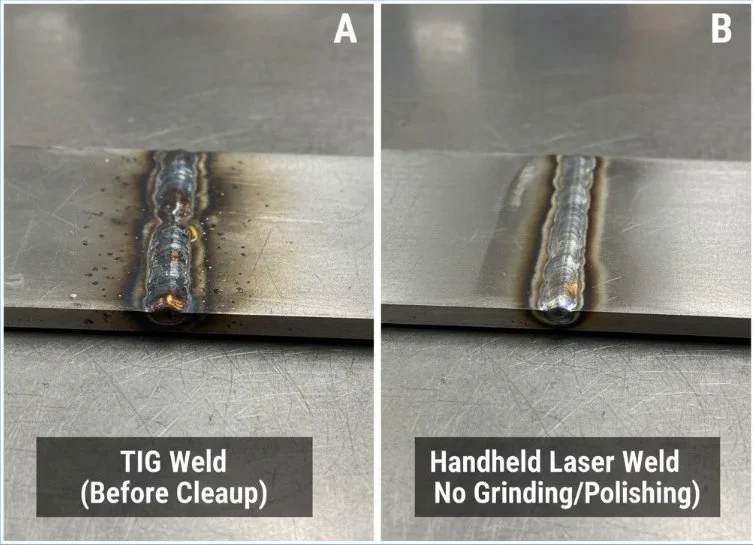
The Aesthetic Shift: Meeting the “Handmade” Standard
In premium kitchen and bathroom design, the market has moved toward “zero-radius” corners and sharp architectural lines. These features are difficult to achieve with traditional deep-drawing or pressing methods.
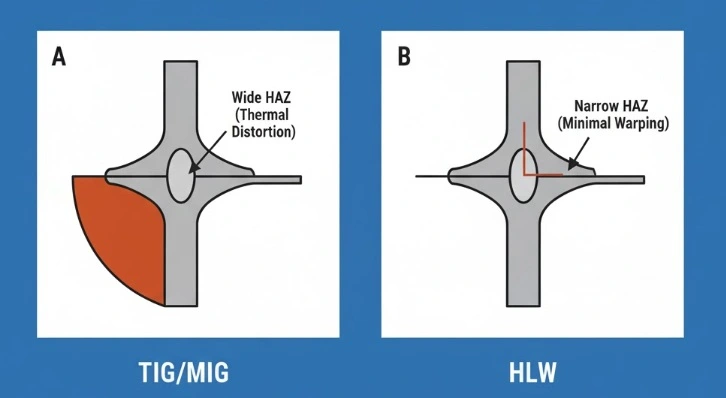
- Zero Distortion on Thin Sheets: Conventional TIG welding creates a large Heat-Affected Zone (HAZ), which causes thin panels (0.5 mm–1.5 mm) to warp or show “read-through” on the visible side. Handheld lasers use a concentrated beam to minimize heat input, ensuring range hoods and appliance panels remain perfectly flat.
- Hygienic Surface Integrity: For food-grade and medical-grade fixtures, surfaces must be smooth to prevent bacterial growth. Laser welding creates narrow, clean seams with minimal spatter, preserving the material’s corrosion resistance and reducing the risk of “weld decay” common in slow, high-heat processes.
- Cosmetic “No-Grind” Seams: While TIG leaves a raised “stacked dime” bead that requires heavy grinding, laser welding produces a flush, consistent finish. This allows manufacturers to eliminate up to 90% of post-weld polishing labor.
Operational Velocity: 4x Faster Production
Overcoming the Skilled Labor Shortage
The American Welding Society (AWS) projects a deficit of over 320,000 welding professionals by 2029. Handheld laser welding lowers the barrier to entry significantly.
- Reduced Technical Barrier: TIG welding requires years of experience to master hand-eye-foot coordination. Handheld lasers use an intuitive, “point-and-shoot” interface.
- Simplified Controls: Modern machines include pre-set libraries. An operator can select “304 Stainless, 1.2 mm” and the machine automatically adjusts Power (Watts), Pulse frequency, and Wobble (oscillation) width.
- Wobble Technology: Standard laser beams are microscopic (0.1 mm). Modern “Wobble” heads oscillate the beam up to 4.0 mm, allowing the laser to bridge gaps and handle inconsistent part fit-up that would otherwise cause defects.
Economic Analysis: Total Cost of Ownership (TCO)
While the initial investment for a high-quality 1500W to 3000W fiber laser welder is higher than a TIG power source, the operational savings provide a rapid Return on Investment (ROI).
- Energy Efficiency: Laser systems draw roughly 2–3 kW, compared to the 5–7 kW required for TIG/MIG active arcs. Over a standard production cycle, this reduces energy costs by 60–70%.
- Consumable Savings: TIG requires frequent replacement of tungsten electrodes and high volumes of argon gas. Laser welding eliminates tungsten costs and uses significantly less gas due to the faster travel speeds.
Estimated Cost per Meter Welded:
- TIG Setup: $4.15 per meter (includes gas, rod, and grinding labor).
- Fiber Laser: $2.00 per meter (includes energy and gas).
Safety Compliance and Integration
Handheld laser welders are Class 4 laser products, which require strict adherence to international safety standards, such as ISO 11553-2 and ANSI Z136.9.
- Laser Controlled Area (LCA): Operations must occur in a light-tight enclosure with interlocked doors that kill power if opened.
- Personal Protective Equipment (PPE): Standard welding helmets are insufficient. Operators must wear specialized laser safety eyewear with an Optical Density (OD) of 6+ or 7+ for the 1070–1080 nm wavelength.
- Fume Extraction: Even though spatter is low, laser welding vaporizes metal into nanoparticles. High-efficiency fume extraction is mandatory for respiratory safety.
FAQs
Early laser welders required perfect part fit-up because the beam was only 0.1 mm wide. Modern “Wobble” heads oscillate the laser beam in patterns (circles or figure-eights) up to 4.0 mm wide. This oscillation stirs the weld pool, bridging gaps in sheet metal and providing the flexibility to handle inconsistent tolerances typical in manual fabrication.
Because handheld laser welders are Class 4 laser devices, they cannot be used on an open factory floor. You must establish a Laser Controlled Area (LCA)—a light-tight enclosure with interlocked doors and external warning signs. Operators must wear specialized laser safety eyewear (OD 6+ or 7+) and flame-resistant clothing; standard welding helmets do not provide adequate protection against laser radiation.
Yes. The technology is highly versatile and can weld carbon steel, aluminum, copper, and titanium. It is also exceptionally capable of joining dissimilar metals, such as copper to stainless steel, which is useful for specialized faucets and high-end hardware. For reflective materials like aluminum, it is recommended to use at least a 1500 W source to maintain process stability.
Conclusion: Strategic Recommendations
For manufacturers of kitchen and bathroom fixtures, the transition to handheld laser welding is no longer optional for those seeking to remain competitive.
Next Steps for Evaluation:
- Process Audit: Identify your parts with the highest grinding and polishing costs.
- Material Test: Conduct a weld trial on your specific 0.7 mm–2.0 mm stainless steel grades to verify distortion-free results.
- Safety Planning: Appoint a Laser Safety Officer (LSO) to oversee the establishment of an LCA before machine delivery.
Disclaimer: Laser welding involves high-intensity radiation. Always consult a certified Laser Safety Officer and follow local ISO/OSHA regulations before operation.
Contact us for a TCO/ROI calculation tailored to your specific production volume or to schedule a sample weld trial.