
For manufacturing engineers accustomed to the thermodynamics of electric arc welding, laser welding represents a fundamental shift in energy delivery. It is not merely “hot light”; it is the precise application of high power density (often exceeding 1 MW/cm2) to decouple heat input from penetration depth.
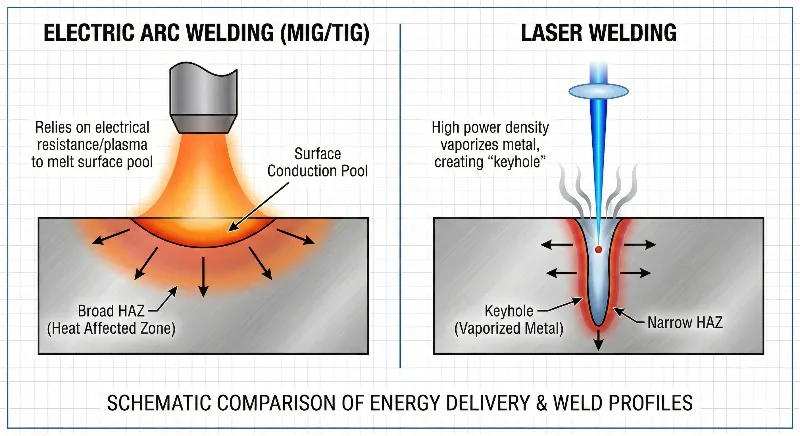
Unlike MIG or TIG processes, which rely on electrical resistance or plasma to melt a surface pool, a laser welding machine generates a coherent stream of photons. This stream is focused to a spot size often smaller than a human hair (0.05 – 0.6 mm), creating enough energy density to vaporize metal instantly and drill a “keyhole” rather than just melting a surface conduction pool. The result is a deep, narrow weld with a minimal Heat Affected Zone (HAZ) and virtually zero mechanical distortion.
The Physics of the Process: Conduction vs. Keyhole Mode
The operation of a laser welder is governed by a single critical metric: Power Density (Power ÷ Spot Area). Understanding the threshold between conduction and keyhole modes is essential for specifying the right machine for your application.
Conduction Mode (The “Quiet” Mode)
At lower power densities (typically <0.5 MW/cm2), the laser beam is absorbed at the material’s surface. The energy is transferred into the bulk material solely through thermal conduction.
- Result: The weld is semi-circular, wide, and shallow (Aspect ratio <1).
- Use Case: Ideal for aesthetic welds on thin electronics enclosures, battery tabs, or medical devices where backside marking or burn-through is unacceptable.
Keyhole Mode (The “Deep Penetration” Mode)
When power density crosses the threshold of approximately 1.5 MW/cm2 (for steel), the surface temperature reaches the vaporization point instantly.
- Mechanism: The rapid vaporization creates high recoil pressure that drills a vapor capillary—the keyhole—into the material. The laser beam travels inside this vapor channel, delivering heat through the entire thickness of the plate simultaneously.
- The “Light Trap” Effect: Inside the keyhole, the beam undergoes multiple reflections. Each bounce increases the total energy absorption to near 90%, allowing fiber lasers to efficiently weld highly reflective metals like copper and aluminum that would otherwise reflect the beam.
Under the Hood: Critical Machine Components
A modern laser welding cell is a system of synchronized photonic and mechatronic components.
The Engine: Fiber Laser Source (1μm)
While CO₂ lasers (10.6 μm wavelength) were once standard, modern industrial welding is dominated by Fiber Lasers (approx. 1.07 μm).
- Why Fiber? The active gain medium is a rare-earth (Ytterbium) doped optical fiber. This solid-state design eliminates mirrors that require alignment, achieves wall-plug efficiency of >30% (compared to ~10% for CO₂), and produces a wavelength that is better absorbed by metals.
Beam Delivery: The QBH Interface
The beam is transported from the source to the welding head via a flexible process fiber. This fiber terminates in a QBH (Quartz Block Head) or similar connector.
- Maintenance Note: The QBH connector is an active component with safety interlocks and thermal sensors. Contamination on the quartz block is the #1 cause of catastrophic fiber failure; it must be connected in a clean-room environment.
The Welding Head: Focusing the Power
The welding head creates the tool point using a specific optical ratio:
- Collimation: A lens straightens the diverging beam from the fiber.
- Focusing: A second lens concentrates the beam onto the part.
- Magnification: The ratio of these lenses determines the spot size. For example, a 100μm fiber core with a 100mm collimator and 200mm focus lens results in a 2:1 magnification, creating a 200μm spot.
Advanced Beam Control: Solving Real-World Problems
Legacy laser systems struggled with fit-up gaps and spatter. Modern systems utilize dynamic beam control to overcome these physical limitations.
Beam Wobble (Oscillation)
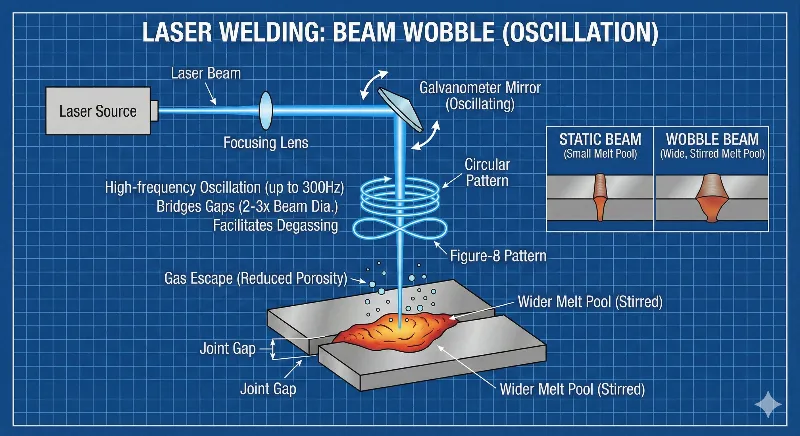
A focused laser spot (0.1 mm) is often too small to bridge gaps in imperfect industrial fit-ups. Wobble heads employ galvanometer mirrors to oscillate the beam (in circles or figure-8s) at high frequencies (up to 300Hz).
- Gap Bridging: By “stirring” the melt pool, wobble welding can effectively bridge gaps that are 2-3x larger than the static beam diameter.
- Degassing: The stirring action facilitates the escape of gas bubbles, significantly reducing porosity in aluminum welding.
Adjustable Ring Mode (ARM) / Dual-Beam
Welding copper busbars for Electric Vehicles (EVs) creates spatter challenges due to copper’s low absorption and low viscosity. Ring-Mode Lasers solve this by using a dual-core delivery fiber.
- Core Beam: Provides high intensity to penetrate and maintain the keyhole.
- Ring Beam: Warms the surrounding area, softening the surface tension and keeping the keyhole open. This stabilizes the process and virtually eliminates spatter.
Process Comparison: Laser vs. The Old Guard (TIG/MIG)
For a Process Engineer evaluating ROI, the trade-off is typically CapEx vs. OpEx and Throughput.
| Feature | TIG (GTAW) | Fiber Laser | Advantage |
| Speed | 0.5 – 1 m/min | 3 – 10 m/min | Laser (5-10x faster) |
| Heat Input | High (Wide HAZ) | Low (Focused) | Laser (Minimal Distortion) |
| Fit-up Tolerance | Forgiving | Strict (<10% of material thickness) | TIG (Requires less fixturing) |
| Energy Efficiency | Low | High (>30%) | Laser |
| Safety | UV Radiation / Burns | Invisible IR Radiation (Class 4) | TIG (Easier to guard) |
Key Takeaway: Laser welding is not a direct replacement for manual TIG in all scenarios. It excels in high-volume, automated environments where fixture precision can be controlled.
Safety & Facility Requirements (The “Red Tape”)
Implementing laser welding requires strict adherence to safety standards like ANSI Z136.1.
- Class 4 Hazard: The 1.07 μm wavelength is invisible and passes directly through the cornea to the retina. A scattered reflection can cause instantaneous, permanent blindness. Standard welding helmets are useless; laser-specific safety glasses with the correct Optical Density (OD) are mandatory.
- Light-Tight Enclosures: Automated cells must be fully enclosed and interlocked. If a door opens, the laser must shut down within milliseconds.
- Fume Extraction: Laser welding vaporizes metal into nanoparticles (<100 nm), which behave like gas and penetrate deep into lungs. Standard dust collectors are insufficient; extraction systems must use HEPA H13/H14 or ULPA filters to capture these carcinogens (especially Hexavalent Chromium from stainless steel).
Buying Criteria: How to Specify Your Machine
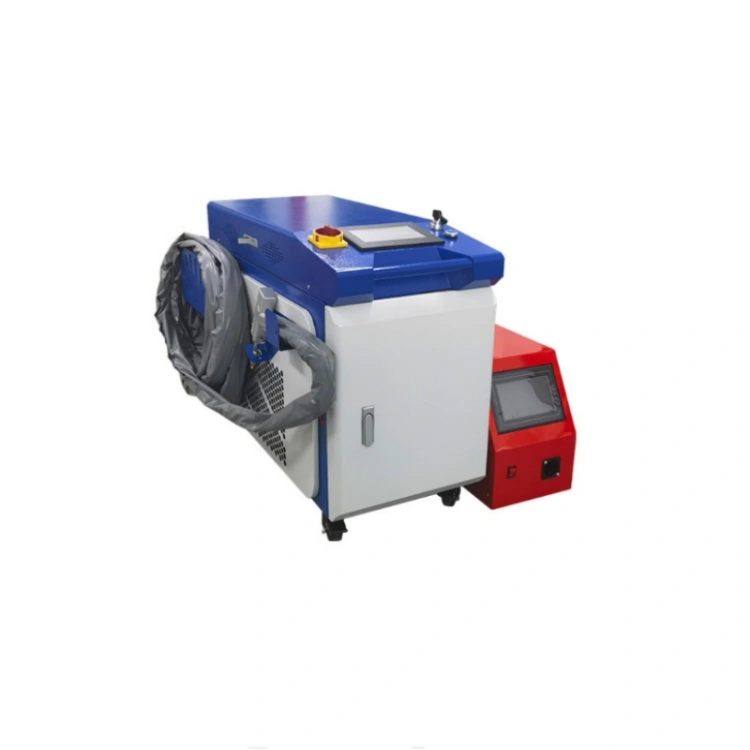
When evaluating quotes, look beyond the price tag.
- Power Selection: Do not oversize unnecessarily. A 1.5 kW laser is sufficient for penetrating 3-4mm stainless steel. You typically only need 6 kW+ for deep penetration in thick plate or EV copper applications.
- Automation Level:
- Handheld: Disruptive for high-mix job shops replacing TIG. Offers flexibility but relies on operator skill for safety and motion.
- Robotic/Gantry: Essential for automotive volume. Gantries offer higher precision for large flat parts, while 6-axis robots offer 3D flexibility.
- Serviceability: Ensure the welding head has field-replaceable protective cover slides (windows). These are sacrificial parts that protect the expensive optics from spatter and smoke.
Conclusion
A laser welding machine is a precision instrument that converts electrical energy into production speed. By utilizing keyhole mode physics, it allows manufacturers to weld 5-10x faster than traditional arc methods while nearly eliminating post-weld grinding and straightening.
For the manufacturing engineer, the transition to laser welding is an investment in throughput and quality. While the initial capital expenditure is higher, the ROI—driven by the elimination of consumables, reduction in floor space, and massive speed increases—is often realized within 12–18 months for high-volume production.
FAQs
A: Laser welding significantly reduces distortion because it utilizes a high power density (>1 MW/cm2) to create a narrow fusion zone. This results in a much smaller Heat Affected Zone (HAZ) and far lower total heat input than TIG welding, often eliminating the need for post-weld straightening or surface grinding.
A: Yes. Modern fiber lasers operate at a wavelength of 1.07μm which has a much higher absorption rate in reflective metals compared to CO₂ lasers. When combined with “wobble” heads or ring-mode beam shaping, fiber lasers can weld copper and aluminum with minimal spatter and high process stability.
A: Industrial fiber lasers are Class 4 devices, meaning the beam and scattered reflections can cause instant, permanent eye damage. Safety requirements include a light-tight enclosure with active door interlocks, fume extraction for nanoparticle capture (HEPA/ULPA), and safety glasses with the specific Optical Density (OD) rating for the laser’s wavelength—standard welding helmets are insufficient.