
The primary parameters that affect handheld laser welder quality are a combination of machine settings, material preparation, environmental factors, and operator technique. To achieve strong, consistent, and clean welds, an operator must master the core trio of machine settings: laser power, welding speed, and focus position. However, in a manual process, the operator’s skill in maintaining a steady hand and correct angle is often the most influential factor of all.
This guide provides engineers, operators, and procurement managers with the essential knowledge to optimize welding parameters, troubleshoot defects, and make informed decisions.
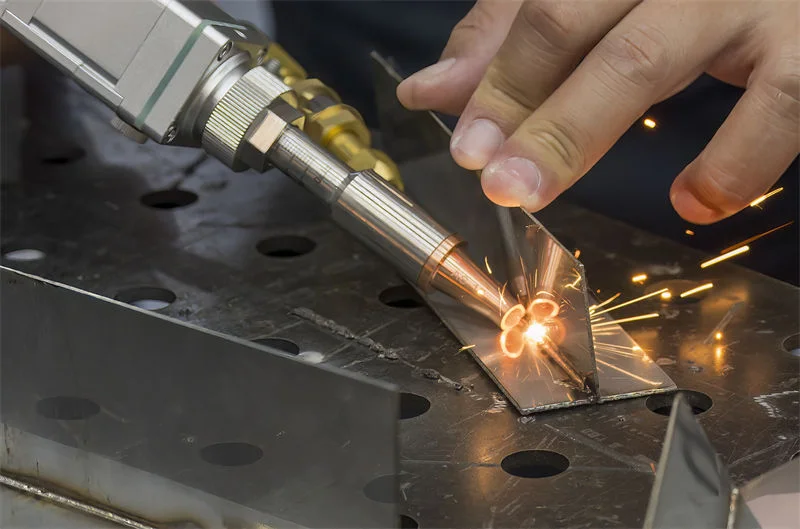
The Core Trio: Mastering the Most Critical Handheld Laser Welding Settings
The foundation of a high-quality weld is the precise balance of energy delivery. This is controlled by three interconnected settings.
Laser Power (Watts): The Engine of Penetration
Laser power, measured in watts (W), is the rate of energy the laser delivers to the workpiece. It is the primary control for heat intensity and penetration depth.
- Function: Higher power allows the laser to melt material faster, enabling deeper welds and the ability to join thicker materials. For example, welding highly reflective aluminum requires more power to overcome the initial reflectivity and initiate a weld pool.
- Impact of Incorrect Power:
- Too Low: Results in incomplete fusion or a weak, shallow joint.
- Too High: Can cause defects like spatter (molten metal droplets), burn-through on thin materials, and a large, distorted heat-affected zone (HAZ).
Welding Speed: The Pacesetter for Heat Input
Welding speed, or travel speed, is the rate the operator moves the welding head along the joint. This parameter controls how long the laser energy is applied to a specific spot.
- Function: Welding speed has an inverse relationship with heat input. A slower speed delivers more energy per unit length, while a faster speed delivers less.
- Impact of Incorrect Speed:
- Too Slow: Causes excessive heat buildup, leading to warping, undercutting (a groove melted at the weld edge), and burn-through.
- Too Fast: The material doesn’t have enough time to melt properly, resulting in a weak bond and incomplete penetration.
Focus Position (Defocus): The Sharpness of Your Tool
The focus position determines the location of the laser beam’s narrowest point relative to the material’s surface. Adjusting it changes the laser’s power density (W/cm2) without altering the power output.
- Function: This setting controls the “sharpness” of the energy source. A tightly focused beam has a high power density, ideal for deep penetration.
- Common Settings:
- On-Focus: The focal point is precisely on the surface, creating maximum power density for deep, narrow “keyhole” welds in thick materials.
- Positive Defocus (Above Surface): Creates a larger, less intense spot. This is ideal for producing wide, smooth, shallow welds on thin materials where burn-through is a risk.
- Negative Defocus (Below Surface): Also used for deep penetration, this setting can help stabilize the keyhole and produce robust welds.
The Operator: Why You Are the Most Important Parameter
In handheld laser welding, the operator is the motion control system. Even with perfect machine settings, inconsistent manual technique will produce inconsistent welds. The goal is to emulate the stability of a robot.
Maintaining Consistent Travel Speed
Any fluctuation in travel speed directly alters the heat input, leading to an uneven weld bead with both weak spots and overheated areas.
- Technique: Brace your arm against the workbench or workpiece to create a stable pivot point. Use smooth, deliberate movements from your arm, not just your wrist, to maintain a steady pace.
Controlling Standoff Distance (Focus)
The standoff distance—the space between the nozzle and the workpiece—directly controls the focus position. Varying this distance is like constantly changing the focus setting mid-weld.
- Technique: Many handheld welding heads have a nozzle tip designed for direct contact with the workpiece. This acts as a physical guide to ensure a constant standoff distance. It is also often a safety feature, as an interlock prevents the laser from firing unless the tip is in contact with the part.
Mastering the Correct Torch Angle
The angle of the torch relative to the joint affects heat distribution and weld bead shape. An incorrect angle can direct too much energy to one side, causing poor fusion and defects.
- Technique:
- For T-Joints (Fillet Welds): Position the torch at a 45-degree angle to bisect the joint, ensuring equal energy distribution on both surfaces.
- For Butt and Lap Joints: Hold the torch nearly perpendicular to the surface, with a slight “drag” angle of about 15 degrees in the direction of travel.
Wobble Welding: The Secret to Perfect Seams and Bridging Gaps
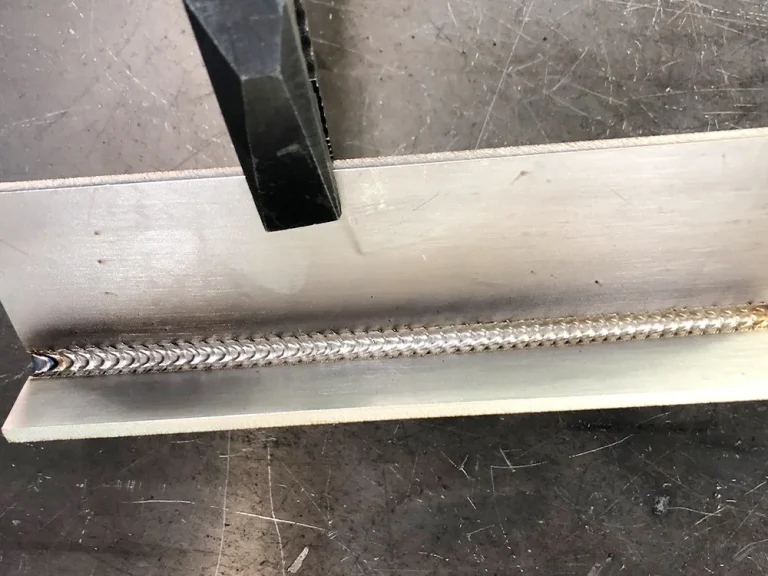
One of the most significant advancements in handheld systems is wobble welding. This technology uses small, high-speed mirrors inside the welding head to oscillate the laser beam in a predefined pattern.
What is Wobble and Why Does it Matter?
Wobble technology effectively “paints” with the laser, expanding its functional width.
- Benefits:
- Bridges Gaps: Wobble is the most effective way to compensate for poor part fit-up. The oscillating beam can melt both edges of a gap simultaneously, creating a single molten pool to form a solid joint.
- Improves Aesthetics: It creates a wider, more uniform, and visually appealing weld bead.
- Enhances Stability: The stirring motion helps release trapped gases that could cause porosity.
Key Wobble Settings: Width and Frequency
- Wobble Width: Controls the size of the oscillation pattern, determining the final weld seam width. Many systems can add up to 5 mm of effective width.
- Wobble Frequency: Controls the speed of the oscillation, measured in Hertz (Hz). Faster travel speeds generally require higher wobble frequencies to ensure a smooth, consistent weld.
The Unseen Essentials: Environment and Preparation
A perfect weld requires more than just correct machine settings. The environment and the condition of the workpiece are critical parameters.
The Critical Role of Shielding Gas
Shielding gas (typically Argon or Nitrogen) flows from the nozzle to protect the molten weld pool from the atmosphere.
- Functions:
- Prevents Contamination: It displaces oxygen and nitrogen, which can cause oxidation, porosity, and brittle welds.
- Controls Plasma: In high-power welding, a plume of ionized gas (plasma) can form and block the laser beam. Shielding gas helps suppress this plasma, ensuring stable energy delivery.
- Protects Optics: The gas flow helps prevent weld spatter from damaging the protective lens in the welding head.
Joint Preparation: Why Cleanliness and Fit-Up are Non-Negotiable
- Surface Cleanliness: Surfaces must be free of oil, grease, rust, or moisture. When heated, these contaminants vaporize and get trapped in the weld, causing porosity and significantly weakening the joint.
- Gap Control: Laser welding has a very low tolerance for gaps between parts. A gap larger than 10-20% of the material thickness can lead to incomplete fusion, holes, and a structurally unsound weld.
Material Matters: Adapting Parameters to Your Workpiece
Different materials require different welding strategies. The material’s properties are active parameters in the welding process.
How Material Type Changes the Game
- Reflectivity: Materials like aluminum and copper are highly reflective and require higher laser power to initiate melting.
- Thermal Conductivity: Materials with high thermal conductivity, like aluminum, dissipate heat quickly. This requires a higher power density to maintain a molten state. Materials like stainless steel have low thermal conductivity, making them easier to weld with less power.
Adjusting for Material Thickness
The rule is simple: thicker materials require more energy to achieve a full-penetration weld.
- Thick Materials (>3 mm): Require higher laser power and often a slower travel speed to ensure the heat penetrates the full joint.
- Thin Materials (<2 mm): Require lower power and faster travel speeds to prevent burn-through and minimize distortion.
| Material | Thickness (mm) | Laser Power (W) | Notes |
| Stainless Steel | 1.0 | 1000-1500 | Lower power and higher speeds are effective. |
| Stainless Steel | 3.0 | 1500-2000 | Good penetration is achievable with moderate power. |
| Aluminum | 1.0 | 1500+ | Higher power is needed to overcome reflectivity. |
| Aluminum | 3.0 | 2000+ | Slower speeds and wobble are often necessary. |
Under the Hood: How Machine Components Define Performance Limits
The quality of a machine’s internal components sets the ceiling for its performance.
- Laser Source: This is the heart of the machine, generating the laser beam. Modern handheld welders almost exclusively use fiber lasers for their efficiency, reliability, and excellent beam quality.
- Beam Delivery System & Optics: This system of fiber optic cables and lenses transports the beam to the workpiece. A dirty or damaged protective lens is a very common cause of weak welds, as it blocks and scatters the laser energy.
- Cooling System: Laser generation creates significant heat. A water or air chiller is essential to prevent the laser source from overheating, which would cause power loss and potential damage.
Troubleshooting Common Weld Defects by Adjusting Parameters
When defects appear, a systematic approach to troubleshooting is key. Always check foundational issues (cleanliness, gas flow, consumables) before adjusting machine settings.
- Problem: Weak or Inconsistent Welds
- Causes & Solutions: Check for a dirty protective lens. If clean, increase laser power or decrease travel speed.
- Problem: Porosity (Pinholes)
- Causes & Solutions: This is almost always caused by contamination. Thoroughly clean the workpiece. Also, check for adequate shielding gas flow and ensure there are no leaks in the gas line.
- Problem: Spatter
- Causes & Solutions: Laser power is likely too high. Reduce power in small increments. An incorrect focus position can also be a cause.
- Problem: Undercutting or Burn-Through
- Causes & Solutions: Travel speed is too slow or laser power is too high. Increase travel speed or decrease power.
Frequently Asked Questions (FAQ)
For handheld systems, while the core settings of power, speed, and focus are critical, the operator’s ability to maintain consistent travel speed and standoff distance is arguably the most important parameter for achieving repeatable quality.
Wobble welding oscillates the laser beam to create a wider weld seam. This is extremely useful for bridging gaps between parts that don’t fit perfectly and also produces a more uniform, aesthetic finish.
Argon is the most common and versatile shielding gas for materials like stainless steel, carbon steel, and aluminum. It is inert and provides excellent protection for the weld pool.
It is a critical factor. An expert operator with a steady hand can produce high-quality welds with a basic machine, while a novice may struggle to get consistent results even with the best equipment. Practice and technique are essential.