
When comparing the Riselaser F20 vs xTool F1, the decision simplifies to one critical question: What is your primary application? Your choice is between a specialized industrial tool designed for metal and a versatile, portable unit built for a wide range of materials. This guide provides the direct, data-backed comparison needed for engineers, procurement managers, and small business owners to make a confident purchasing decision.
- Choose the Riselaser F20 (or any 20W fiber laser) if your core business is the high-speed, deep, and permanent marking of metals.
This is a specialist’s tool, ideal for industrial part marking, jewelry engraving, and batch production where performance on metals is the only metric that matters. - Choose the xTool F1 if your operation demands versatility, portability, and ease of use across a wide variety of materials.
This is a generalist’s powerhouse, perfect for on-demand customization at craft fairs, in small retail shops, or for prosumers working with wood, leather, slate, and light metal marking.
This article will break down the technical specifications, performance capabilities, and operational differences to help you select the right asset for your business.
Quick Comparison: Riselaser F20 vs. xTool F1 at a Glance
For decision-makers who need the key specifications immediately, this table outlines the fundamental differences.
| Feature | Riselaser F20 (20W Fiber Laser Class) | xTool F1 |
| Laser Type | 20W Pulsed Fiber Laser (1064 nm) | 10W Diode Laser (455 nm) + 2W Infrared Laser (1064 nm) |
| Primary Use Case | Deep metal engraving & high-speed industrial marking | Multi-material engraving & on-site customization |
| Performance on Metals | Excellent (Deep, fast, permanent, can cut thin sheets) | Good (Surface marking only, cannot cut) |
| Performance on Wood/Leather | Poor (Inefficiently chars and burns) | Excellent (Clean engraving and cutting) |
| Ideal User | Jewelers, Industrial Operations, Metal Fabricators | Craft Fair Vendors, Small Business Retail, Hobbyists |
| Ease of Use | Steeper learning curve (Requires technical proficiency) | Beginner-friendly (Intuitive software and setup) |
| Safety Classification | Typically Open-Frame (Class 4 Laser) | Fully Enclosed (Class 1 Laser with lid down) |
Who Should Buy the Riselaser F20? (The Metal Specialist)
A 20W fiber laser like the Riselaser F20 is a capital investment in specialized capability. It is the correct choice for operations where metal is the primary or sole workpiece.
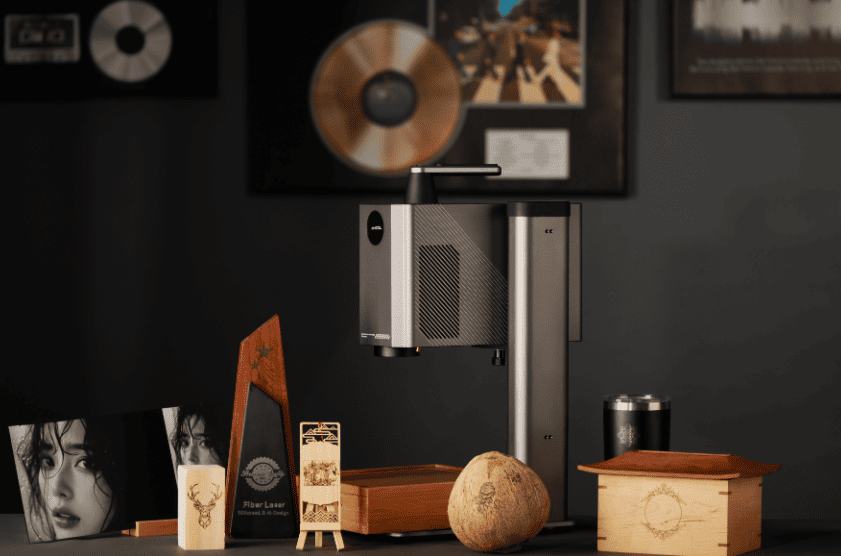
You’re a Jeweler or Metal Customizer
For creating high-value products, the quality of the mark is paramount. A 20W fiber laser provides the power necessary for deep, tactile engraving on stainless steel, aluminum, brass, copper, and precious metals. This creates a professional-grade finish that a lower-power laser cannot replicate. The ability to achieve up to 1mm of engraving depth (with sufficient time) is critical for applications like personalizing jewelry or creating molds.
Your Business Needs High-Speed Production on Metal Parts
In a production environment, throughput is directly tied to profitability. The Riselaser F20 class boasts engraving speeds up to 10,000 mm/s, more than double the xTool F1’s maximum speed. For batch-marking serial numbers, QR codes, or logos on hundreds of parts, this speed advantage significantly reduces cycle times and increases operational efficiency.
You’re Technically Proficient and Prioritize Power Over Polish
Industrial tools require a skilled operator. Users of a 20W fiber laser should be prepared for a steeper learning curve with industrial software. More importantly, because these systems are often open-frame Class 4 lasers, operators must implement and adhere to strict safety protocols, including the use of certified personal protective equipment (PPE) and adequate fume extraction.
Who Should Buy the xTool F1? (The Versatile Creator)
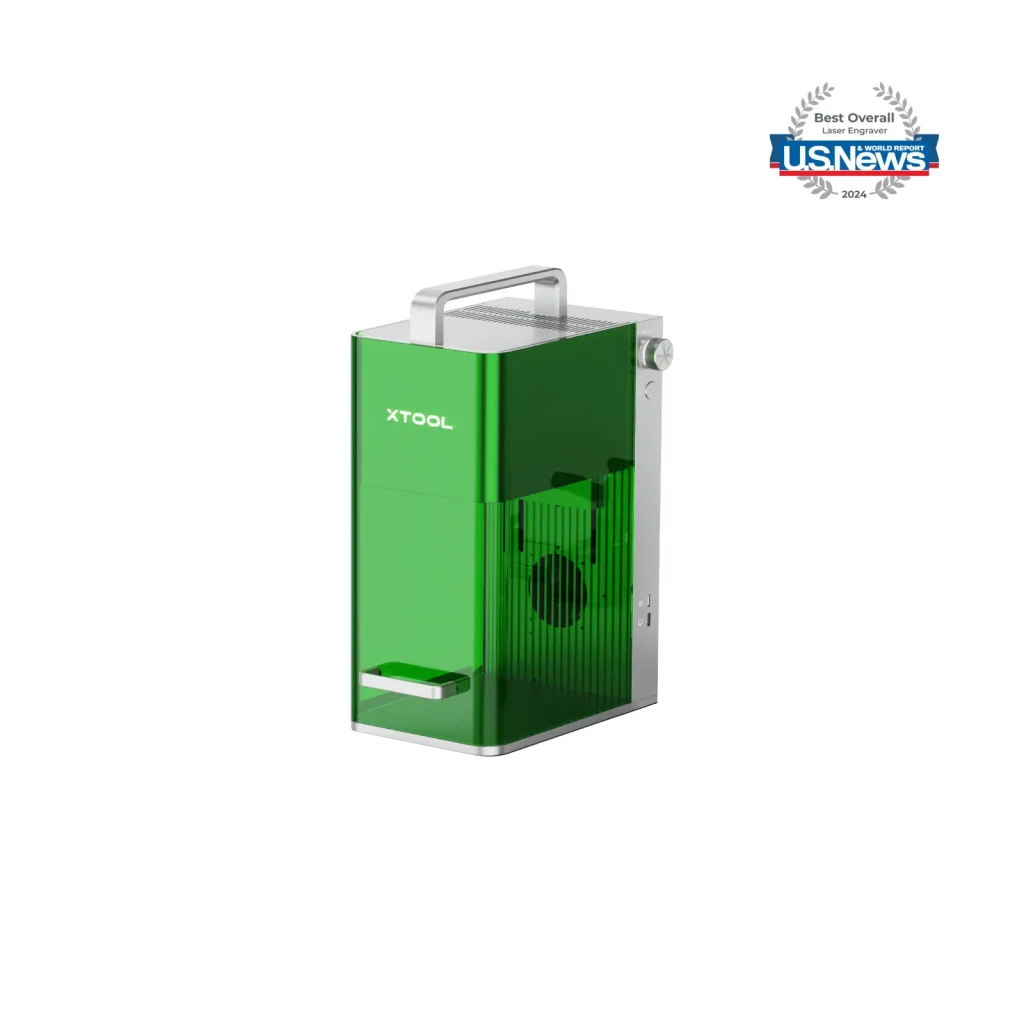
The xTool F1 is engineered for flexibility and accessibility. It is the superior choice for businesses and creators who value a “one-tool” solution for a wide array of materials and applications.
You’re a Craft Fair Vendor or Mobile Entrepreneur
The F1’s design is purpose-built for on-site work. It is lightweight (4.6 kg), features a carrying handle, and its fully enclosed design achieves a Class 1 safety rating with the lid down, making it safe for use in public spaces. Its high speed (4,000 mm/s) allows for on-the-spot personalization of customer items in seconds, a key advantage in a fast-paced retail environment.
Your Projects Span Wood, Leather, Slate, and More
The dual-laser system is the F1’s greatest asset. The 10W diode laser excels at engraving and cutting organic materials like wood and leather, while the 2W infrared (IR) laser handles surface marking on metals and plastics. Notably, the 2W IR laser produces a superior, high-contrast white mark on slate, often outperforming even more powerful CO2 lasers.
You Want a “Plug-and-Play” Experience
The xTool F1 is designed for immediate productivity. It arrives fully assembled and can be operational within minutes. The free xTool Creative Space (XCS) software is widely praised for being intuitive and user-friendly, and features like the live preview frame drastically simplify material alignment. This low barrier to entry minimizes training time and reduces operator error.
Head-to-Head Breakdown: Key Differences Explained
Understanding the core technology is essential for making an informed investment.
Technology: The Specialist vs. The Hybrid
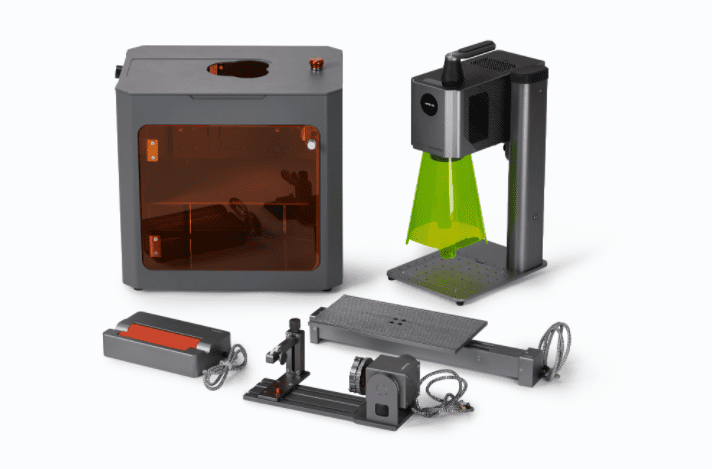
The Riselaser F20 class uses a true 20W pulsed fiber laser. This technology is the industry standard for efficiently ablating (vaporizing) or annealing (coloring) metal surfaces. The xTool F1 uses a dual system: a 10W diode laser for organic materials and a 2W 1064nm infrared laser for metals. It is critical to note that the F1’s IR laser is a Diode-Pumped Solid-State Laser (DPSSL), which is inherently less powerful and efficient for metalwork than a true fiber laser source.
Performance & Material Capability
- Metals: The performance gap is significant. A 20W fiber laser can deeply engrave and even cut thin metal sheets, such as a business card, in seconds. The xTool F1 is incapable of cutting metal and is limited to creating surface-level marks that lack depth.
- Organics (Wood/Leather): The roles are reversed. The F1’s 10W diode laser is designed for these materials, producing clean cuts and engravings. A fiber laser’s wavelength is poorly absorbed by organics, resulting in heavy charring and poor quality.
Speed & Throughput
Both machines use a galvanometer (Galvo) system, which uses mirrors to direct the laser beam for extremely fast engraving. However, the F20 class has a much higher top speed (7,000–10,000 mm/s) compared to the F1’s 4,000 mm/s, making it the clear choice for production environments.
Software & Usability
The xTool F1 offers a polished, consumer-grade experience with its free and intuitive XCS software, which is also compatible with the industry-standard LightBurn. F20-class lasers typically rely on powerful but less user-friendly industrial software like EZCad, which requires a significant time investment to master.
Safety & Design
The xTool F1’s enclosed design is rated Class 1 with the lid down, making it inherently safer for use in open environments. Most industrial 20W fiber lasers are open-frame Class 4 systems, which mandate a controlled workspace and the strict use of laser safety glasses and fume extraction.
The Final Verdict: Which is the Right Investment for You?
The decision between these two machines is not about which is “better,” but which is the correct tool for your specific operational needs.
- Choose the Riselaser F20 (or a similar 20W fiber laser) if:
Your business is built on metal. You require professional-grade depth, permanence, and the high speed necessary for production runs. - Choose the xTool F1 if:
Your business model thrives on material versatility, portability for on-site events, and ease of use. You need a single machine that can handle a wide range of custom jobs quickly and safely.
Do not invest in a versatile multi-tool when your operation requires a surgical scalpel. Choose the laser that is purpose-built for the work you do every day.
Frequently Asked Questions (FAQ)
A: No. The F1’s 2W IR laser is designed for surface marking only. For deep, tactile engraving, a 20W+ fiber laser is required.
A: It is not recommended. The 1064nm wavelength of a fiber laser is poorly absorbed by organic materials, resulting in heavy charring and low-quality marks. The xTool F1’s diode laser is the correct tool for this application.
A: The xTool F1 is significantly more beginner-friendly due to its intuitive software, enclosed safety design, and quick, assembly-free setup.
A: If your only application is metal, a dedicated 20W fiber laser will offer far greater performance (speed and depth) for a similar or potentially lower price. The F1’s value is in its multi-material versatility.