
In modern automotive manufacturing, laser welding is no longer just an option—it is a critical technology. It enables the industry’s shift toward lightweight designs, multi-material bodies, and electric vehicles. Laser welding solves a key problem: it can join advanced materials like high-strength steel, aluminum, and copper, which are difficult to weld using traditional methods. This leads to stronger, safer, and more efficient vehicles. It also helps create longer-range EVs and paves the way for the zero-defect “smart factory” of the future. This isn’t just a better weld; it’s a new way to design and build cars from the ground up.
Why Lightweighting and EVs Make Laser Welding Essential
The push for laser welding isn’t happening in a vacuum. It’s a direct response to two of the biggest shifts in the automotive world: the global mandate for efficiency and the rise of electrification.
The Mandate for Mass Reduction
Automakers are under immense pressure to meet stringent global emissions standards. A core principle of vehicle design is that weight is the enemy of efficiency. In fact, a 10% reduction in vehicle weight can improve fuel economy by 6-8%.
For Electric Vehicles (EVs), this principle is even more critical. Reducing weight is the most direct way to extend battery range or, alternatively, allow for a smaller, lighter, and less expensive battery pack while maintaining competitive performance. This makes automotive lightweighting a direct path to profitability in the competitive EV market.
From Steel Monoculture to a Multi-Material Body
For decades, car bodies were built almost exclusively from mild steel. Today, that “monoculture” has been replaced by a strategic mix of advanced materials to optimize weight, cost, and safety. This includes:
- Advanced High-Strength Steels (AHSS)
- Aluminum Alloys
- Composites and Polymers
The problem? These materials often can’t be joined effectively with old-school welding. This is where the precision and low-heat characteristics of laser welding become indispensable.
3 Breakthrough Applications Where Laser Welding is a Game-Changer
Laser welding isn’t just a theoretical improvement; it is redefining laser welding applications in automotive industry production by delivering tangible results in three key areas.
1. Tailor Welded Blanks (TWBs): Engineering Strength Before Stamping

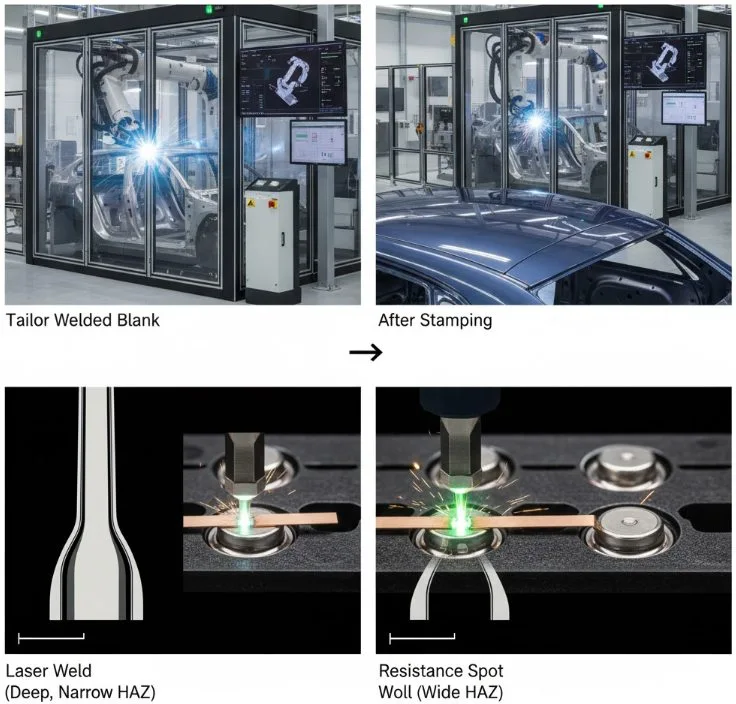
One of the most innovative applications is the Tailor Welded Blank (TWB). Instead of stamping multiple parts and welding them together, a TWB is made by laser welding different sheets of metal—varying in thickness, material grade, or coating—into a single, optimized blank before it is stamped into a final part.
This “engineer-then-form” approach allows designers to place the strongest, toughest materials precisely where they are needed for crash safety while using lighter, more formable materials elsewhere. This optimizes weight, reduces the number of components, and lowers manufacturing costs.
2. Body-in-White (BIW): A Lighter, Stiffer, and Safer Vehicle Skeleton
The Body-in-White (BIW) is the vehicle’s core structure. When it comes to laser welding automotive structures, the process offers two huge advantages compared to traditional Resistance Spot Welding (RSW):
- Increased Stiffness and Strength: Laser welding creates continuous seams, which distribute loads more evenly than a series of discrete spot welds. This results in a stiffer, more rigid vehicle body, which improves handling, safety, and crash performance.
- Weight Savings: RSW requires wide overlaps (flanges) for its large electrodes to clamp onto. Laser welding is a single-sided, non-contact process, allowing for much narrower flanges. This seemingly small change saves significant weight when multiplied across the hundreds of joints in a vehicle.
3. Electric Vehicles (EVs): The Indispensable Tool for Electrification
The shift to specialized automotive laser welding for electric vehicles is happening because the technology is the only viable solution.
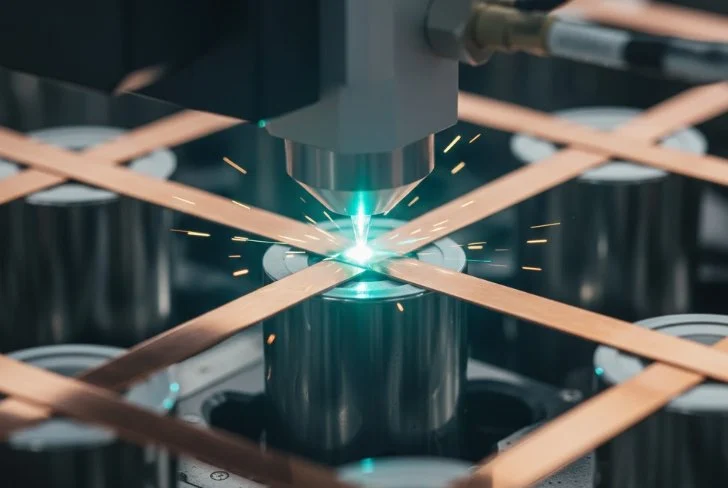
Battery production is the prime example. A typical EV battery pack contains hundreds or thousands of individual cells that must be connected with busbars made of highly conductive copper and aluminum. These materials are notoriously difficult to weld because they reflect most of the energy from standard infrared lasers.
The solution is wavelength diversity. Specialized green and blue lasers operate at a wavelength that is absorbed far more efficiently by copper (up to 50% absorption with green lasers vs. just 5% with infrared). This enables strong, spatter-free welds without introducing excessive heat that could damage the sensitive battery cells. Laser welding is also essential for creating the strong, lightweight, and hermetically sealed aluminum enclosures that protect the battery pack.
Laser Welding vs. The Old Guard
For engineers and procurement managers evaluating new technologies, it’s crucial to compare laser welding against incumbent processes.
Outperforming Resistance Spot Welding (RSW)
For decades, RSW has been the workhorse of automotive assembly. However, when it comes to modern materials and performance demands, laser welding vs spot welding presents a clear case for an upgrade.
While laser brazing automotive techniques handle aesthetic joints, structural laser welding creates the backbone of the vehicle’s safety cage.
| Feature | Resistance Spot Welding (RSW) | Laser Welding |
| Joint Strength | Good | Excellent. Studies show up to 14.5% higher tensile-shear strength in aluminum joints. |
| Heat-Affected Zone (HAZ) | Large, which can degrade the properties of advanced steels. | Very small and controlled, preserving material integrity. |
| Design Freedom | Low. Requires wide flanges for two-sided electrode access. | High. Single-sided access allows for narrow flanges and complex designs. |
| Dissimilar Materials | Poor. Not suitable for joining materials like steel and aluminum. | Good. Can reliably join dissimilar materials with precise control. |
Working with Adhesive Bonding
Adhesive bonding is another key technology, especially for joining composites to metal. Rather than competing, laser welding and adhesives are often complementary. The most advanced approach is a hybrid process called “weld-bonding,” where a structural adhesive is applied between panels, and then laser welds are made through it. This synergistic approach produces a joint that can be over 80% stronger than a laser-welded joint alone, combining the stiffness of the adhesive with the peel strength of the weld.
The Smart Factory Arrives: Laser Welding and Industry 4.0
The future of laser welding in automotive manufacturing is deeply connected to the principles of the smart factory automotive concept, or Industry 4.0.
Real-Time Monitoring for 100% Quality Assurance
Modern laser welding heads are equipped with a suite of sensors that monitor the process in real-time, creating a unique “digital fingerprint” for every weld. This data is fed into Artificial Intelligence (AI) algorithms that can detect and even predict weld defects like porosity or incomplete penetration before they happen. This enables 100% traceability for every joint—a non-negotiable requirement for safety-critical components like battery enclosures and structural pillars.
Digital Twins and Flexible Automation
Before a single robot is installed on the factory floor, manufacturers can now simulate and optimize the entire welding process in a virtual “digital twin” environment. This drastically reduces commissioning time and cost. Furthermore, the rise of flexible automation, including collaborative robots (cobots), is making this advanced technology more accessible for a wider range of applications and suppliers.
Frequently Asked Questions (FAQ)
A: The primary advantage of laser beam welding automotive industry processes is precision. The highly focused, low-heat energy input allows it to reliably join the advanced lightweight and dissimilar materials (like aluminum to steel) that are essential for modern fuel-efficient and electric vehicles, which traditional methods cannot do effectively.
A: The initial equipment investment for laser welding can be higher. However, it often results in a lower total cost of ownership due to higher production speeds, reduced material usage (from narrower flanges), fewer consumables (no electrodes), and significantly less scrap and rework.
A: The main operational challenge is its sensitivity to the gap between the parts being joined, known as “fit-up”. It requires more precise part forming and clamping than RSW. However, modern systems overcome this with advanced techniques like beam oscillation (or “wobble”) and dynamic robotic clamping systems that adapt to part variations in real-time.
Conclusion: The Road Ahead is Forged with Light
As the adoption of laser welding in automotive industry processes grows, it becomes the foundational technology enabling critical goals like lightweighting and electrification. It provides the precision, speed, and control needed to work with the materials of tomorrow. For automakers and suppliers, investing in and mastering advanced laser welding is no longer a competitive advantage—it is a prerequisite for leadership in the future of mobility.
Ready to see how laser welding can transform your production line? Schedule a complimentary application audit with our engineering team to identify opportunities for weight reduction and efficiency gains.