
If you need to test metals accurately on the job, finding the right tool is a big decision. The Thermo Scientific Niton XL5 is a top-of-the-line handheld XRF analyzer, famous for being powerful and very lightweight. But for many businesses, the best tool is one that works great without breaking the budget.
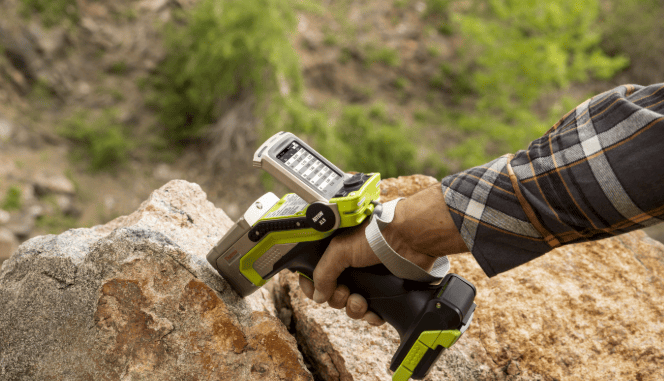
That’s where the RL-G3000 Handheld XRF Analyzer comes in. It’s a top alternative for anyone who needs a strong, reliable tool for testing materials without the high price of the Niton XL5. It does many of the same core jobs, like testing for a wide range of materials in solid, powder, or liquid form. This makes it a great choice for everything from sorting scrap metal to making sure the right parts are used in a project, a process known as Positive Material Identification (PMI).
This guide will give you a clear, side-by-side comparison of the Niton XL5 and the RL-G3000. We will also look at other excellent options on the market. Our goal is to give you the information you need to pick the perfect XRF analyzer for your work and your budget.
The RL-G3000 – Power and Value Combined
Why the RL-G3000 is the #1 Niton XL5 Alternative
For many industrial applications, the deciding factor isn’t just having the most powerful specifications—it’s about having the right specifications for the job at a price that makes sense. The RL-G3000 is engineered to hit this sweet spot.
It provides the versatility and accuracy required for critical tasks like PMI in manufacturing, QA/QC checks, and rapid scrap metal evaluation. Its ability to analyze 82 elements from Sodium (Na) to Uranium (U) in solids, powders, and liquids makes it a flexible workhorse for diverse operational needs. With test times as fast as 3 seconds, it keeps your workflow moving without compromising data quality. The RL-G3000 delivers the core capabilities that engineers and technicians rely on, making it the leading value-based alternative on the market.

Head-to-Head Spec Comparison: RL-G3000 vs. Niton XL5
A side-by-side look at the specifications reveals how the RL-G3000 provides a compelling alternative for decision-makers focused on capability and total cost of ownership.
| Feature | RL-G3000 | Thermo Scientific Niton XL5 |
| Weight | 1.58 kg | 1.3 kg |
| Detector | Si-Pin | Geometrically Optimized Large Area Drift Detector (GOLDD) |
| Measurable Elements | 82 elements (Na to U) | 30+ common elements, excellent light element detection (Mg-S) |
| Test Time | 3–30 seconds | < 2 seconds for many grade IDs |
| Price | ~$14,000 | ~$13,000 – $25,000+ (new) |
| Sample Forms | Solid, powder, liquid | Solid, powder, liquid, slurries |
| Key Advantage | Excellent balance of comprehensive features and affordability. | Industry-leading power-to-weight ratio and superior light element detection. |
Other Top-Tier Niton XL5 Alternatives
While the RL-G3000 is our top pick for overall value, the market offers other excellent, specialized analyzers. Your specific operational needs—be it extreme durability, raw speed, or ergonomics—might make one of these a better fit.
For Maximum Ruggedness: Evident Vanta Max
The Evident (formerly Olympus) Vanta Max is the best choice for the harshest environments where durability is non-negotiable. It is not only IP54/55 rated but also certified to MIL-STD-810G drop-test standards, offering superior protection against impacts, dust, and water. This ruggedness makes it a reliable tool in mines, shipyards, and demanding field conditions. The trade-off for this toughness is weight, as it is noticeably heavier than the Niton XL5.9
For Unmatched Speed: SciAps X-550
In high-throughput environments like scrap metal processing, speed is money. The SciAps X-550 is positioned as the speed champion, particularly for the rapid sorting of valuable aluminum alloys. Its high-power tube is optimized for light elements, allowing operators to process more material in less time, directly impacting profitability.
For All-Around Field Use: Bruker S1 TITAN
The Bruker S1 TITAN is a strong and lightweight (1.5 kg) competitor that focuses on reliability and low cost of ownership. Its signature feature is the TITAN Detector Shield, a physical guard that protects the instrument’s most sensitive and expensive component from being punctured by sharp metal turnings or wires—a common and costly failure point in the field. This makes it an excellent choice for routine PMI and general scrap analysis.
For Superior Ergonomics & Battery Life: Hitachi X-MET8000
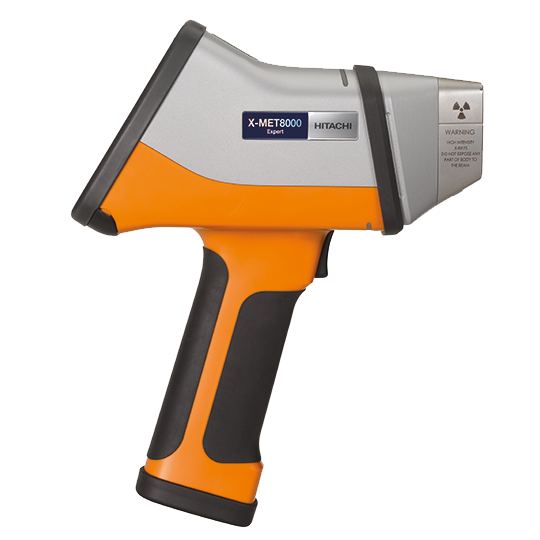
Designed for operators who run tests all day, the Hitachi X-MET8000 excels in ergonomics and uptime. It features a large, intuitive touchscreen and an impressive 10–12 hour battery life to minimize interruptions. Like the Vanta, it is also built to last, with both IP54 and MIL-STD-810G ratings for durability.
How to Choose the Right Handheld XRF Analyzer
A Quick Buyer’s Checklist
Selecting the right handheld XRF analyzer comes down to matching the instrument’s strengths to your primary needs. Ask yourself these five questions:
- Application: What is your primary use? Critical Positive Material Identification (PMI) requires high accuracy, while scrap sorting prioritizes speed and a broad alloy library.
- Environment: Where will you be working? For harsh outdoor or industrial settings, look for high IP ratings (IP54 or greater) and MIL-STD-810G certification.
- Elements of Interest: Is trace-level light element detection (Mg, Al, Si) critical for your alloys, or do you need a broad elemental range for general analysis?
- Budget: What is your budget for the initial purchase? Consider the total cost of ownership, including potential repairs. Models with detector protection can save thousands in the long run.
- Throughput: How many tests will you perform per shift? For high-volume testing, prioritize speed, low operator fatigue (lightweight design), and long or hot-swappable battery life.
The Final Verdict: Which Niton XL5 Alternative is Best?
While the Thermo Scientific Niton XL5 sets a high standard for performance and portability, the best alternative is the one that best fits your operational priorities and budget.
For businesses seeking the most effective combination of comprehensive analytical power, operational versatility, and financial value, the RL-G3000 is the clear choice. It delivers the robust performance needed for confident decision-making without the premium cost of an S-Tier analyzer.
If your budget is higher and your needs are highly specialized—such as requiring military-grade ruggedness or the absolute fastest sorting speed—then the Evident Vanta Max and SciAps X-550 are excellent, purpose-built options.
Ready to get lab-quality results without the lab-quality price? Request a quote for the RL-G3000 today to see how it can revolutionize your quality control and material verification workflow.
FAQs
No. The main difference between those steel grades is the amount of carbon, and handheld XRF technology cannot detect carbon. To measure carbon content, you would need a different tool called a Laser-Induced Breakdown Spectroscopy (LIBS) analyzer.
For the best accuracy, the sample surface must be clean and smooth. Dirt, paint, rust, or other coatings can block the X-rays and lead to incorrect results. Always prepare the surface for applications that require high precision.
The most common and expensive repair is a punctured detector window, which is often damaged by sharp metal objects in scrap or fabrication shops. To avoid this, look for models that have a built-in detector shield for protection.