
In 2026, the shortage of skilled manual welders is no longer just a hiring challenge—it is a production bottleneck. For industrial fabricators, the shift to 6-axis robotic laser welding is the only scalable solution to maintain throughput and quality.
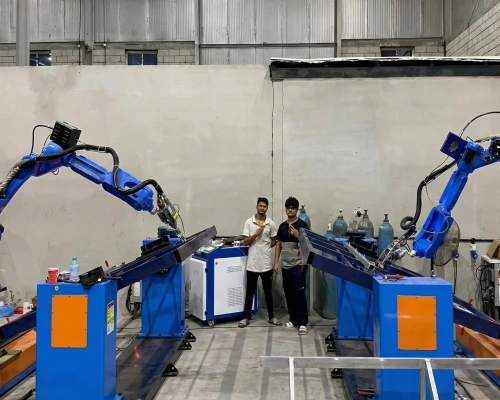
If you are evaluating automation, the market has bifurcated into two distinct categories: heavy-duty industrial robots (designed for speed, reach, and durability) and collaborative robots or “cobots” (designed for flexibility and ease of use).
This guide reviews the top 6 systems on the market, categorized by their specific operational strengths.
The Top 6 Laser Welding Robots:
- Riselaser RL-R1825: Best for Extended Reach & Large Parts.
- FANUC ARC Mate 100iD: The Industrial Standard for High Volume.
- Yaskawa Motoman AR1440: Best for Precision Path Control.
- Universal Robots UR10e: Best Entry-Level Cobot.
- IPG LightWELD Cobot: Best Turnkey Laser-Native Solution.
- Standard Bots RO1: Best Value & AI Technology.
Quick Comparison Matrix
The following table compares the critical specifications for decision-makers. Note the variance in “Reach,” which dictates whether you will need to purchase additional external tracks or gantries for larger parts.
| Robot Model | Robot Type | Payload | Max Reach | Best Application |
| Riselaser RL-R1825 | 6-Axis Industrial | 8 kg | 1840 mm | Large Frames, Battery Trays |
| FANUC ARC Mate 100iD | Industrial | 12 kg | 1441 mm | Automotive Chassis |
| Yaskawa Motoman AR1440 | Industrial | 12 kg | 1440 mm | Tubular Seat Frames |
| Universal Robots UR10e | Cobot | 12.5 kg | 1300 mm | High-Mix / Low-Volume |
| IPG LightWELD Cobot | Cobot System | 12 kg | ~1370 mm | Sheet Metal Fabrication |
| Standard Bots RO1 | Cobot | 18 kg | 1300 mm | Budget & AI-Vision |
In-Depth Reviews of the Top Systems
1. Riselaser RL-R1825 (The High-Reach Industrial Choice)
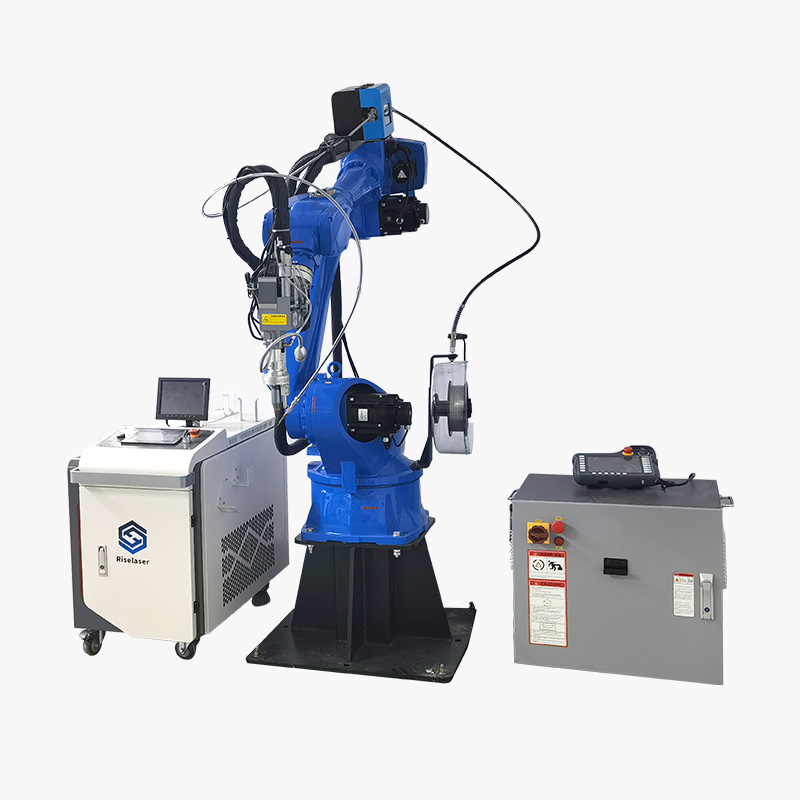
Verdict: The strategic choice for manufacturers welding large-scale components (EV battery trays, furniture, automotive frames) who require maximum reach without the cost of a linear track.
While standard industrial welding robots typically top out at a reach of ~1440mm, the Riselaser RL-R1825 provides an extended 1840mm radius of motion. This additional ~400mm of reach is operationally significant; it allows the robot to access the far corners of large fixtures or weld long seams in a single pass without stopping to reposition the base.
Key Technical Capabilities:
- Extended Envelope: The 1840mm reach enables the welding of large “New Energy” components, such as electric vehicle battery trays, which are often too wide for standard arms.
- Multi-Material Joining: The system is engineered to handle dissimilar metals, specifically the copper-aluminum connections required in modern electronics and battery manufacturing.
- Industrial Protection: The wrist axes are rated IP67, and the base is IP56, ensuring the system remains operational in environments with conductive dust or oil mist.
- Dual-Station Support: The controller supports dual-station setups, allowing an operator to load Part B while the robot is welding Part A, achieving near 100% arc-on time.
Best For: Facilities transitioning from manual TIG to automated laser welding for large or complex 3D parts.
2. FANUC ARC Mate 100iD (The Industrial Standard)
Verdict: The “workhorse” of the automotive industry, optimized for high-speed, 24/7 production lines.
FANUC dominates the high-volume sector with the ARC Mate 100iD. Its defining feature is the “Hollow Wrist” design (57mm diameter), which allows sensitive fiber optic laser cables and assist gas lines to be routed through the robot arm rather than strapped to the outside.This prevents cable snagging and fatigue—the #1 cause of downtime in robotic laser welding.
Key Technical Capabilities:
- Rigidity: The mechanical stiffness of the arm minimizes vibration at the Tool Center Point (TCP), ensuring the laser focal spot (often <0.6mm) remains perfectly aligned with the seam.
- Speed: High axis speeds allow for rapid air-moves between welds, reducing total cycle time in high-volume spot or stitch welding applications.
Best For: Automotive Body-in-White (BIW) and high-volume bracket assembly.
3. Yaskawa Motoman AR1440 (The Precision Specialist)
Verdict: The leader for applications requiring complex path contouring and synchronized motion.
Laser welding requires the beam to remain perpendicular to the surface to maintain proper penetration. Yaskawa’s AR1440 excels at coordinated motion, where the robot arm moves in perfect synchronization with a multi-axis positioner rotating the part.This capability allows for the welding of complex tubular geometries (like seat frames or exhaust systems) without the weld pool succumbing to gravity.
Key Technical Capabilities:
- Path Accuracy: Known for superior trajectory control, essential for maintaining the focal distance on curved surfaces.
- Integration: Seamless digital interfacing with major welding power sources (Fronius, IPG) for real-time parameter control.
Best For: Aerospace components and complex tubular assemblies.
4. Universal Robots UR10e (The Flexible Cobot Leader)
Verdict: The best entry point for high-mix job shops lacking in-house robotics engineers.
The Universal Robots UR10e is a collaborative robot (cobot) designed for flexibility. Unlike industrial robots that require complex coding, the UR10e utilizes a “teach pendant” that allows operators to physically guide the arm to weld points and save them. Recent updates have increased the payload to 12.5 kg, allowing it to carry heavier laser processing heads and wire feeders without triggering force-limit stops.
Key Technical Capabilities:
- UR+ Ecosystem: A vast library of plug-and-play end-effectors and software makes integration simple.
- Deployment: Can be redeployed to different tasks (e.g., sanding or tending) in hours rather than days.
Best For: High-mix, low-volume shops (e.g., 50-100 parts per run).
5. IPG LightWELD Cobot System (The Laser-Native Solution)

Verdict: A fully integrated turnkey appliance for fabricators who want a single vendor for both the robot and the laser.
IPG Photonics manufactures the laser source itself. Their LightWELD Cobot system pairs an industrial cobot arm with their proprietary laser engine. The system includes over 100 material presets; an operator simply selects the material (e.g., “Stainless Steel, 3mm”) and the system automatically configures the laser power, pulse frequency, and “wobble” width.
Key Technical Capabilities:
- Wobble Welding: Built-in optical beam oscillation (up to 5mm width) bridges gaps in parts with poor fit-up.
- Cleaning Mode: The system can switch to a cleaning mode to remove rust or oils before welding, and heat tint after welding.
Best For: Sheet metal fabrication and shops requiring pre/post weld cleaning.
6. Standard Bots RO1 (The Value & AI Disruptor)
Verdict: The budget-friendly choice leveraging modern AI for part detection.
Standard Bots challenges the status quo with the RO1, offering an 18 kg payload for a list price of roughly $37,000—significantly lower than comparable industrial arms. Its standout feature is native AI vision, which allows the robot to “see” the part and adjust the weld path dynamically if the fixture is slightly misaligned, reducing the need for expensive precision tooling.
Key Technical Capabilities:
- Payload-to-Price: Highest payload in its price class.
- No-Code Interface: Designed for extreme ease of use via web-based controls.
Best For: Cost-conscious shops and applications requiring vision guidance.
6-Axis Industrial vs. Collaborative Robots
The choice between an industrial robot (Riselaser, FANUC, Yaskawa) and a cobot (UR, Standard Bots) dictates your facility’s safety infrastructure and potential throughput.
6-Axis Industrial Robots
- Primary Advantage: Reach and Speed. An industrial unit like the Riselaser RL-R1825 offers an 1840mm reach. In contrast, most cobots are limited to ~1300mm. If your parts are large (e.g., door frames, battery trays), an industrial arm eliminates the complexity and cost of adding a linear slide axis.
- Speed: Industrial robots can reposition at speeds exceeding 2 meters/second, maximizing arc-on time.
- Safety: Requires physical safety fencing or a dedicated cell.
Collaborative Robots (Cobots)
- Primary Advantage: Flexibility. Cobots are ideal for “High-Mix, Low-Volume” environments where part changeovers occur daily.
- Safety Reality: While the robot arm is safe to touch, laser welding is a Class 4 hazard. Therefore, all robotic laser welding systems—including cobots—must be operated inside a light-tight, laser-safe enclosure to prevent eye injury from scattered radiation.
Critical Buying Factors for 2026
When requesting a quote, prioritize these three technical specifications:
- Radius of Motion (Reach):Ensure the robot can reach the entire weld seam without re-orienting the part. The 1840mm reach of the Riselaser RL-R1825 allows for continuous welding on large assemblies that would force smaller 1300mm robots to stop and wait for a positioner to rotate.
- Payload Capacity:A laser welding head with optics, cameras, and crash sensors typically weighs 4–6 kg. Adding a wire feeder (for bridging gaps) adds torque load. A minimum payload of 8–10 kg is recommended to prevent motor strain errors during high-speed acceleration.
- Multi-Material Capability:If you are entering the EV or electronics market, your system must handle dissimilar metals (e.g., Copper to Aluminum). This requires specific laser “wobble” patterns and precise energy control to prevent intermetallic cracking.
ROI Analysis: The Business Case
Industry data suggests a Return on Investment (ROI) period of 12 to 18 months for a single robotic cell.
- Manual Welding Efficiency: A manual welder typically achieves an “arc-on” time (actual welding) of 30% due to fatigue, setup, and repositioning.
- Robotic Welding Efficiency: A robot maintains an arc-on time of 90%+, effectively tripling the output of a single station.
TCO Calculation Example:
Replacing two manual welders (approx. $120k/year combined labor cost) with one robotic system ($80k – $150k CapEx) typically yields net savings in Year 2, alongside consistent quality improvements that eliminate post-weld grinding costs.
Frequently Asked Questions (FAQ)
A: Yes. While the cobot arm is force-limited and safe to touch, the laser source is a Class 4 hazard. You must use a light-tight safety enclosure to contain the laser radiation and protect bystanders.
A: Laser welding generally requires cleaner parts than MIG welding. However, systems like the Riselaser and IPG offer cleaning modes that can ablate rust and oil immediately before welding, reducing prep time.
A: A 6-axis robot offers 3D flexibility, allowing the torch to approach the part from any angle (e.g., underneath or sideways). Gantries are typically limited to linear, top-down welds.
Ready to Automate Your Production?
For manufacturers requiring the reach and versatility to handle large-scale components, the Riselaser RL-R1825 offers a distinct advantage with its 1840mm working radius and robust industrial design.