
Aluminum. It’s lightweight, strong, corrosion-resistant, and looks great. From boat hulls gleaming in the bright sun to intricate aerospace components and everyday items, its uses are vast. But for many, a critical question remains: can you weld aluminum to aluminum effectively?
The answer is a resounding yes. Aluminum can be welded. However, it’s not as straightforward as welding steel. Welding aluminum to aluminum presents unique challenges that demand specific knowledge and techniques. Many wonder, “is aluminum weldable?” and the answer depends on having the right approach.
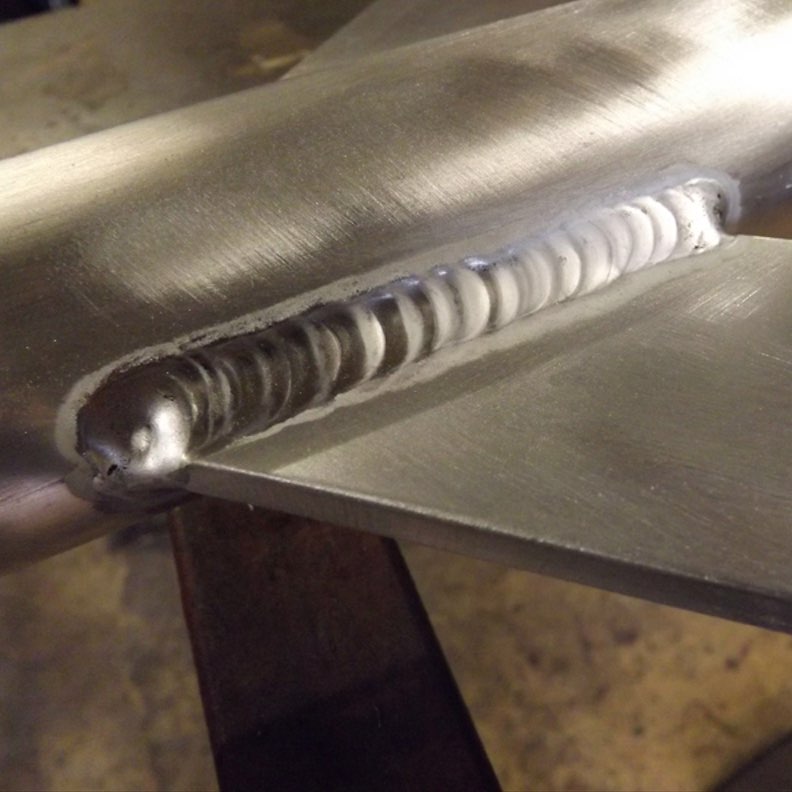
This guide is for the hands-on welder, the workshop professional, and the dedicated enthusiast. We’ll explore why aluminum to aluminum welding can be tricky, cover traditional methods, and introduce why modern handheld laser welding is a game-changer. Our goal is to answer the question, “can you weld aluminum?” with a confident “yes” and equip you with the knowledge to do it efficiently.
Why Welding Aluminum Requires Special Attention
Before you weld aluminum to aluminum, it’s crucial to understand its unique properties. Recognizing these challenges is the first step to overcoming them.
- The Tenacious Oxide Layer: This is challenge number one. Aluminum instantly forms a tough, refractory layer of aluminum oxide (Al₂O₃) upon exposure to air. This layer melts at a much higher temperature (around 2072°C / 3762°F) than the aluminum base metal (around 660°C / 1220°F). If not dealt with, this oxide gets mixed into the weld pool, causing inclusions, lack of fusion, and weak joints. It must be removed before welding and managed during the process.
- High Thermal Conductivity: Aluminum dissipates heat rapidly – about 5-6 times faster than steel. This means you need significantly higher heat input to form a weld puddle, increasing the risk of distortion (especially on thin sheets) and burn-through if not controlled carefully. It also means the puddle solidifies quickly once the heat source is removed.
- Hydrogen Porosity: Molten aluminum readily absorbs hydrogen, which then tries to escape as the metal solidifies. If trapped, it forms gas pores – essentially tiny bubbles – within the weld, significantly reducing its strength and integrity. Hydrogen sources are everywhere: moisture in the air, on the filler or base metal, contaminants like grease or oil, and even moisture within the shielding gas hose.
- Susceptibility to Cracking: Certain aluminum alloys are prone to solidification cracking (hot cracking) as the weld cools. This is influenced by the alloy composition, joint stress, and cooling rate. Proper filler metal selection is crucial to mitigate this.
- Alloy Variations: The weldability of aluminum varies significantly across different series (e.g., 1xxx, 3xxx, 5xxx, 6xxx, 7xxx). Knowing “can you weld aluminum alloy” types is key. For instance, the 5xxx series is very weldable, while some 7xxx series alloys are considered unweldable with fusion methods.
Table: Aluminum Alloy Weldability & Filler Selection Guide
| Alloy Series | General Weldability | Common Examples | Typical Applications | Recommended Filler(s) | Notes |
|---|---|---|---|---|---|
| 1xxx | Excellent | 1100, 1350 | Electrical conductors, chemical equipment | 1100 | Non-heat-treatable. Low strength. |
| 3xxx | Excellent | 3003, 3004 | Cookware, sheet metal work, heat exchangers | 4043 or 5356 | Non-heat-treatable. Good formability. |
| 4xxx | N/A (Mainly Fillers) | 4043, 4047 | Used as filler/brazing alloys | N/A | Lower melting point silicon alloys. |
| 5xxx | Excellent | 5052, 5083, 5086 | Marine (boats), pressure vessels, transport | 5356 (preferred), 5183, 5556 | Non-heat-treatable. Good strength & corrosion resistance. |
| 6xxx | Good | 6061, 6063 | Structural shapes, automotive, bike frames | 4043 or 5356 | Heat-treatable. Strength reduced in HAZ. Avoid welding 6061 with 6061 filler. 4043 reduces crack sensitivity but lower strength/ductility than 5356. |
| 7xxx | Fair to Poor (Special procedures) | 7005, 7075 | Aerospace, high-strength applications | 5356 or specific 5xxx fillers (e.g., 5180) | Heat-treatable. Some alloys (like 7075) considered unweldable by fusion methods due to high crack sensitivity. Weldable 7xxx alloys exist (e.g., 7005). |
Tried and True: Traditional Aluminum Welding Methods
For decades, two primary arc welding processes have been the go-to for aluminum. So, can you arc weld aluminum? Yes, and these are the most common ways.
- Gas Tungsten Arc Welding (GTAW / TIG):
- How it Works: Uses a non-consumable tungsten electrode to create the arc. Requires a separate filler rod fed manually. Typically uses Alternating Current (AC) for aluminum, as the AC cycle provides a ‘cleaning action’ that helps break up the surface oxide layer during part of the cycle.
- Pros: Excellent control over heat input and the weld puddle, produces high-quality, precise welds with great appearance. No spatter. Good for thin materials.
- Cons: Relatively slow process, requires significant operator skill, demands exceptional cleanliness of base metal and filler.
- Best For: Thin sections, visible welds where aesthetics matter, critical joints requiring high precision.
- Gas Metal Arc Welding (GMAW / MIG):
- How it Works: Uses a consumable wire electrode fed continuously through a welding gun, which also delivers the shielding gas. Typically uses Direct Current (DC) with reverse polarity (DCEP). A ‘push’ gun angle is usually preferred for aluminum to ensure good shielding gas coverage ahead of the puddle.
- Pros: Much faster travel speeds than TIG, easier to learn the basics, good for thicker materials and longer welds.
- Cons: Prone to feedability issues with soft aluminum wire (requiring U-groove drive rolls, Teflon liners, possibly push-pull guns), higher risk of porosity if parameters/technique aren’t optimal, potential for spatter. Control over the puddle is less fine than TIG.
- Best For: Thicker sections, production environments where speed is key, longer continuous welds.
Can You Stick Weld Aluminum?
If you’re wondering, “can you weld aluminum with an arc welder” of the stick variety, the answer is generally no. While technically possible with special electrodes, it is not recommended due to extreme difficulty and poor weld quality. TIG and MIG are far superior choices.
The Game Changer: Handheld Laser Welding for Aluminum
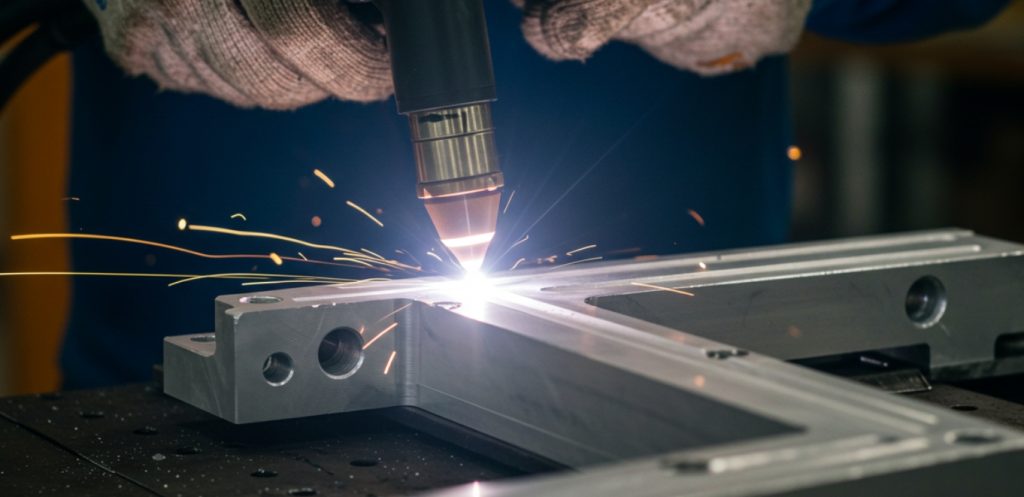
A modern answer to “can aluminum be welded to aluminum” effectively is laser welding. This technology is rapidly gaining traction for its ability to overcome aluminum’s challenges. The question is no longer just if we can weld aluminum, but how we can do it best.
So, can you weld aluminum with a laser welder? Absolutely. Laser welding uses a highly concentrated beam of light to melt and fuse the metal with incredible precision.
What is Laser Welding?
Instead of an electric arc, laser welding uses a highly concentrated beam of light energy to melt and fuse the metal. Handheld systems put this power into a portable, maneuverable welding torch.
Why is it Effective for Aluminum?
Breaks Through the Oxide Layer with Strong Power
The laser’s power is extremely strong—it can be more than 1 million watts per square centimeter. This focused energy quickly heats up and blasts away the tough aluminum oxide layer (which melts at about 2072°C) before the aluminum underneath (which melts at about 660°C) even starts to melt. This is very different from AC TIG welding, which uses a back-and-forth current to slowly remove the oxide layer like sandblasting. The laser’s strong energy makes a cleaner weld with fewer impurities from the oxide.
Controls Heat Very Carefully
Aluminum spreads heat very quickly, so TIG and MIG welding need a lot of heat, which can cause a big heat-affected zone (HAZ) and warping. The laser’s focused beam creates a much smaller HAZ—about 50-80% smaller than TIG welding.
Example: For a 1.5mm (1/16 inch) aluminum sheet, this means the finished piece will be almost flat instead of bent, saving time and money on fixing the shape later.
Reduces Gas Bubbles in the Weld with “Keyhole” Welding
The laser makes a deep, narrow hole called a “keyhole” in the metal. This hole gives trapped gases like hydrogen a way to escape as the weld forms. Because the weld cools quickly, the metal has less time to soak up hydrogen compared to slower TIG or MIG welding. This lowers the chance of weak spots caused by bubbles.
Amazing Control and Precision
The laser focuses energy on a very small spot, usually less than 1mm wide. This means it can:
- Weld very thin aluminum sheets or foils as thin as 0.5mm (0.02 inches) without burning through—a very hard task for MIG and TIG welding.
- Weld near delicate parts or complex shapes with little risk of damage.
Faster and More Efficient
Handheld laser welding can be 2 to 10 times faster than TIG welding in many cases.
- A skilled TIG welder might take several minutes to weld a 1-meter seam on 2mm aluminum.
- A laser welder can often do the same weld in under 30 seconds.
While MIG welding is fast for long straight lines, laser welding often ends up being faster overall because there is less spatter and cleanup. You don’t have to grind down extra metal or fix warped parts as much, saving more time.
Easier to Learn
Learning AC TIG welding on aluminum can take hundreds of hours. But many operators can learn to make good-quality welds using a handheld laser welder in just one day. This is because modern laser welders have preset programs built in.
Example: The user picks “2mm 5052 to 2mm 5052 – Fillet Weld” on a touchscreen. The machine then sets the right power, frequency, and gas automatically. The operator just needs to keep the right speed and position of the torch, making the process much simpler than balancing all settings by hand like with TIG.
Real-World Observations
From my experience observing workshops adopt this technology, handheld laser welders are proving particularly valuable for aluminum sheet metal fabrication, enclosure assembly, repairs, and joining components where low distortion and speed are paramount. While TIG remains the king for certain high-spec, cosmetic welds, the speed and ease-of-use benefits of handheld laser are making it a highly practical and increasingly popular choice for a wide range of aluminum welding tasks.
Non-Negotiable Best Practices for Any Aluminum Welding Method
Whether using TIG, MIG, or Laser, how to weld aluminum to aluminum successfully depends on these fundamentals:
Cleanliness is Paramount: This cannot be overstated.
- Degrease: Make sure to remove all oils, grease, paint, and markings using a proper cleaner like acetone or a special degreaser. If you don’t do this, it can cause big problems. When the welding heat gets very hot, it will turn these leftovers into gas. This gas gets trapped in the weld as tiny bubbles called porosity. These bubbles make the weld weak and brittle, so it can break easily when used.
- Oxide Removal: Immediately before welding (within a few hours, max), remove the oxide layer from the weld area and filler material (if applicable). Use a dedicated stainless steel wire brush (used only for aluminum) or chemical etching. Brush in one direction. Avoid overly aggressive grinding which can embed particles.
Proper Filler Metal: Use a filler alloy compatible with the base aluminum alloy(s) being joined. Common choices include ER4043 (good general-purpose, less crack-sensitive, good flow) and ER5356 (stronger, better color match for 5xxx series, stiffer wire feeds better for MIG). Consult alloy charts.
Shielding Gas: Pure Argon is the standard for both TIG and MIG, and commonly used for laser. Argon/Helium mixes can provide hotter arc/beam characteristics, beneficial for thicker sections, but cost more. Ensure adequate flow rates and leak-free delivery systems.
Table: Shielding Gas Selection Guide for Aluminum Welding
| Shielding Gas | Typical Composition | Primary Application (Aluminum Thickness) | Key Effects | Considerations |
|---|---|---|---|---|
| Pure Argon (Ar) | 100% Argon | General purpose; Thin to medium thickness (e.g., up to ~1/2 inch / 12mm) | Stable arc/beam initiation; Good cleaning action (AC TIG); Provides good puddle control. | Most common; Readily available; Lower cost. Requires adequate flow rate (e.g., 20-35 CFH typical). |
| Argon/Helium (Ar/He) Mixes | Typically 25-75% Helium (He), balance Argon | Thicker sections (e.g., >1/4 inch / 6mm); High-speed automated welding. | Provides a hotter arc/beam; Increases penetration depth and width; Allows faster travel speeds; Reduces porosity risk in some cases. | Higher cost; Lighter He requires higher flow rates (can be 2x Argon flow); Can make arc starting slightly more difficult; Less cleaning action in AC TIG compared to pure Ar. |
| Pure Helium (He) | 100% Helium | Very thick sections; Specialized high-speed / high-heat applications. | Very hot arc/beam; Maximum penetration & travel speed. | Highest cost; Requires very high flow rates; Difficult arc starting; Less common for manual welding. |
Joint Design & Fit-Up: Ensure good fit-up with minimal gaps to reduce weld stress and the amount of filler needed.
Parameter Optimization: Dialing in the correct settings (Amps/Voltage/Wire Feed Speed for TIG/MIG; Power/Frequency/Speed for Laser) is critical. Start with manufacturer recommendations and fine-tune based on material thickness and joint type.
Technique Matters: Maintain consistent travel speed, torch/gun angles (push angle often for MIG on aluminum), and arc length/standoff distance.
Putting Handheld Laser Welding to Work on Aluminum
So, how does handheld laser translate to the workshop floor for aluminum?
- Addressing Pain Points: It directly counters the distortion issues caused by aluminum’s thermal conductivity thanks to its low HAZ. Its speed reduces overall exposure to contaminants, helping manage porosity. The focused beam aids in dealing with the oxide layer.
- Ideal Applications: Think aluminum enclosures, signage, kitchen equipment, automotive components (non-structural repairs/fabrication), marine fittings (using appropriate alloys like 5xxx), and general sheet metal work where speed and low distortion are key.
- Important Considerations:
- Safety: Laser safety protocols are essential and different from arc welding. Proper eyewear (specific to the laser wavelength), fume extraction, and controlled work areas are non-negotiable.
- Cost: Initial investment is typically higher than traditional TIG/MIG setups, but ROI can be rapid due to increased productivity and potentially lower rework rates.
You Can Weld Aluminum – And Laser Makes it Easier
So, can you weld aluminum to aluminum? Absolutely. While the inherent properties of aluminum – its oxide layer, thermal conductivity, and susceptibility to porosity – demand respect and proper technique, they are entirely manageable challenges.
Traditional TIG and MIG processes remain reliable options, each with its strengths. However, for welders and workshops looking for enhanced speed, reduced distortion, and often a simpler path to achieving high-quality welds on a variety of aluminum tasks, handheld laser welding presents a powerful, modern solution. It directly addresses many of aluminum’s most frustrating characteristics.
By understanding the challenges, meticulously preparing your material, and choosing the right process – increasingly, that process includes laser – you can confidently and successfully weld aluminum.

Ready to Conquer Aluminum Welding Challenges?
Stop letting aluminum welding complexities slow you down. If you’re looking for a faster, cleaner, and often easier way to produce high-quality aluminum welds with minimal distortion, explore the capabilities of advanced handheld laser welding systems.
Contact us today to discuss your specific aluminum welding applications. We can provide expert advice, arrange a demonstration, and help you find the right laser welding solution to elevate your work. Buy the tool that helps you weld aluminum better – inquire about our handheld laser welders now!
FAQs of Aluminum Welding
Yes, you absolutely can weld aluminum to aluminum! However, it’s definitely trickier than welding steel. Aluminum has unique challenges like a tough, invisible oxide skin (that must be cleaned off!), it spreads heat really fast (risking warping), and it can easily trap gas bubbles (porosity) or even crack if you don’t use the right technique. So, while possible, it requires specific knowledge, careful preparation (especially cleaning!), and the right method to do it well.
here isn’t one single “best” way – it depends on your specific job!
TIG welding gives the best control and prettiest welds, great for thin stuff, but it’s slow and takes skill.
MIG welding is much faster, good for thicker aluminum, and easier to learn the basics, but needs careful setup to avoid problems like wire feeding issues or defects.
Handheld Laser Welding is a very popular modern choice because it’s super fast, creates very little warping (low heat), handles aluminum’s challenges well, and can be easier to learn for many common joints. For speed and minimizing distortion, laser is often the top pick today.
Cleaning is the #1 most critical step! Aluminum instantly forms a hard, clear “skin” (oxide) when exposed to air. This skin melts at a much higher temperature than the aluminum itself. If you don’t scrub it off right before welding with a dedicated aluminum-only stainless steel brush, it gets trapped in the weld, causing weak spots, poor fusion, and defects. You also need to remove all grease, oil, or dirt first, as these contaminants cause gas bubbles (porosity) that weaken the weld significantly. Perfect cleaning = better, stronger welds!