
If you run a heavy steel fabrication shop, you know the daily struggle. Cutting 50 millimeters (2-inch) plate usually means relying on slow plasma or oxy-fuel machines. These older methods create wide cuts, put too much heat into the metal, and leave a mess of dross and slag that requires hours of manual grinding.
But that era is over. Upgrading to a high-power fiber laser cutting machine (30 kilowatts and above) changes everything. We are no longer just melting metal; we are vaporizing it. This breakthrough allows you to cut thick structural steel with the exact same speed and “nest-to-weld” efficiency that used to be limited to thin sheets.
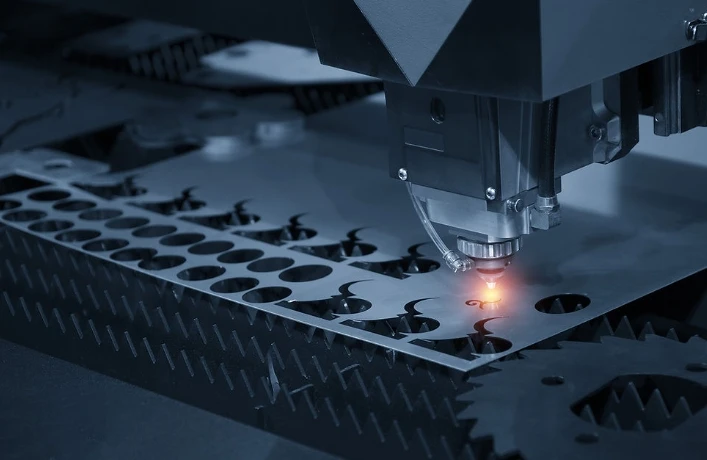
Why Thick Metal Now Cuts “Like Paper”
In older 4 kW or 6 kW lasers, cutting thick carbon steel was a constant struggle. The laser melted the metal, but the assist gas could not push the thick, sticky metal out of the deep cut (known as the kerf width). This left rough edges and heavy slag.
Today’s 30 kW to 60 kW fiber lasers operate on a new principle: vaporization dominance. When you focus 30 kW of power into a tiny 100-micron spot, the metal does not just melt—a large portion of it instantly vaporizes. This creates a high-pressure vapor cloud that acts like a piston, pushing the molten material straight down and out of the cut.
To achieve this, modern lasers use two specific tools:
Supersonic Air: Cutting thick metal requires a strong force to sweep away the mess. High-power systems use special nozzles (Laval nozzles) to shoot compressed air at supersonic speeds, clearing the metal before it sticks to the bottom edge.
Beam Shaping Technology: Instead of a simple pinpoint of light, modern optics change the focus position into a wider ring or “donut” shape. This makes the kerf slightly wider, allowing the gas to flow smoothly to the bottom of a 50 mm plate without turbulence.
Plasma vs Fiber Laser Thick Plate
For shop owners, the choice often comes down to evaluating plasma vs fiber laser thick plate cutting. Plasma pushes an electrically conductive gas through a hot arc, which is cheap upfront but slow and messy. High-power fiber lasers have shifted the crossover point—the thickness where plasma used to be more efficient—from 6 mm up to nearly 30 mm.
Here is a realistic look at cutting speeds for carbon steel (mild steel) using a 30 kW fiber laser compared to a standard High-Definition (High-Def) plasma cutter:
| Material Thickness | High-Def Plasma Speed | 30 kW Fiber Laser Speed | The Advantage |
| 6 mm (1/4″) | ~5.2 m/min | 22.0 – 25.0 m/min | Fiber is 4x to 5x Faster |
| 20 mm (3/4″) | ~2.5 m/min | 5.0 – 6.0 m/min | Fiber is over 2x Faster |
| 30 mm (1.18″) | ~1.8 m/min | 1.5 – 2.0 m/min | Fiber is Equal or Faster |
| 50 mm (2″) | ~0.8 m/min | 0.6 – 0.8 m/min | Fiber is Similar but Cleaner |
(Data based on stable production speeds utilizing Nitrogen or High-Pressure Air assist gases.)
While a 30 kW machine has an absolute maximum cutting thickness of around 70 mm, keeping the machine in its stable production range (up to 40 mm) ensures continuous, reliable cutting shift after shift.
Superior Edge Quality and ISO 9013 Standards
Plasma cutting often leaves a massive heat-affected zone (HAZ) and a 1-to-3-degree bevel (taper). This means you must pay workers to manually grind the edges before the parts can be welded.
High-power fiber lasers fix this expensive bottleneck. They can achieve ISO 9013 Range 2 to 4 cut quality, meaning the edge is exceptionally straight and vertical. Because the laser beam is so precise, you can cut small bolt holes and complex shapes directly on the machine’s gantry structure without needing secondary drilling operations. The parts come off the machine ready to weld.
High-Pressure Air Cutting: Slicing Gas Costs
Using a high-power laser requires a smart assist gas strategy. The old way of cutting thick steel used bulk Nitrogen (which is incredibly expensive) or Oxygen (which leaves a dark oxide layer that must be removed).
The new standard is high-pressure compressed air cutting. A 30 kW laser can easily cut 20 mm carbon steel using shop air compressed to 16 to 20 bar. Because regular air is roughly 78% Nitrogen and 21% Oxygen, the laser uses the Nitrogen to cool the cut and the Oxygen to add a small heat boost. This reduces gas costs by up to 80% compared to pure Nitrogen. The edge might have a slight yellow tint, but it is burr-free and perfect for structural steel framing and machinery bases.
Calculate Your ROI: The Cost Per Part Advantage
When looking at a high-power fiber laser, the initial price tag is high. But you must look at the Cost Per Part to understand the fiber laser ROI (Return on Investment).
Imagine a scenario where you need to cut 1,000 meters of 20 mm steel flange plate:
- Plasma: Slower speed + High Gas Cost + Expensive Grinding Labor = High Cost Per Part.
- 30 kW Fiber Laser: Faster Speed + Low Gas Cost (Air) + Zero Grinding = Low Cost Per Part.
A single 40 kW laser can cut about 38,000 meters of 20 mm steel a month, while a heavy-duty 300-amp plasma only cuts 19,000 meters. Because one high-power laser does the work of two or more old plasma tables, you instantly cut your labor and facility overhead in half. This consolidation frees up floor space, lowers maintenance costs, and lets you move your operators to more valuable tasks.
Industrial Safety and Machine Reliability
Unlike open-bed plasma tables, high-power lasers are Class 4 laser systems and must be treated with strict safety rules.
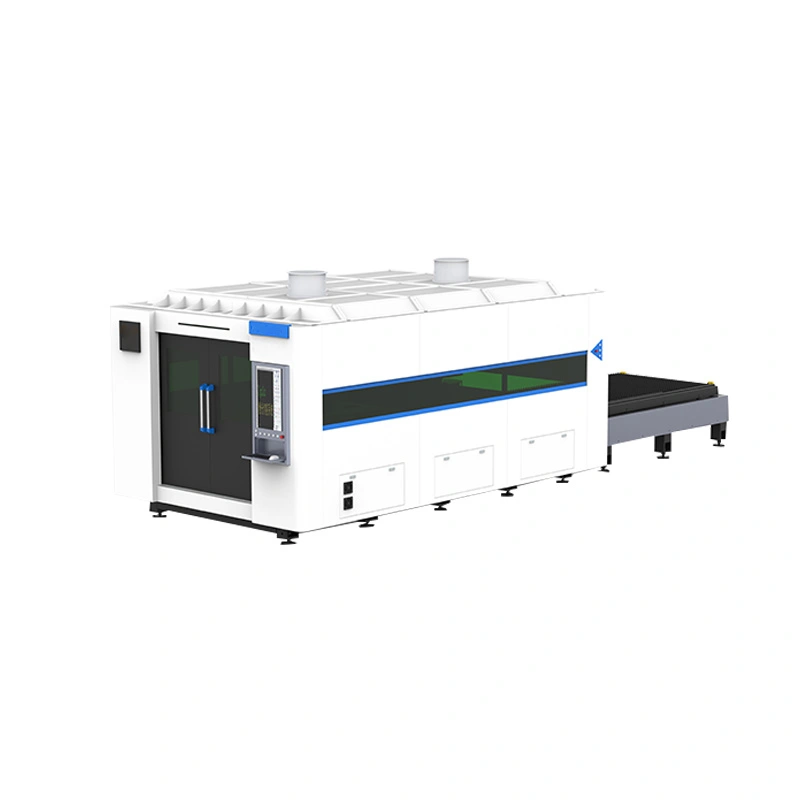
- Enclosures: The machine must be a fully enclosed Class 1 laser product. It must have light-tight walls and safety interlocks on the doors to protect workers from invisible, blinding radiation.
- Glass Standards: Any viewing windows must meet high Optical Density (OD) ratings specifically tested for the 1064 nm laser wavelength.
- Reliability: Inside, top-tier laser sources have no moving mirrors. The internal diodes can operate efficiently for over a decade with minimal maintenance, greatly outlasting old CO2 resonators or plasma torches.
Ready to Redefine Your Production?
The ability to cut thick steel “like paper” is not just a marketing slogan; it is the reality of modern manufacturing. If your shop is currently grinding dross off plasma-cut parts or turning away thick plate jobs, relying on old technology is holding you back.
Next Steps for Fabrication Managers:
- Audit Your Gas Bill: Calculate exactly how much you spend on Nitrogen and Oxygen every month.
- Get a Free Cutting Sample: Ask vendors for a 25 mm air-cut steel sample to test the weldability for yourself.
- Calculate Cost Per Part: Compare the throughput of one automated high-power fiber laser against your entire current fleet to see your true ROI.
FAQs
It can cut thick plate, but validate your acceptance criteria. Benchmark tables show ~20–25 mm with oxygen at production speeds, then power level and process packages matter for thicker work.
Oxygen is commonly used for thick carbon steel to support stable cutting and economics, but it can oxidize the edge. Validate downstream requirements (painting, coating, weld cosmetics).
If 30–50 mm is frequent and time-critical, you usually want the margin. OEM spec pages show thicker capability with higher power and thick-sheet packages.