
While air cooling is driving the future of portable welding, water cooling remains the undisputed standard for today’s high-power industrial applications.
If you are a fabrication manager or procurement engineer deciding between these two architectures, you likely don’t have time for fluff. You need to know which machine delivers the ROI for your specific floor plan and material mix.
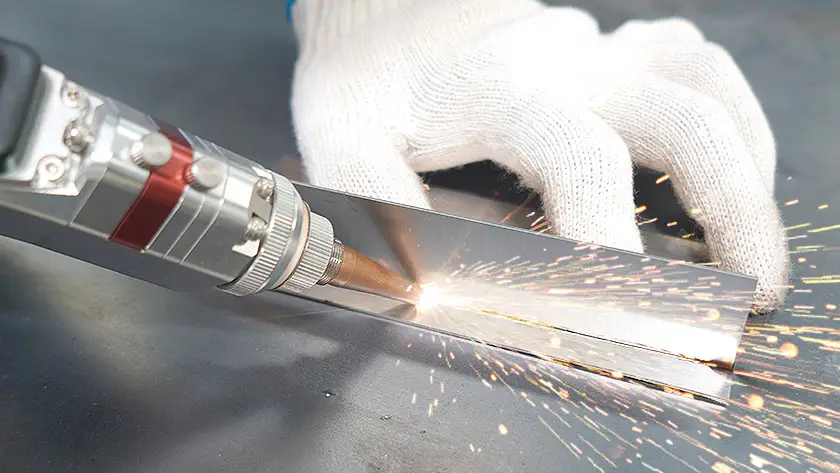
The Short Answer
In the 2026 landscape, the choice comes down to mobility vs. raw power. While air-cooled technology has matured significantly, physics still dictates the operational limits of thermal management.
- Choose Air-Cooled Handheld Laser Welder(Up to 3kW) If:
- You are a mobile service provider: HVAC, construction, or on-site repair where dragging a 150kg chiller is impossible.
- You weld thin-to-medium gauge: Stainless and carbon steel up to 6mm–8mm.
- You value “maintenance-free” logistics: No water to freeze in the van overnight; no filters to change weekly.
- Choose Water-Cooled (Up to 6kW) If:
- You run a stationary factory: The machine sits in a booth or on a dedicated line.
- You weld heavy structural plate: Thicknesses >10mm requiring deep penetration and high heat input.
- You operate in extreme heat: Unconditioned shops >35°C (95°F) where air-cooling fans would throttle the laser source.
Quick Decision Matrix: 2026 Standards
| Feature | Air-Cooled (3kW Max) | Water-Cooled (6kW Max) |
| Primary Advantage | Extreme Portability (~40-60kg) | 100% Duty Cycle at High Power |
| Max Penetration | ~6mm – 8mm (Single Pass) | ~10mm – 12mm+ (Single Pass) |
| Maintenance | Low (Dust filters only) | High (Fluid changes, chillers) |
| Ambient Temp Limit | Throttles >40°C | Stable up to 45°C+ |
| Winterization | Not Required | Critical (Glycol required) |
3kW is the New Standard
Just two years ago, air-cooled units were effectively capped at 1.5kW, struggling to compete with TIG for anything beyond sheet metal. Today, advances in phase-change heat pipes and direct refrigerant cooling have pushed the envelope to 3kW.
- The Air-Cooled Surge: New active cooling architectures—similar to miniaturized AC units—allow 3kW air-cooled systems to replace traditional 250A MIG welders for field work.
- The Water-Cooled Scale-Up: To maintain their industrial stronghold, water-cooled manufacturers have pushed handheld units to 6kW. These “beasts” are now used for heavy equipment repair and shipbuilding, tasks previously reserved for submerged arc or automated robotic cells.
The Air-Cooled Handheld Laser Welder

The air-cooled welder utilizes high-static pressure fans and copper heat sinks to dissipate the waste heat generated by the pump diodes. It is the preferred choice for high-mix, low-volume shops and field operators.
Unmatched Portability and Logistics
The defining feature of 2026 air-cooled models is weight efficiency. A typical 3kW unit weighs between 40kg and 60kg, roughly half the weight of a water-cooled equivalent.
- The “Van Test”: One or two operators can lift an air-cooled unit into a service vehicle. It occupies a fraction of the floor space (approx. 0.1m³) of a chiller-based system.
- Zero Winterization: For contractors in northern climates, this is a decisive factor. There is no water loop to freeze and rupture the laser source if the van sits in -20°C temperatures overnight.
The Trade-Offs of 3kW Air-Cooling
Physics demands a price for removing heat without water.
- Noise Pollution: Dissipating 3kW of heat requires fans spinning at high RPMs. Expect noise levels to exceed 75-80 dB, which can increase operator fatigue in small, enclosed rooms.
- Thermal Throttling: In environments exceeding 40°C (104°F), intelligent control systems may reduce output power to protect the diodes. If your shop lacks AC and you live in a hot climate, a 3kW air-cooled unit may effectively become a 2kW unit on summer afternoons.
The Water-Cooled Handheld Laser Welder
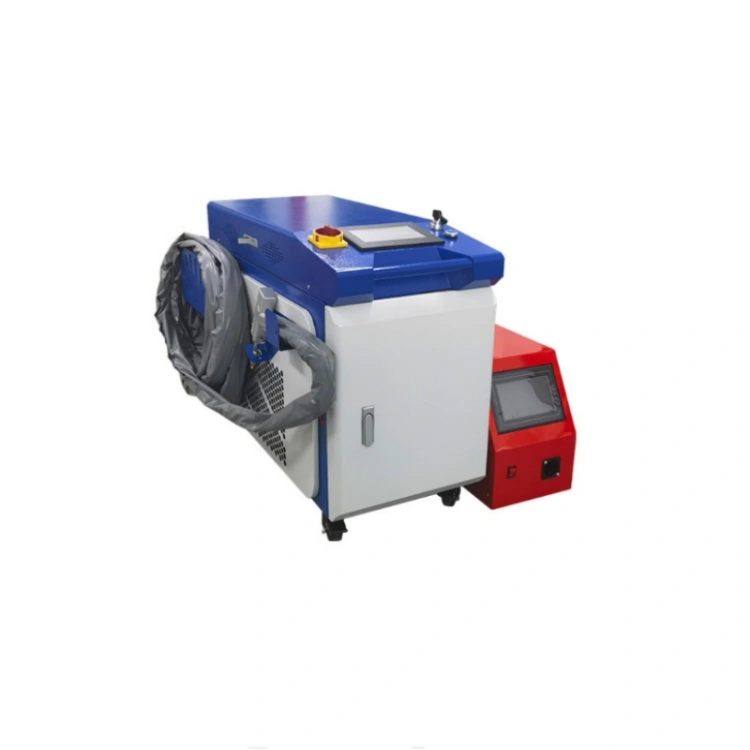
Water-cooled systems circulate a mixture of distilled water and propylene glycol through a chiller unit. Water’s high specific heat capacity makes it the ultimate thermal buffer for high-volume, continuous production.
Raw Power for Heavy Fabrication
Water-cooled units currently dominate the 3kW to 6kW range.
- Thickness Capability: With 6kW, operators can achieve single-pass penetration on 8mm+ stainless steel or 10mm carbon steel. Air-cooled units simply cannot sustain the beam density required for these structural welds without overheating.
- Beam Stability: Water cooling maintains the optical fibers at a precise temperature (±1°C). This prevents “thermal lensing”—a phenomenon where heat distorts the beam focus, causing inconsistent weld depths during long seams.
The Maintenance Reality
“Industrial reliability” comes with a strict maintenance schedule. Neglecting a water-cooled system is the #1 cause of laser failure.
- Fluid Management: You must change the deionized/distilled water every 3 to 6 months to prevent conductivity buildup, which can short-circuit the pump diodes.
- Winter Protection: Water cooling won’t work if the temperature is below 0 degrees Celsius because the water will freeze. If the shop temperature drops below freezing, you must use a specific ratio of Propylene Glycol (e.g., 30-50%) or drain the system nightly. A single freeze event can crack the internal cooling plates, costing thousands in repairs.
ROI and Cost of Ownership
When presenting this CapEx request to finance, consider the Total Cost of Ownership (TCO) over 3 years.
Upfront Cost vs. Operational Cost (OpEx)
- Purchase Price: Surprisingly, water-cooled units are often cheaper upfront. Generic 1500W-3000W water-cooled imports can be found for $3,000–$5,000, while proprietary 3kW air-cooled units from top-tier brands (IPG, GW, etc.) command a premium of $8,000–$15,000+ due to their advanced engineering.
- Energy Efficiency: Air-cooled units are roughly 42% wall-plug efficient and eliminate the 1-2kW power draw of a refrigerant compressor/water pump. Over a single shift (2000 hours/year), an air-cooled unit can save significantly on electricity.
Which System Pays for Itself Faster?
- Scenario A: The Job Shop. If you switch materials 5 times a day and move the welder between bays, Air-Cooled wins. The time saved in setup and mobility translates directly to billable hours.
- Scenario B: The Production Line. If you weld the same 4mm steel bracket 500 times a day, Water-Cooled wins. The lower consumable cost (no high-tech fans to fail) and 100% duty cycle ensure the line never stops.
Laser Welding Safety and Compliance (ISO 11553 & ANSI Z136.1)
Regardless of the cooling method, handheld laser welding machine falls under Class 4 Laser Safety regulations. This is a critical YMYL (Your Money Your Life) consideration for your facility.
- Controlled Area: You must establish a Laser Controlled Area (LCA) with interlocked doors and light-tight curtains.
- PPE: Operators must wear OD6+ (Optical Density) safety glasses matched to the 1064nm wavelength. Standard welding helmets are not sufficient protection against direct laser strikes.
- Safety Interlocks: Ensure your chosen model complies with ISO 11553-2 for handheld devices. This requires a two-step trigger and a workpiece contact sensor (electrical safety loop) that cuts the beam instantly if the gun is lifted from the metal.
Conclusion: Matching the Machine to the Mission
In 2026, the technology gap has narrowed, but the application gap has widened.
- Buy Air-Cooled if your work is dynamic, mobile, and involves materials under 8mm. The premium price buys you operational freedom and “grab-and-go” readiness.
- Buy Water-Cooled if your work is stationary, heavy-duty, or involves continuous high-amp welding. The maintenance burden is a small price to pay for 6kW of unthrottled power.
Ready to calculate your ROI?
Don’t guess. Contact us today, and we will help you evaluate your specific labor rates and material thickness to find the exact model that fits your P&L.
FAQs
Generally, no. While 2026 air-cooled models can handle materials up to 6mm–8mm, welding heavy structural plate (10mm+) requires the sustained high energy density and thermal stability of a 6kW water-cooled system.
Not entirely. While you avoid fluid changes and leak risks, you must clean the air intake filters and heat sinks weekly. Accumulated shop dust will insulate the components, leading to overheating and power throttling.
Yes, it is critical. If your shop temperature drops below 0°C (32°F), the water inside the laser source will freeze and rupture the cooling plates. You must use a specific ratio of Propylene Glycol or drain the system nightly in winter.