
Manual grinding and chemical pickling are the biggest bottlenecks in modern fabrication. They are slow, inconsistent, and hazardous. If your production line struggles with aluminum porosity (“Swiss cheese” welds) or you are spending thousands annually on grinding discs and hazardous waste disposal, laser cleaning is the solution to scalable precision.
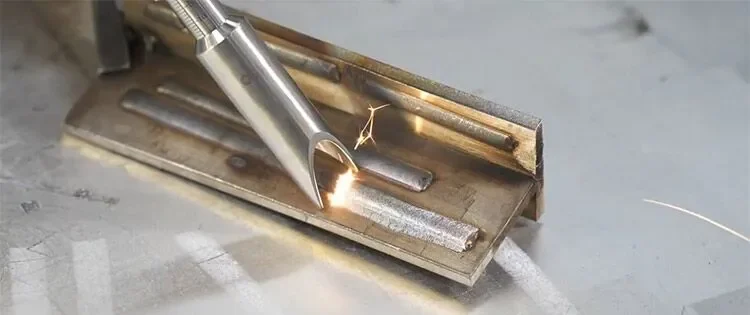
For decades, laser technology was too expensive for small shops. Today, with the advent of 4-in-1 handheld laser welding machines—which integrate welding, cutting, and seam cleaning—the technology is accessible. Entry-level water-cooled units now start around $2,500, making the ROI undeniable for even modest job shops.
This guide analyzes the technical advantages of laser cleaning for weld seams, compares it to traditional methods, and breaks down the real-world ROI.
What Is Laser Weld Cleaning?
Laser cleaning, technically known as laser ablation, uses high-intensity pulses of light to remove surface contaminants. The process relies on ablation thresholds: contaminants like rust, oil, and oxides absorb the laser energy and vaporize (sublimate) instantly. The underlying metal reflects the beam, remaining cool and untouched. This makes the process self-limiting—you cannot accidentally “dig” into the base metal like you can with a grinder.
4-in-1 Handheld Systems
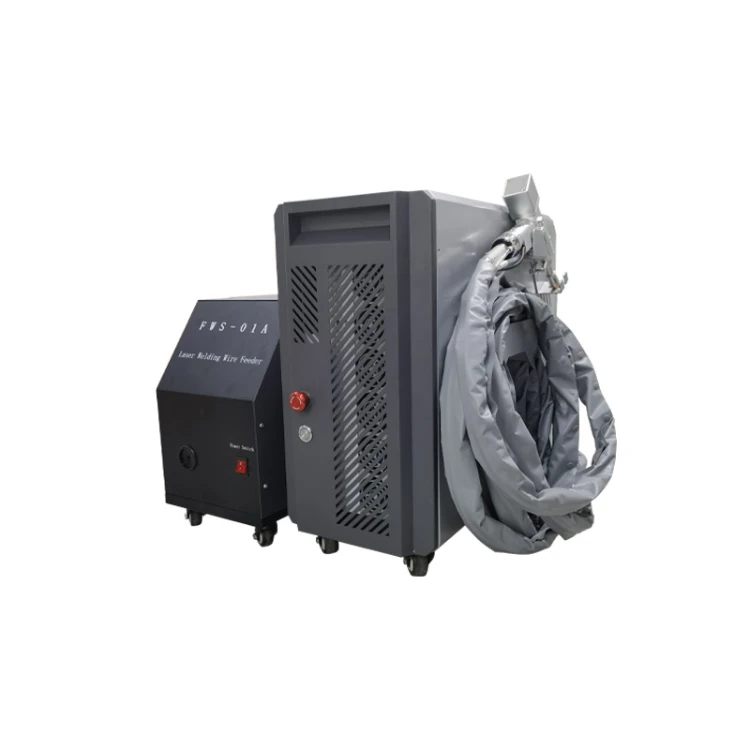
Historically, you needed a dedicated laser cleaning machine. Now, the market standard is the 4-in-1 handheld laser welder. These versatile units allow operators to:
- Pre-clean: Remove oils and rust.
- Weld: Join materials with deep penetration.
- Post-clean: Swap the nozzle and software mode to immediately remove heat tint and oxides.
- Cut: Perform basic cutting operations.
This versatility condenses a welder, plasma cutter, grinder, and chemical tank into a single footprint.
Pre-Weld Cleaning: Preventing Defects at the Source
The quality of a weld is determined before the arc is struck. Surface contamination is the leading cause of porosity and cracking.
1. Solving Aluminum Porosity
Aluminum welding is notorious for porosity because the surface oxide layer (Al₂O₃) absorbs moisture (hydrates). During welding, this moisture releases hydrogen, which gets trapped in the cooling metal, creating gas pockets.
- The Data: Research shows laser cleaning removes these hydrates completely. Studies indicate laser cleaning can reduce porosity in aluminum welds to below 0.3%, compared to 1.4% in uncleaned or mechanically cleaned samples.
- The Benefit: Eliminates the “Swiss cheese” effect and reduces rework rates significantly.
2. Preventing Hydrogen Cracking in Steel
In high-strength steels, hydrocarbons (grease/oil) release hydrogen that causes Hydrogen Induced Cracking (HIC). Laser cleaning vaporizes these hydrocarbons down to the micropores of the metal, ensuring a hydrogen-free weld zone.
3. EV Battery Applications (Copper & Hairpins)
For Electric Vehicle (EV) manufacturers, removing insulation from copper “hairpin” stators or cleaning busbars is critical. Laser cleaning strips insulation in under one second per pin without nicking the soft copper, ensuring perfect electrical conductivity.
Post-Weld Cleaning: Passivation and Aesthetics
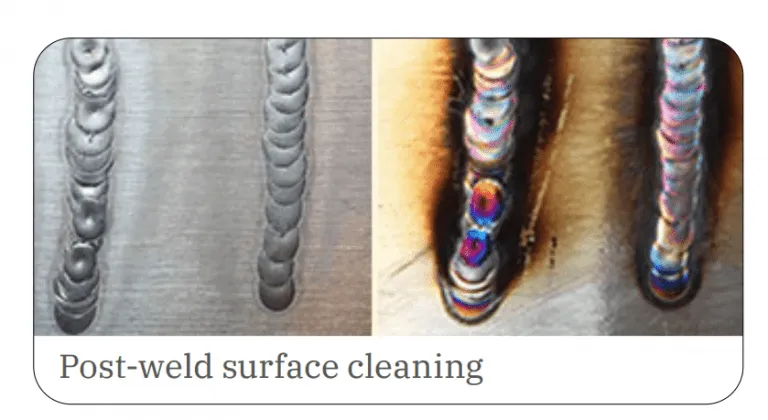
After welding, stainless steel develops a colored oxide layer known as heat tint. This is not just cosmetic; the heat has depleted the chromium on the surface, leaving the steel vulnerable to rust.
Stainless Steel Passivation
Traditional methods use pickling paste (hydrofluoric acid) to remove heat tint. This is highly toxic and requires strict waste disposal.
- Laser Passivation: The laser selectively ablates the iron-rich heat tint layer. This exposure to oxygen allows the chromium-rich passive layer to reform immediately. It restores corrosion resistance without chemicals.
- Speed: Laser cleaning speeds on stainless steel can reach 1.5 meters per minute, often matching the travel speed of the welding process itself.
NDT Surface Preparation
For safety-critical parts requiring Non-Destructive Testing (NDT), such as Ultrasonic or Dye Penetrant testing, the surface must be spotless. Laser cleaning removes slag and spatter that could mask defects or create false positives.
Laser vs. Traditional Methods: Value Over Cost
While a $2,500 laser setup is more expensive than a $500 angle grinder, the operational comparison favors the laser heavily.
| Feature | Laser Cleaning (4-in-1) | Mechanical Grinding | Chemical Pickling |
| Precision | Micron-level (No base metal loss) | Low (Removes base metal) | High (But hard to control depth) |
| Speed | High (Up to 20 m²/hr) | Slow (Labor intensive) | Slow (Soaking/drying time) |
| Consumables | None (Electricity/Gas) | Discs, Brushes, Pads | Acids, Neutralizers, Water |
| Safety | Class 4 Laser (Eye risk managed) | Dust, Vibration, Injury risk | Chemical burns, Fumes |
| Waste | Filtered Dust (Low volume) | Metal dust + Abrasive grit | Toxic Sludge (Hazardous waste) |
| Secondary Steps | None (Dry process) | Cleaning dust residue | Rinsing and Neutralizing |
Key Takeaway: Laser cleaning is a “dry” process. There is no slurry to manage, no media to sweep up, and no chemicals to dispose of.
ROI Analysis: Is It Worth the Investment?
The barrier to entry for laser technology has lowered drastically.
1. Equipment Cost
- Economy Water-Cooled Models (~$2,500): These units are cost-effective workhorses for shops with fixed stations. They require a water chiller (often included) which makes them heavier but allows for 100% duty cycles.
- Portable Air-Cooled Models (~$3,500 – $4,500): These use advanced phase-change cooling to eliminate the water tank. They are lightweight (often <40kg) and ideal for field work or moving around large assemblies.
2. Operational Savings
- Labor: A laser cleans 4-5x faster than grinding. A job taking 1 hour with a grinder takes ~10 minutes with a laser.
- Consumables: Eliminating grinding discs and pickling paste saves hundreds of dollars a month.
- Energy: A 1000W machine consumes roughly 10–15 kWh. At $0.10/kWh, running costs are approximately $1.00 – $1.50 per hour.
- Comparison: A study showed total hourly costs dropping from $73.50/hr (sandblasting labor + media) to $27.22/hr (laser labor + energy).
Payback Period: For a typical job shop, the labor and consumable savings often result in a full ROI in under 6 months.
ROI Calculator Tip: Calculate your monthly spend on abrasives + disposal fees. If it exceeds $300, a lease on a laser machine may cost less than your current consumables.
Safety and Regulatory Compliance
Laser cleaning machines are Class 4 laser devices. They are safe when used correctly, but they require respect and compliance.
- Eye Protection: All personnel in the area must wear OD6+ rated safety glasses specific to the laser’s wavelength (typically 1064nm-1080nm).
- Fume Extraction: Vaporizing metal and paint creates hazardous fumes (including Hexavalent Chromium from stainless steel). A fume extractor with HEPA filtration is mandatory to meet OSHA PEL standards (Permissible Exposure Limits).
- Designated Area: Operations should take place in a controlled area with interlocked barriers or laser-safe curtains to prevent accidental beam exposure to bystanders.
Conclusion: The Smart Shop’s Upgrade
The shift to 4-in-1 handheld laser systems is not just about buying a new tool; it’s about consolidating your workflow. By replacing grinders and chemical tanks with a single photonic tool, you improve weld quality, reduce porosity defects to near zero, and eliminate the monthly bleed of consumable costs.
Ready to evaluate the numbers?
- : Compare your current grinding/chemical spend against a $2,500 unit.
- : Send us your metal samples to see the porosity reduction firsthand.
Disclaimer: Laser equipment requires strict adherence to safety protocols, including ANSI Z136.1 standards. Always consult with a certified Laser Safety Officer (LSO) before implementation.
FAQs
A: Laser seam welding uses a high-energy focused light beam to melt and fuse materials. Unlike TIG or MIG, it creates a narrow, deep-penetration weld with very low heat input. In 4-in-1 handheld units, this process is integrated with cleaning capabilities, allowing operators to weld and clean using the same machine by simply changing nozzles and settings.
A: You clean weld joints using laser ablation. By passing the laser head over the seam, high-frequency light pulses instantly vaporize contaminants like oxides, rust, and heat tint. It is a dry, non-contact process that requires no chemicals or abrasive media, leaving the surface ready for passivation or coating immediately.
A: No, when used correctly. The process is self-limiting based on ablation thresholds. The laser is tuned to vaporize contaminants (which have a low resistance to heat) but reflects off the base metal (which has a high resistance). This leaves the substrate’s geometry and surface profile completely intact, unlike grinding or sandblasting.