
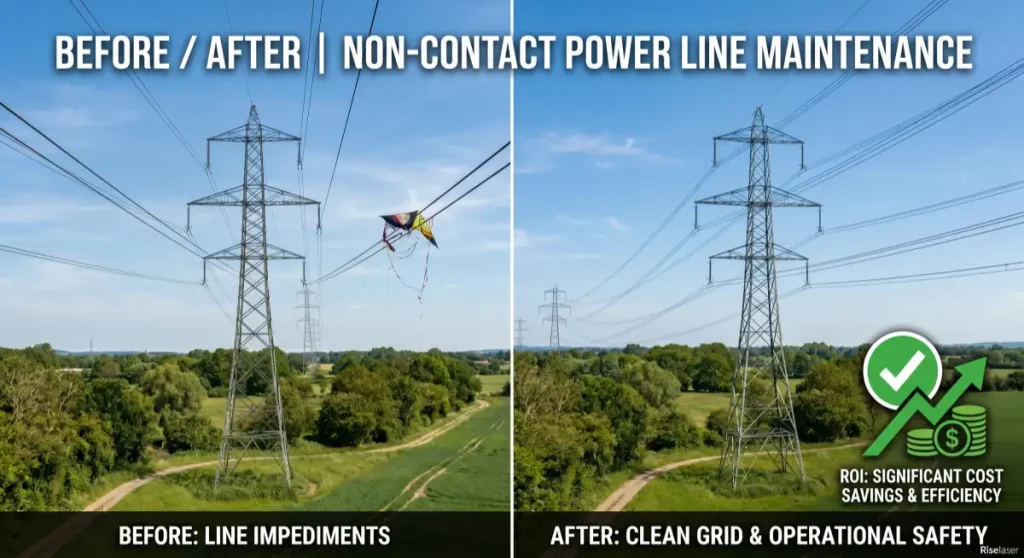
A laser obstacle removal machine for power line maintenance is a ground-based fiber laser system used to remotely clear kites, plastic film, balloons, bird nests, vines, and selected tree branches from overhead power lines. It helps utility crews remove suitable non-metallic obstacles without direct contact with the line.
For power grid maintenance teams, the main value is simple: faster response, less manual climbing, fewer bucket truck limitations, and reduced need for outage-based removal in suitable cases.
However, a laser obstacle remover is not a universal tool for every object. The right solution depends on the obstacle material, working distance, laser power, target position, weather, and field safety controls.
Need to evaluate a real power line obstacle?
Send us your obstacle type, estimated working distance, voltage environment, and site photos or videos. Our engineers can help check whether a 500W, 1000W, or higher-power portable fiber laser obstacle remover is suitable for your application.
Quick Answer: What Is a Laser Obstacle Removal Machine?
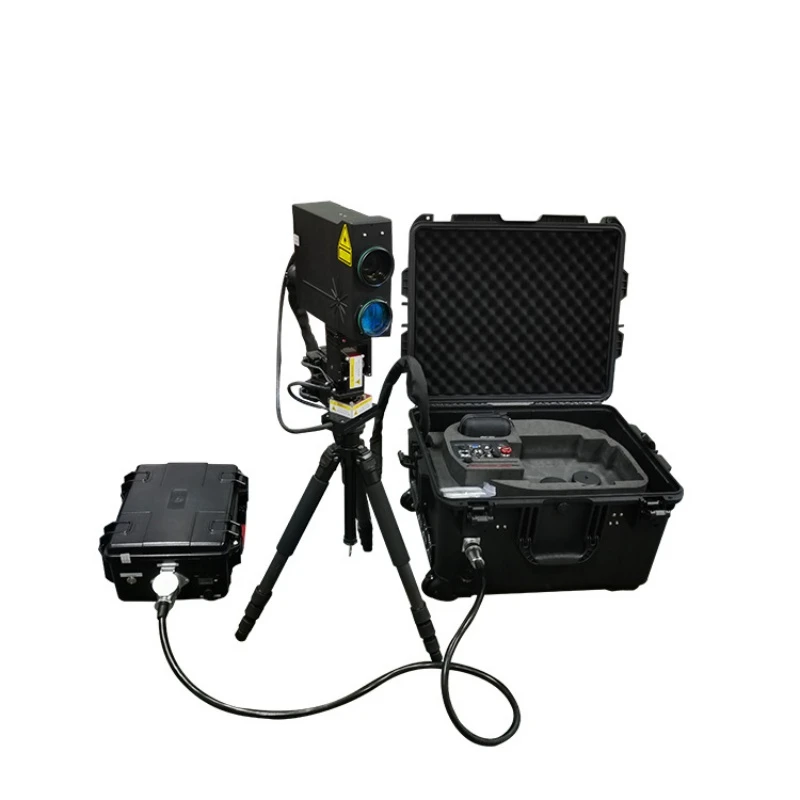
A laser obstacle removal machine is a portable or vehicle-mounted fiber laser device used to remove foreign objects from overhead power lines. It focuses laser energy on the obstacle until the material burns, melts, weakens, or separates from the line.
It is commonly used for:
- kites and kite strings
- plastic bags and plastic film
- balloons
- bird nests
- vines
- light debris
- small or medium tree branches
This type of machine is mainly suitable for many non-metallic foreign objects. It should be operated by trained personnel with a clear line of sight, controlled work area, and proper laser safety procedures.
Why Foreign Object Removal Matters in Power Line Maintenance
Foreign objects on overhead power lines can create serious maintenance problems. A small kite, plastic sheet, or branch may seem harmless at first. But under wind, rain, or electrical stress, it can increase the risk of flashover, short circuit, outage, or fire.
Common power line obstacle problems include:
- kites caught on conductors
- plastic film wrapped around overhead lines
- balloons near energized equipment
- bird nests near insulators or crossarms
- vines growing around line hardware
- branches close to transmission or distribution lines
- storm debris in remote areas
Vegetation is also a known reliability concern for transmission systems. The North American Electric Reliability Corporation has published annual reports on vegetation-related transmission outages, showing why utilities take line clearance and right-of-way maintenance seriously. You can review the official report here: NERC Vegetation-Related Transmission Outages Annual Report.
Traditional removal methods can be slow or difficult. Crews may need climbing teams, insulated rods, bucket trucks, helicopters, or planned outages. In remote terrain, narrow roads, farmland, or mountain areas, access can become the biggest problem.
A laser obstacle remover for power lines gives maintenance teams another option. In suitable cases, it allows crews to clear the object remotely from the ground without touching the line directly.
Field Example
A plastic film is caught on an overhead line after strong wind. A bucket truck cannot reach the area because the line crosses farmland. If the film is visible and the area can be controlled, a portable laser obstacle removal machine may allow the crew to clear the film from a distance instead of waiting for special access equipment.

Who Should Use a Laser Obstacle Removal Machine?
A laser obstacle removal machine is mainly used by utility companies, transmission line maintenance teams, distribution grid operators, emergency repair crews, and power infrastructure contractors.
It is most useful for teams that often deal with kites, plastic film, bird nests, vines, or small branches on overhead lines, especially in areas where bucket trucks, climbing crews, or manual access are difficult.
| Buyer Type | Common Problem | Why Laser Removal May Help |
|---|---|---|
| Utility maintenance team | Repeated foreign objects on overhead lines | Remote removal may reduce response time |
| Transmission line contractor | Hard-to-access line corridors | Portable or vehicle-mounted operation can improve field access |
| Emergency repair crew | Storm debris, kites, plastic film, branches | Fast deployment for visible, suitable targets |
| Power grid equipment buyer | Need safer and more efficient maintenance tools | Can support non-contact obstacle removal in suitable cases |
How a Fiber Laser Obstacle Remover Works
A fiber laser obstacle remover works by aiming laser energy at the foreign object, not the power line itself.
The target material absorbs the laser energy. As the temperature rises, the object may burn, melt, vaporize, carbonize, or weaken. Once the object loses strength, it can break apart or fall away from the line.
For tree branches, performance depends on branch thickness, moisture content, wood density, laser power, working distance, beam stability, and exposure time. A study published in Frontiers in Physics examined laser ablation of tree obstacles in transmission lines and found that laser power, clearance distance, tree density, and moisture content affect the removal process. You can read the study here: laser ablation characteristics of tree obstacles in transmission lines.
In simple terms, a dry, thin branch is usually easier to remove than a thick, wet, green branch. This is why laser power selection should be based on real field conditions, not wattage alone.
Main Components of a Laser Obstacle Removal Machine
| Component | Function | Why It Matters |
|---|---|---|
| Fiber laser source | Provides laser energy | Affects removal speed and target suitability |
| Aiming camera or telescope | Helps locate the object | Improves accuracy at long distance |
| Rangefinder | Measures working distance | Helps set proper operation parameters |
| Gimbal, tripod, or vehicle mount | Stabilizes the beam | Important for safe and accurate targeting |
| Control system | Adjusts power and operation mode | Helps match different materials and distances |
| Power supply | Provides field power | Affects mobility and deployment time |
| Safety controls | Helps reduce operation risk | Essential for high-power laser work |
What Obstacles Can a Laser Obstacle Removal Machine Remove?
A laser obstacle removal machine for power lines works best on visible, non-metallic objects with clear line of sight. It is especially useful for light and medium debris that is hard to remove manually.
Kites and Kite Strings
Kites are common near residential areas, schools, parks, and open fields. Many kite strings are lightweight and non-metallic, making them suitable for laser cutting or weakening.
However, metallic kite wire or unknown string material should be assessed before operation.
Plastic Bags, Plastic Film, and Agricultural Film
Plastic film is one of the strongest use cases for laser obstacle removal. It is common after storms, wind, or agricultural activity. Thin plastic can often be cleared efficiently if the operator has a stable view of the target.
The main challenge is movement. If the plastic is swinging heavily in the wind, accurate aiming becomes harder.
Balloons and Fabric Debris
Balloons, fabric banners, and light debris may also be suitable. The operator should consider the material, target position, wind, and fire risk before using the laser.
Bird Nests and Light Debris
Bird nests require more caution. They are often located near crossarms, insulators, or other line hardware. Local wildlife rules may also apply.
A laser should only be used after checking the site condition, line hardware, and environmental risk.
Tree Branches and Vines
A laser obstacle remover can remove selected branches and vines, but it is not a full replacement for vegetation management.
It is better for:
- thin branches
- dry branches
- small hanging branches
- vines near the line
- emergency branch removal where access is difficult
It may not be suitable for:
- thick branches
- wet or green branches
- large limbs
- branches very close to sensitive hardware
- full right-of-way vegetation clearing
Obstacle Suitability Table
| Obstacle Type | Suitability | Notes |
|---|---|---|
| Kite string | High | Good target if non-metallic and visible |
| Plastic film | High | Strong use case with clear line of sight |
| Plastic bag | High | Often suitable for remote removal |
| Balloon | Medium to high | Depends on material and position |
| Fabric banner | Medium | Fire and fume risk should be assessed |
| Bird nest | Medium | Requires hardware and wildlife assessment |
| Vine | Medium | Depends on thickness and moisture |
| Dry small branch | Medium to high | Easier than green or wet branches |
| Green branch | Medium | Moisture can slow removal |
| Thick branch | Low to medium | May require higher power or mechanical cutting |
| Metal wire | Not recommended without assessment | Higher risk and different material behavior |
| Object near insulator | Needs assessment | Sensitive area; avoid careless operation |
Example Use Cases for Power Line Obstacle Removal
Case 1: Plastic Film on a Distribution Line
A distribution line crosses farmland, and plastic film becomes tangled on the conductor after strong wind. The line is visible, but vehicle access is limited. A portable laser obstacle removal machine may help the crew clear the film from a controlled distance if the site is safe and the object is not too close to sensitive hardware.
Case 2: Kite String on an Overhead Line
A kite string is caught on an overhead line near a residential area. The crew must first control public access and confirm the working distance. If the string is non-metallic and clearly visible, a laser obstacle remover may cut or weaken the string without direct line contact.
Case 3: Small Branch Near a Transmission Line
A small dry branch is hanging near a transmission line in a hard-to-access area. If the branch is thin enough, the working distance is suitable, and the fire risk is controlled, a laser system may remove the branch remotely. If the branch is thick, wet, or too close to hardware, traditional cutting may be safer.
Laser Obstacle Removal vs Traditional Power Line Maintenance Methods
A laser obstacle remover does not replace every maintenance method. It is best viewed as a specialized tool for remote, non-contact removal.
The right choice depends on access, safety, obstacle type, urgency, and cost.
| Method | Best For | Limitations | Outage Needed? | Safety / Cost Notes |
|---|---|---|---|---|
| Manual climbing | Complex close-up work | Higher worker exposure | Sometimes | Labor-intensive and site-dependent |
| Insulated rod | Simple nearby objects | Limited reach and control | Sometimes | Lower equipment cost but limited use |
| Bucket truck | Accessible roadside lines | Needs road access and setup space | Sometimes | Good control, but not ideal in remote areas |
| Drone | Inspection and light tasks | Limited removal power | Usually no | Strong for inspection, not all removal |
| Helicopter | Remote transmission corridors | Very high cost | Sometimes | Fast but expensive and weather-dependent |
| Laser obstacle remover | Remote removal of suitable objects | Needs line of sight and safety zone | Can reduce outage need in suitable cases | Strong for debris, plastic film, kites, and selected branches |
The better question is not whether laser removal is always better. The better question is: Which method removes this specific object with the lowest practical risk, shortest response time, and lowest total cost?
Compare your current removal method with a laser solution.
If your team often uses bucket trucks, climbing crews, or outage-based removal for repeated foreign-object problems, send your typical obstacle types and working distance for technical review.
Key Benefits of Laser Obstacle Removal for Utility Maintenance Teams
Remote, Non-Contact Operation
Crews can operate from the ground or a vehicle-mounted platform. This reduces the need to touch the line directly and may lower worker exposure in difficult field conditions.
Faster Emergency Response
Foreign objects often appear after storms, strong wind, festivals, kite flying, or agricultural activity. A portable laser obstacle remover can be deployed quickly when the target is visible and the work area can be controlled.
Reduced Need for Power Shutdowns in Suitable Cases
One major benefit is that laser removal may reduce the need for planned outages in some situations.
This should be stated carefully. A laser obstacle removal machine does not guarantee live-line work in every case. Utility rules, local regulations, object position, and site risk assessment still decide the final method.
Better Access in Difficult Terrain
Some power lines cross farmland, rivers, mountains, forests, and narrow roads. In these cases, large vehicles may not reach the site easily.
A portable or vehicle-mounted laser system can help crews remove selected obstacles without getting directly under the line.
Safety Precautions for High-Power Laser Obstacle Removal
Safety is one of the most important parts of laser obstacle removal. A laser obstacle removal machine is a high-power industrial laser system. It should not be described as risk-free.
OSHA notes that Class 4 lasers can create eye, skin, and fire hazards from direct or reflected beams. You can review OSHA’s laser hazard guidance here: OSHA Laser Hazards.
High-Power Laser Safety
Before operation, the team should define a laser safety zone, control public access, confirm the beam direction, prepare fire prevention measures, and assign trained personnel to operate and monitor the system.
Key controls include:
- laser safety zone
- operator training
- protective eyewear
- warning signs
- public access control
- emergency stop
- fire prevention
- reflected beam risk control
- crew communication
Will the Laser Damage Conductors or Insulators?
The laser should be aimed at the foreign object, not at the conductor, insulator, tower, transformer, or other line hardware. In normal operation, the goal is to cut or weaken the obstacle while avoiding direct exposure to power line components.
If the object is wrapped around a conductor or located near an insulator, the site should be reviewed before operation. In some cases, another removal method may be safer.
Environmental Limits
Field conditions can affect laser obstacle removal. Poor conditions include:
- heavy rain
- fog
- dust
- strong wind
- poor visibility
- dry vegetation near the target
- unstable ground
- crowded public areas
If the operator cannot see and control the target clearly, the job should be delayed or handled by another method.
When Not to Use a Laser Obstacle Remover
Do not use a laser obstacle remover blindly in these situations:
- metallic object without technical assessment
- object too close to critical hardware
- unknown material
- thick branch that requires mechanical cutting
- strong wind moving the target
- no clear line of sight
- unsafe public area
- dry vegetation with high fire risk
- untrained operator
Risk and Control Table
| Risk Factor | Why It Matters | Recommended Control |
|---|---|---|
| Direct or reflected laser exposure | Can injure eyes or skin | Safety zone, PPE, trained operator |
| Dry vegetation | Fire risk | Fire watch and site assessment |
| Object near insulator | Possible hardware risk | Engineer review before operation |
| Strong wind | Target moves during aiming | Delay operation or reassess |
| Poor visibility | Lower aiming accuracy | Operate only with clear view |
| Public access | Bystander safety risk | Secure exclusion area |
| Unknown material | Unpredictable reaction | Identify material first if possible |
How to Choose a Laser Obstacle Removal Machine for Power Lines
A good purchase decision starts with field requirements, not just laser power.
1. Laser Power
Common power options include 500W, 1000W, and higher-power systems. Higher power may improve removal speed or help with tougher targets, but it also increases cost and safety requirements.
Choose laser power based on:
- obstacle type
- object thickness
- working distance
- expected removal speed
- safety rules
- field use frequency
- portability needs
2. Working Distance
Working distance is model-dependent. A system that works well for short-range distribution lines may not be ideal for long-distance transmission line work.
Before buying, define your typical distance:
- 30–80 m: closer distribution work
- 80–150 m: many field maintenance tasks
- 150 m+: longer-distance transmission scenarios
The actual range depends on machine configuration, visibility, beam stability, target material, and operator control.
3. Targeting and Monitoring System
For power line maintenance, aiming is just as important as power.
Look for:
- high-zoom camera
- visible aiming support
- rangefinder
- stable gimbal or tripod
- remote control
- real-time image monitoring
- night operation support if needed
- data recording if your team needs traceability
4. Portability and Deployment
A portable unit is useful for teams that move between sites. A vehicle-mounted system may fit large utilities or contractors that handle frequent emergency calls.
Ask:
- Can one or two people deploy it?
- Does it need a generator?
- Can it work on rough ground?
- How long does setup take?
- How is the machine transported?
- Is vehicle-mounted operation required?
5. Safety Features
Important safety features include:
- emergency stop
- key switch or authorization control
- warning light
- controlled firing mode
- beam protection design
- tilt or fall protection
- access control
- operator training documents
- operation SOP
6. Supplier Support
For this type of equipment, supplier support matters as much as the hardware.
Check whether the supplier can provide:
- operation training
- demo video
- technical documents
- spare parts
- remote support
- warranty
- application testing
- power selection guidance
- laser safety guidance
Buyer Checklist
| Information to Provide | Example |
|---|---|
| Obstacle type | Kite string, plastic film, branch, nest, balloon, vine |
| Target material | Plastic, fabric, wood, nest material, metal, unknown |
| Working distance | 80 m, 150 m, 300 m |
| Target position | On conductor, near insulator, on branch, near tower hardware |
| Field condition | Urban, rural, roadside, mountain area, farmland |
| Required setup | Portable tripod, vehicle-mounted, generator-powered |
| Proof material | Photos, videos, site distance, line environment |
500W vs 1000W Laser Obstacle Removal Machine: How to Choose
Many buyers compare 500W and 1000W laser obstacle removal machines first.
For most buyers, 500W is usually considered for light foreign objects and shorter-distance work, while 1000W is usually considered when the team needs faster removal, longer working distance, or better performance on harder targets.
| Power Level | Better For | Limitations | Buyer Fit |
|---|---|---|---|
| 500W | Kites, plastic film, light debris, small dry branches | Slower on thicker, wet, or dense targets | Entry-level utility maintenance or occasional use |
| 1000W | Faster removal, tougher debris, selected branches, longer distance | Higher cost and stricter safety control | Frequent field response teams |
| Higher power | Heavy-duty or specialized use | Higher budget, stricter control, more training | Large utilities or vehicle-mounted setups |
Do not choose power by wattage alone. A lower-power machine with stable aiming may perform better than a higher-power machine that is difficult to control in the field.
Best selection rule: Match laser power to the real obstacle, real distance, and real safety environment.
Not sure whether 500W or 1000W is enough?
Send your obstacle type, estimated distance, and site photos. We can help check the best power range for your application.
ROI: When Does a Laser Obstacle Removal Machine Make Business Sense?
The ROI of a laser obstacle removal machine for power line maintenance is not only about machine price.
For utility teams, the real cost of obstacle removal may include:
- crew dispatch
- bucket truck setup
- outage planning
- traffic control
- climbing risk
- helicopter use
- delayed response
- repeated site visits
- emergency repair cost
- customer outage impact
A laser system makes the most sense when a team often deals with visible, non-metallic obstacles that are difficult, slow, or costly to remove by traditional methods.
When the ROI Is Strongest
The ROI is usually stronger when a utility team faces repeated foreign-object problems, works in difficult-access areas, or often needs bucket trucks, climbing crews, or planned outages for small obstacles. If the machine can reduce even part of these repeated response costs, the investment becomes easier to justify.
Cost Factors It May Reduce
| ROI Factor | How Laser Removal May Help |
|---|---|
| Outage management | May reduce shutdown need in suitable cases |
| Labor efficiency | Smaller crew may handle some removal tasks |
| Emergency response | Faster deployment for common debris |
| Remote access | Less dependence on bucket trucks or road access |
| Safety management | Reduces direct contact with live-line areas |
| Equipment dispatch | May reduce use of large vehicles or helicopters |
Costs Buyers Still Need to Consider
A complete budget should include:
- machine price
- laser power level
- targeting system
- tripod or vehicle mount
- generator or battery system
- operator training
- PPE
- safety-zone control
- spare parts
- maintenance
- warranty
- shipping and import cost
- local compliance requirements
For procurement teams, the best question is not only: “How much is the machine?”
A better question is: “How many high-risk or high-cost obstacle removal jobs can this machine replace or simplify each year?”
For more price-related buying factors, you may also review our guide: How Much Does a Laser Obstacle Remover Cost?
Application Checklist Before Buying
Before requesting a quote, collect the following information.
Site and Obstacle Details
- What object needs to be removed?
- Is it plastic, fabric, wood, nest material, metal, or unknown?
- Is it dry or wet?
- Is it fixed or moving in the wind?
- Is it wrapped around the line?
- Is it near an insulator or other hardware?
- What is the estimated working distance?
- Is there a clear line of sight?
Field Operation Details
- Is the area urban, rural, mountainous, or roadside?
- Can the crew secure a safety zone?
- Is there vehicle access?
- Is portable operation required?
- Is a generator available?
- Will the machine be used during daytime, nighttime, or both?
- What local laser safety rules apply?
Buying Details
- How often will the team use the machine?
- What power range are you considering?
- Do you need training?
- Do you need spare parts support?
- Do you need test videos before purchase?
- Do you need a portable or vehicle-mounted configuration?
Need help choosing the right configuration?
Send the obstacle type, estimated working distance, voltage environment, and site photos or videos. Our engineers can recommend the right laser obstacle removal machine for your power line maintenance work.
FAQ About Laser Obstacle Removal Machines
What is a laser obstacle removal machine?
A laser obstacle removal machine is a fiber laser system used to remotely clear foreign objects from overhead power lines. It focuses laser energy on the object until it burns, melts, weakens, or falls away.
How does a laser obstacle remover work?
It aims a controlled fiber laser beam at the obstacle. The material absorbs laser energy and heats up. Depending on the material, it may burn, melt, carbonize, weaken, or separate from the line.
What objects can a laser obstacle removal machine remove?
It is commonly used for kites, kite strings, plastic bags, plastic film, balloons, light debris, bird nests, vines, and selected tree branches.
Can a laser obstacle remover be used on live power lines?
It can support live-line maintenance in suitable cases, but operation must follow utility safety rules, local regulations, and proper laser safety procedures. The site should always be assessed before operation.
Will the laser damage conductors or insulators?
The operator must aim at the obstacle, not at the conductor or insulator. Objects close to line hardware need special assessment. A proper safety procedure is required to reduce risk.
Can it remove tree branches from power lines?
Yes, it can remove selected branches, especially thinner or drier branches. Performance depends on branch thickness, moisture, density, working distance, laser power, and beam stability.
Conclusion: Is Laser Obstacle Removal Right for Your Power Line Maintenance Team?
A laser obstacle removal machine is a practical tool for utility companies and power line maintenance contractors that need to remove foreign objects from overhead lines remotely.
It is especially useful for kites, plastic film, balloons, light debris, vines, and selected branches. Its main benefits are non-contact operation, faster field response, better access in difficult terrain, and reduced need for outage-based work in suitable cases.
But it is not a universal replacement for all maintenance methods. It requires clear line of sight, trained operators, proper safety controls, and careful target assessment.
The best machine should be chosen based on:
- obstacle type
- working distance
- object position
- laser power
- safety requirements
- portability needs
- supplier support
Need help choosing a laser obstacle removal machine for power line maintenance?
Send your obstacle type, estimated working distance, voltage environment, and site photos or videos. Riselaser engineers can help recommend the right laser power and configuration for your field application.