
Tube laser cutting helps fabricators reduce cycle time and scrap when processing steel pipes and metal profiles. Traditional fabrication methods—like band sawing, drilling, and milling—often create bottlenecks in modern manufacturing. They require multiple setups, frequent tool changes, and secondary deburring.
Metal tube laser cutting is the solution for fabricators demanding speed and precision. By utilizing high-power fiber laser sources and advanced CNC control, this technology consolidates cutting, drilling, and etching into a single, automated step.
Tube Laser Cutting: Quick Answer
Tube laser cutting uses a CNC-controlled fiber laser to cut holes, slots, and profiles on round, square, or special tubes in a single setup. Compared with sawing + drilling, it reduces changeovers, improves fit-up accuracy for welding, and lowers scrap through nesting.
Key takeaways:
- Cuts, drills (pierces), and marks in one automated cycle
- Cleaner edges with less deburring for most tube jobs
- Better repeatability for weld-fit frames and structures
- Lower scrap through tube nesting and common-line strategies
- 2-axis is enough for straight cuts; 5-axis enables bevels and weld prep
- Assist gas choice (O₂ / N₂ / air) changes speed, edge color, and cost
In this guide, we examine the technical advantages of tube laser cutting, compare it to mechanical methods, and provide the data you need to decide if it’s the right upgrade for your production line.
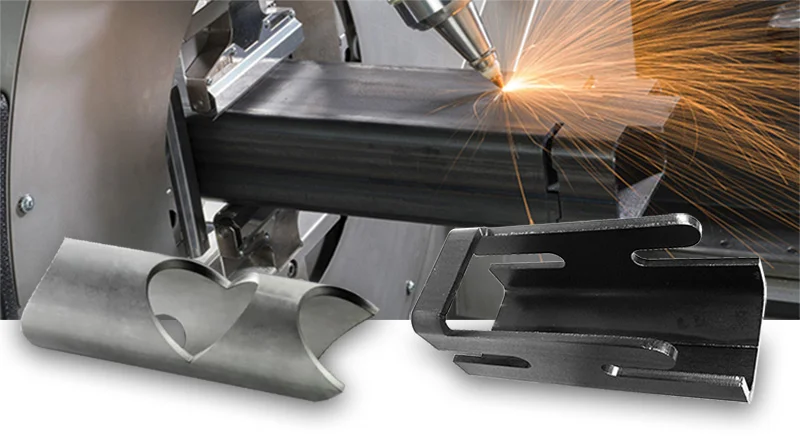
How Does Laser Tube Cutting Work?
Laser tube cutting is a thermal separation process that utilizes a focused beam of high-density energy to melt and vaporize material.
The Core Physics
Modern systems predominantly use fiber laser technology. The beam is generated via active fiber and guided to the cutting head, where a lens focuses it to a diameter often smaller than 0.15mm.
- Photothermal Ablation: The intense energy heats the metal (e.g., carbon steel or aluminum) instantly.
- Assist Gas Dynamics: High-pressure gases (Oxygen, Nitrogen, or Compressed Air) flush the molten material from the kerf (cut width).
- Nitrogen/Air: Used for laser cut stainless steel tube applications to achieve an oxidation-free edge.
- Oxygen: Provides an exothermic reaction to boost speed when laser cutting steel tube (carbon steel) above 4mm.
Control and Axes
The capability of a tube laser cutting system depends on the number of controlled axes. In general, 2-axis machines cover most standard cuts and holes, while 5-axis heads add tilt motion for bevels, chamfers, and weld-prep geometry.
Tube Laser Cutting Process (Step-by-Step)
- Load & clamp the tube
The chuck centers the tube and locks it to prevent slip during rotation.
- Measure and align (auto-calibration)
The machine checks tube diameter, length, and straightness to keep holes and cuts in the correct position.
- Import the part program
Most shops import CAD (DXF/STEP) into tube software and apply nesting to reduce leftover scrap.
- Pierce and cut features
The laser pierces, cuts profiles, and creates holes/slots in one cycle while the tube rotates.
- Optional marking/etching
Part IDs, bend lines, or assembly marks can be added to reduce downstream mistakes.
- Unload and sort parts
Finished parts are separated by length/batch, ready for welding or bending.
2-Axis vs 5-Axis Tube Laser Cutting (When Do You Need Bevels?)
Most tube jobs can be done with a standard 2-axis tube laser, but a 5-axis head becomes essential when you need 3D cuts or weld-prep geometry.
Choose a 2-axis tube laser if you mainly need:
- Straight end cuts, miters, and basic profiles
- Holes, slots, and tabs on round or square tubes
- High throughput for repeatable parts with minimal setup complexity
Choose a 5-axis tube laser if you need:
- Bevels/chamfers for weld preparation (typical tilt range up to ±45°)
- 3D coping cuts for tight tube-to-tube fit-up (frames, structures, interlocks)
- Better edge contact on complex joints to reduce gap and rework before welding
Rule of thumb: If your drawings frequently call for bevel angles, chamfers, or “weld prep” notes, a 5-axis tube laser is usually worth it. If you mostly cut holes and straight profiles, 2-axis often delivers the best cost-per-part.
Steel Tube Laser Cutting: Gas Choice, Edge Quality, and Speed
Steel tube (and steel pipe) laser cutting results depend heavily on assist gas and wall thickness. Choose gas based on the edge-quality target and downstream steps (welding, coating, painting).
O₂ vs N₂ vs Air (quick decision)
- Oxygen (O₂): Fastest for carbon steel, especially thicker walls. Leaves an oxidized edge.
- Nitrogen (N₂): Best for stainless steel or when you need a bright, oxidation-free edge.
- Compressed air: Lower running cost and works for many mild-steel tube jobs, with more variation in edge color.
What changes the real cutting speed
- Wall thickness and piercing time
- Number of holes/slots and tight corners
- Tube diameter, clamping stability, and vibration
- Edge-quality requirement (clean edge vs maximum speed)
Tip: If your shop mainly cuts carbon-steel pipe and throughput matters most, O₂ is often the best choice. For stainless or appearance-critical parts, N₂ usually reduces finishing work.
5 Reasons to Switch to Laser Tube Processing
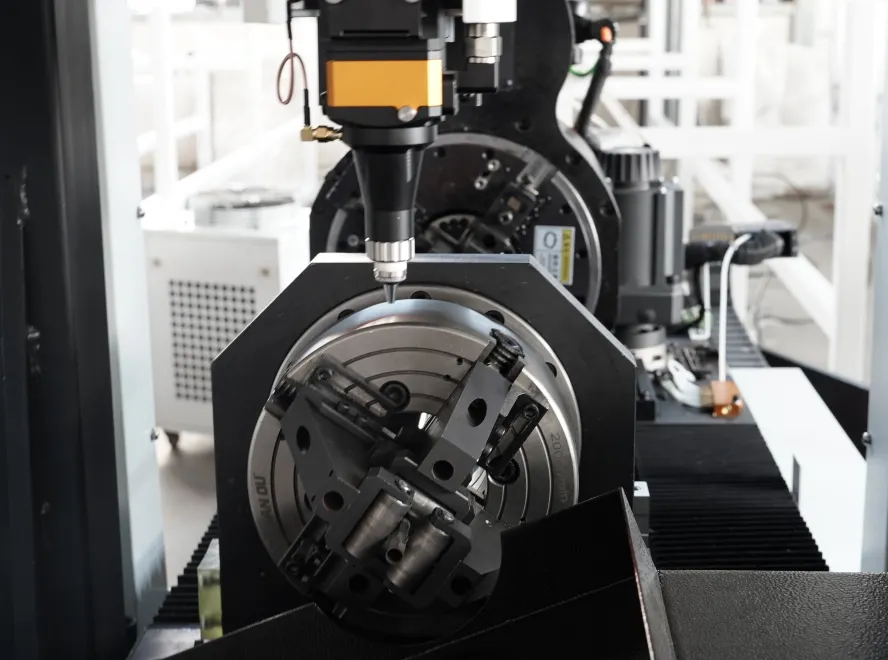
Why are fabricators replacing saws with lasers? Here is the technical breakdown.
1. Unmatched Precision and Repeatability
Mechanical saws suffer from blade drift and wear, leading to inconsistent lengths. Laser cutting of metal tubes offers non-contact processing.
- Tolerance: Standard fiber tube lasers achieve positioning accuracy of ±0.03mm and repeatability of ±0.01mm.
- Quality: Cuts meet ISO 9013 standards for thermal cutting quality. The heat-affected zone (HAZ) is minimal, preventing thermal distortion in thin-walled tubes.
2. Process Consolidation (The “Done-in-One” Philosophy)
A single tube laser cutting machine replaces a drill press, a band saw, a milling machine, and a deburring station.
- You can cut complex contours, bolt holes, and slot tabs in one continuous operation.
- This reduces work-in-progress (WIP) handling and floor space requirements by up to 50%.
3. Drastic Reduction in Material Waste
Using advanced nesting software (like CypNest or TubePro), parts are arranged on the raw stick to maximize yield.
- Common Line Cutting: The laser shares a cut line between two parts, effectively zeroing out the gap between components.
- Scrap Reduction: Users often see raw material savings of 15–20% compared to sawing.
4. Design Versatility
Whether you need square tube laser cutting, round pipes, or special profiles (D-shape, Oval, L-shape), the chuck system adapts instantly.
- Reflective Metals: Modern fiber sources handle aluminum profiles and brass without back-reflection damage, unlike older CO2 models.
- Complex Geometries: A 5 axis tube system can create coping cuts that allow tubes to mate perfectly for continuous tube laser welding downstream.
5. High-Speed Automation
For high-volume runs, manual loading is a bottleneck. Modern systems feature a laser bundling line for metal processing.
- Automatic Loading: An automatic bundle loader feeds tubes continuously.
- Throughput: High-acceleration drives (1.2G+) allow rapid movement between cut features.
Comparison: Laser vs. Traditional Methods
Bottom line: Tube laser cutting is usually the best choice when you need holes/slots + profiles and want parts ready for welding with minimal secondary work. Mechanical sawing is still useful for fast length cutting in low-mix jobs. Plasma can be cost-effective on very thick sections, but it typically requires more cleanup and has a larger heat-affected zone.
| Feature | Laser Tube Cutting | Sawing + Drilling | Plasma Cutting |
| Edge Quality | Burr-free, smooth finish (Ra < 6.3) | Burr-heavy, requires deburring | Dross present, large HAZ |
| Tool Wear | None (Non-contact) | High (Blade sharpening) | Medium (Consumables) |
| Flexibility | High (Cut any shape/hole) | Low (Straight cuts only) | Medium |
| Speed | Extremely fast on <10mm walls | Fast for bundling, slow for shaping | Fast on thick walls (>20mm) |
| Secondary Steps | Minimal (often weld-ready) | Deburring + drilling/slotting + layout | Grinding/deburring + fit-up correction |
Best For
- Laser Tube Cutting: High-mix production, frames/structures, fit-up critical parts
- Sawing + Drilling: Simple length cuts, low feature density
- Plasma Cutting: Thick wall sections where edge finish is less critical
Not sure if laser cutting fits your material? See the results before you buy. Request a Free Sample Cut. Let us process your specific metal tube and send you the video and edge-quality report.
Machine Selection Guide: Matching Specs to Needs
When evaluating a metal tube laser, consider these technical parameters.
1. Laser Source Power
The power determines your maximum wall thickness and cutting speed.
| Laser Power | Carbon Steel Max | Stainless Steel Max | Aluminum Max | Recommended For |
| 1.5kW – 3kW | 12mm – 20mm | 5mm – 8mm | 4mm – 6mm | Furniture, Fitness Equipment, Exhausts |
| 6kW | 25mm | 14mm | 12mm | Structural Steel, Ag Machinery |
| 12kW+ | 30mm+ | 20mm+ | 20mm+ | Heavy Industry, Construction |
2. Chuck Size and Type
- Pneumatic Chucks: Standard for fast clamping.
- Stroke: Ensure the chuck can handle your full diameter range (e.g., 20mm to 220mm) without manual jaw changes to minimize downtime.
3. Automation Level
For “lights-out” manufacturing, look for laser automatic bundling for tube processing options. These systems can load raw sticks (up to 3 tons) and unload finished parts automatically, sorting them by length.
Applications of Laser Tube Technology
Understanding tube laser cutting requires looking at industry-specific use cases:
- Automotive: High-strength steel (HSS) components for chassis and roll cages. Laser cut tubes for metal bumpers require precise coping for robotic welding.
- Furniture: A metal tube laser cutter is essential for creating aesthetic joints in office furniture, eliminating visible welds.
- Construction: Heavy-duty structural columns. Laser cutting steel tube beams ensures bolt holes align perfectly on-site, reducing assembly labor.
- Restoration: Sometimes coupled with a steel tube laser cleaner, laser tech helps in both fabricating new parts and restoring old metal surfaces by removing rust and oxides before welding.
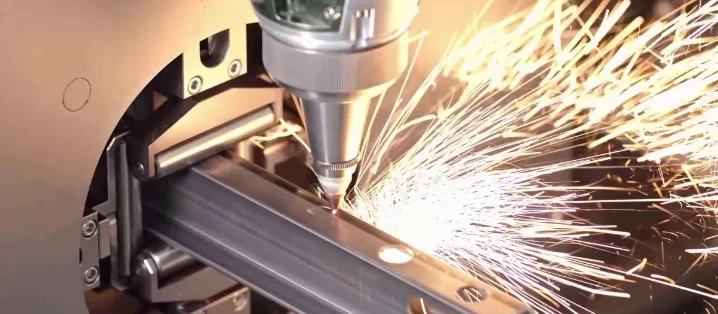
Safety and Compliance
Implementing a laser tube processing line requires adherence to laser cutting safety standards.
- Enclosures: Prefer fully enclosed machines (Class 1 Safety) with laser-safe glass (OD5+ rating) to protect operators from scattered radiation.
- Fume Extraction: Cutting generates metal dust. High-efficiency fume extractors are mandatory to maintain air quality in the shop.
Conclusion: Future-Proofing Your Fabrication
Laser tube cutting for metal is no longer a luxury—it is a competitive necessity. Whether you are doing laser cutting of tubes for delicate medical devices or heavy agricultural machinery, the ROI is driven by speed, precision, and the elimination of secondary processes.
At Riselaser, we specialize in helping fabricators optimize their production lines. From entry-level 2-axis machines to high-power laser automatic bundling for metal processing systems, we provide the expertise to match the machine to your material.
Ready to calculate your cost-per-part savings? Contact Riselaser’s Engineering Team to request a cycle time analysis or a free sample cut on your specific material.
FAQs
Tube laser cutting uses a CNC-controlled fiber laser to cut profiles, holes, and slots on round, square, or shaped tubes in a single setup, often reducing drilling and deburring work.
A typical tube laser cutting process includes clamping the tube, auto-alignment, importing the CAD program, piercing/cutting features while the tube rotates, optional marking, and unloading/sorting parts.
Choose 2-axis for straight cuts, holes, and standard profiles. Choose a 5-axis tube laser when you need bevels, chamfers, or weld-prep geometry for tight fit-up joints.
Oxygen is fastest for carbon steel (often with an oxidized edge). Nitrogen is best for stainless steel or bright, oxidation-free edges. Compressed air can be a lower-cost compromise for many mild-steel jobs.
Most systems can cut round and square tubes, and many also support rectangular, oval, D-shaped, and other profiles as long as the chuck and support system can hold the geometry securely.
Wall thickness, piercing time, and feature density (many small holes/slots) often impact cycle time more than straight-line cutting speed alone.