
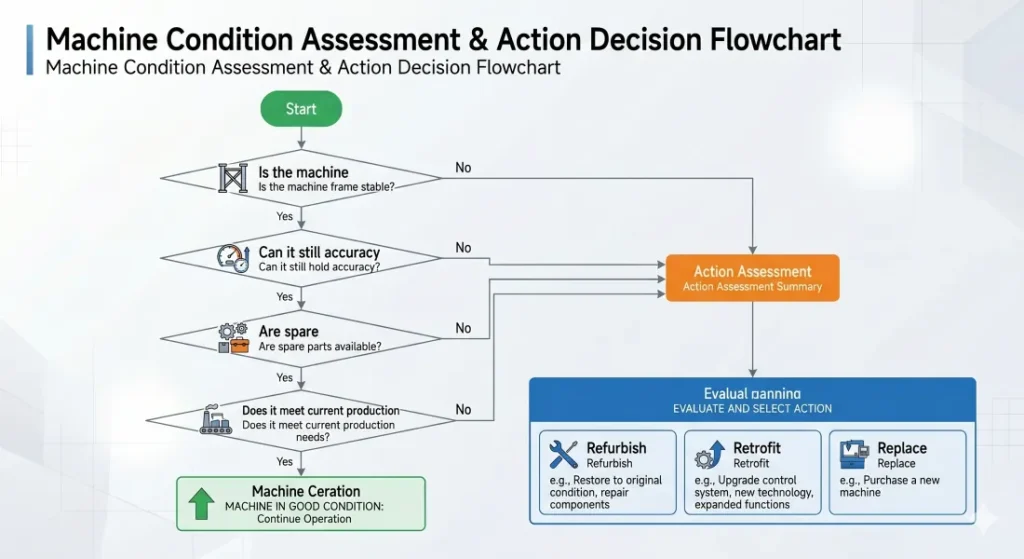
Yes, you should refurbish your old laser cutting machine if the machine frame is still stable, the motion system can still hold accuracy, and the main problems come from replaceable parts. These parts may include the laser source, cutting head, chiller, CNC controller, optics, guide rails, or electrical components.
But refurbishment is not always the best choice.
If your old laser cutting machine has frequent downtime, poor cutting accuracy, outdated safety systems, hard-to-find spare parts, or cannot meet your current production needs, replacing it with a new fiber laser cutting machine may deliver better long-term ROI.
The real question is not only: “Can this machine be repaired?”
The better question is: “After repair, will this machine still be accurate, safe, reliable, and profitable for the next few years?”
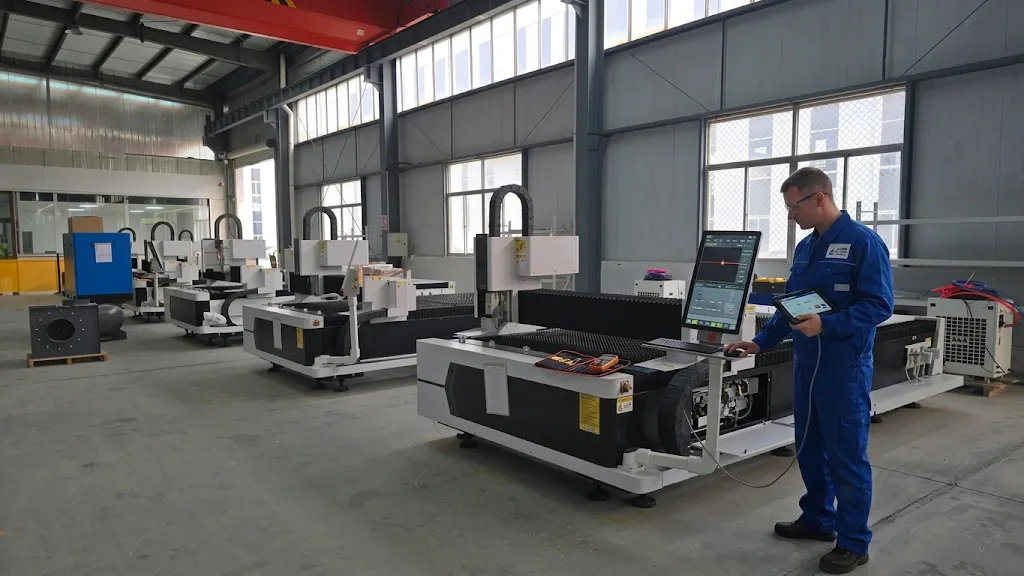
Quick Answer: Should You Refurbish Your Old Laser Cutting Machine?
You should refurbish an old laser cutting machine if the frame is stable, the motion system is accurate, spare parts are available, and the main problems are replaceable components. You should replace it if the machine has frequent downtime, unstable cutting quality, weak safety protection, outdated software, or poor long-term support.
Laser Cutting Machine Refurbishment: Quick Decision Table
Laser cutting machine refurbishment is worth considering when the machine body is still strong and the main problems are limited to replaceable components.
It is usually not worth refurbishing when the machine has structural deformation, poor repeatability, repeated breakdowns, outdated safety protection, or no reliable spare parts support.
| Machine Condition | Best Decision |
|---|---|
| Strong frame, minor component issues | Refurbish |
| Good frame, outdated controller or laser source | Retrofit |
| Weak accuracy, frequent downtime, obsolete parts | Replace |
| Old CO2 laser used for metal cutting | Compare retrofit vs new fiber laser |
| Higher production demand than before | Usually replace or upgrade |
In simple terms: refurbish if the structure is still good. Replace if the structure, safety, or production capacity is no longer reliable.
Need a Refurbish-or-Replace Recommendation?
Send your machine model, laser power, cutting materials, thickness range, and current problems. An engineer can help you compare refurbishment, retrofit, and new machine replacement options.
Repair vs Refurbish vs Retrofit vs Replace: What Is the Difference?
Many buyers use these words in the same way, but they mean different things. Understanding the difference helps you avoid spending money on the wrong solution.
| Option | What It Means | Best For |
|---|---|---|
| Repair | Fix one failed part | A single clear problem |
| Refurbishment | Restore worn or aging parts | An old but usable machine |
| Retrofit | Upgrade old technology | A strong machine body with outdated systems |
| Replacement | Buy a new machine | When the old machine is no longer cost-effective |
Repair
Repair means fixing one specific problem.
For example, if the chiller fails, a lens is damaged, or a sensor is not working, you replace or repair that part and keep using the machine.
Repair is suitable when the rest of the machine is still stable.
Refurbishment
Refurbishment is deeper than simple repair.
It may include replacing worn parts, cleaning and calibrating the machine, restoring cutting quality, checking the electrical system, replacing optics, repairing the cutting head, or replacing the laser source.
The goal is to bring the old laser cutting machine back to a stable working condition.
Retrofit
Retrofit means upgrading old technology while keeping the usable machine structure.
For example, you may keep the frame but upgrade the CNC controller, servo system, fiber laser source, cutting head, software, or chiller.
A retrofit makes sense when the old machine body is still strong, but the technology is limiting performance.
Replacement
Replacement means buying a new machine.
This is often the better choice when the old machine cannot cut accurately, spare parts are hard to find, downtime is too high, or the machine no longer matches your production needs.
When Is an Old Laser Cutting Machine Worth Refurbishing?
An old laser cutting machine may still be worth refurbishing if it has a strong mechanical base.
Machine age alone is not the most important factor. A well-maintained 10-year-old machine may still be usable, while a poorly maintained 5-year-old machine may already have serious problems.
1. The Machine Frame Is Still Stable
The frame is the foundation of the machine.
If the frame is still solid, level, and free from serious deformation, refurbishment may make sense.
A simple test is to cut a 200 mm × 200 mm square, then measure both diagonals. If the diagonals are close and the machine repeats the same result several times, the frame and motion system may still be usable.
If the diagonals are very different, or the same program gives different results each time, the problem may be structural. In that case, replacing parts may not solve the real issue.
2. The Motion System Can Still Hold Accuracy
Check whether the guide rails, rack, ball screws, servo motors, and transmission parts move smoothly.
Warning signs include:
- Vibration during cutting
- Abnormal noise
- Position errors
- Poor repeatability
- Uneven movement
- Inconsistent kerf width
- Parts not matching the drawing
If these problems can be corrected by cleaning, lubrication, calibration, or replacing worn parts, refurbishment may be enough.
If the gantry, machine bed, or frame is already deformed, replacement may be safer.
3. The Main Problems Are Replaceable Parts
Laser cutting machine refurbishment is most practical when the problems come from parts that can be replaced.
Common examples include:
- Weak or unstable laser source
- Damaged cutting head
- Old CNC controller
- Faulty chiller
- Dirty or damaged optics
- Worn nozzles
- Aging electrical parts
- Poor exhaust or fume extraction
For example, a 3015 metal laser cutting machine with a stable frame but an aging laser source and outdated controller may not need full replacement. A laser source and controller retrofit may restore useful performance.
But if the machine has frame deformation or cannot hold accuracy, component replacement will not fix the root problem.
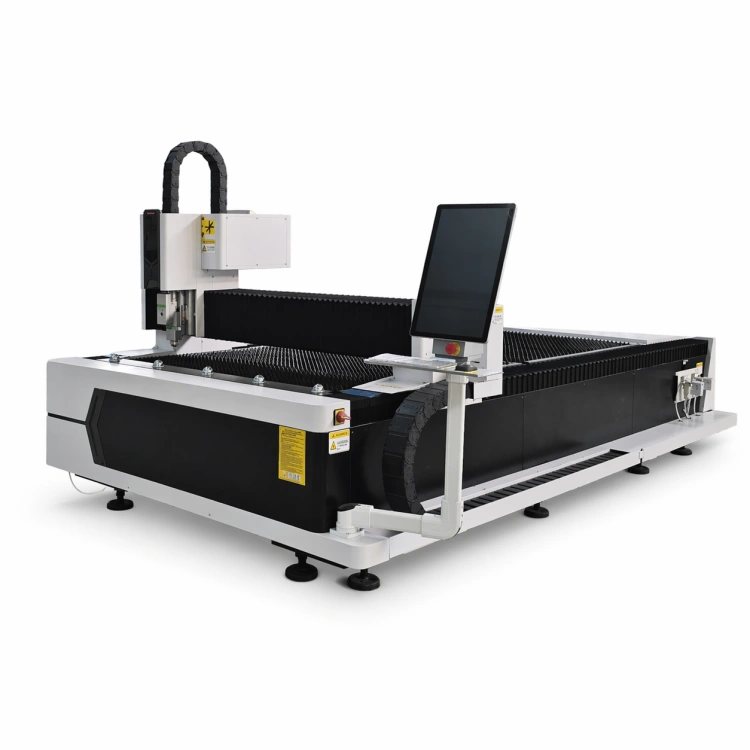
Before You Replace the Machine: Run These Practical Inspection Tests
Before deciding to refurbish or replace your old laser cutting machine, run a few simple checks. These tests help separate normal maintenance problems from deeper machine problems.
| Inspection Test | What It Shows | Warning Sign |
|---|---|---|
| 200 mm × 200 mm square cut | Frame and motion accuracy | Large diagonal difference |
| Repeat cutting test | Repeatability | Same program gives different results |
| Edge inspection | Cutting quality | Heavy burrs, rough edge, unstable kerf |
| Piercing test | Laser source, focus, and gas stability | Unstable piercing or frequent failure |
| Controller alarm history | Electrical, software, and motion problems | Repeated alarms from the same system |
| Chiller temperature check | Cooling stability | Temperature alarms during continuous cutting |
These checks do not replace a professional inspection, but they give you a clearer starting point before asking for repair, retrofit, or replacement advice.
When Should You Replace an Old Laser Cutting Machine Instead?
Sometimes refurbishment becomes a false economy. The repair cost looks lower at first, but the machine keeps losing money through downtime, scrap, poor cutting quality, and repeated service calls.
Replacement is usually better when the machine has problems that refurbishment cannot solve.
1. Downtime Is Becoming Too Frequent
Downtime is not just a maintenance issue. It is a production cost.
When a laser cutting machine stops, you may lose:
- Cutting capacity
- Operator time
- Material
- Delivery speed
- Customer trust
- Emergency repair money
For example, if an old laser cutting machine stops two days per month, and each lost production day costs the factory $800 in delayed output, the downtime cost is about $1,600 per month. Over one year, that is $19,200 before counting repair fees, scrap, labor, or lost orders.
In this case, a low-cost repair may not be cheap. The machine may continue to cost money every month.
2. Cutting Quality Is No Longer Stable
Poor cutting quality is one of the clearest signs that the machine needs serious evaluation.
Common problems include:
- More burrs than before
- Rough edge quality
- Inconsistent cutting width
- Poor hole quality
- Unstable piercing
- More rejected parts
- Parts not matching size requirements
Before replacing the machine, check basic causes first:
- Lens condition
- Nozzle condition
- Gas pressure
- Focus position
- Cutting parameters
- Material quality
If these checks do not solve the problem, the machine may have deeper mechanical, optical, or control issues.
3. Spare Parts and Software Support Are Disappearing
Old machines often become difficult to support.
This is a serious problem if:
- The controller is no longer supported
- The laser source brand no longer provides parts
- The cutting head is outdated
- The software cannot work with current nesting systems
- Electrical components are hard to replace
- Service engineers are not familiar with the system
When spare parts become hard to find, every breakdown becomes a bigger risk. At that point, replacement may provide better long-term stability than repeated repair.
4. The Machine No Longer Matches Your Production Needs
Your old machine may still work, but it may not be good enough for your current business.
Replacement may be better if you now need:
- Faster cutting speed
- Better edge quality
- Higher cutting power
- Thicker material capacity
- Better accuracy
- Lower cost per part
- Automation
- More stable daily production
A machine that was good enough five years ago may now limit your production growth.
Which Parts of a Laser Cutting Machine Can Be Refurbished or Upgraded?
A good decision should be component-specific. Do not judge the machine only by age.
Use this table as a first inspection guide.
| Component | Common Problem | Can It Be Refurbished or Upgraded? | When to Replace |
|---|---|---|---|
| Laser source | Weak power, alarms, unstable beam | Yes, if compatible | If repair cost is too high or parts are unavailable |
| Cutting head | Poor focus, lens damage, collision damage | Yes | If autofocus or precision is unreliable |
| CNC controller | Old software, slow operation, poor compatibility | Usually yes | If it cannot support modern cutting needs |
| Servo system | Vibration, position error, poor repeatability | Sometimes | If motion accuracy cannot be restored |
| Guide rails/rack | Wear, noise, rough movement | Sometimes | If wear is severe or alignment is poor |
| Chiller | Temperature alarms, unstable cooling | Yes | If it cannot protect the laser source |
| Optics | Dirty lens, burned lens, power loss | Yes | If damage keeps repeating |
| Electrical cabinet | Aging wiring, unstable signals | Yes | If electrical risk is high |
| Fume extraction | Smoke buildup, poor airflow | Yes | If safe extraction cannot be achieved |
Laser Source
The laser source is one of the most expensive parts of the machine.
If the source has unstable power, frequent alarms, or poor beam quality, compare the repair cost with replacement cost.
If the source is too old and parts are hard to find, replacing it may be smarter than repairing it again.
Cutting Head
The cutting head affects focus, piercing, edge quality, and cutting stability.
A damaged or outdated cutting head can cause poor edge quality, unstable focus, lens burning, nozzle collision, and inconsistent cutting results.
In many cases, upgrading the cutting head can improve performance without replacing the whole machine.
CNC Controller and Software
The controller can become the bottleneck even when the machine frame is still good.
An outdated controller may limit cutting speed, file handling, nesting compatibility, alarm recovery, operator efficiency, and automation options.
If the controller is the main limitation, a retrofit may be a strong option.
Chiller and Cooling System
A weak chiller can damage the laser source.
Watch for frequent temperature alarms, dirty filters, poor water flow, unstable cooling, old hoses, and water leakage.
Fix cooling problems before blaming the laser source. Poor cooling can make a good laser source look unstable.
Electrical Cabinet and Wiring
Old electrical parts can cause random faults that are hard to trace.
Check grounding, loose terminals, aging wires, relays, contactors, safety circuits, and dust inside the cabinet.
Electrical problems affect both reliability and safety. They should not be ignored.
Laser Cutting Machine Refurbishment Cost vs New Machine ROI
The cheapest upfront option is not always the lowest-cost option.
A repair may cost less today, but if the machine keeps stopping, the long-term cost can be higher than buying a new machine.
Use this simple formula:
True machine cost = repair cost + downtime cost + energy cost + gas and consumables + scrap loss + labor cost + future repair risk
| Cost Factor | Refurbish | Retrofit | New Machine |
|---|---|---|---|
| Upfront cost | Low to medium | Medium | Highest |
| Downtime risk | Medium | Medium | Lower after installation |
| Cutting speed improvement | Limited | Medium to high | High |
| Accuracy improvement | Depends on condition | Good if frame is stable | Strong |
| Safety improvement | Limited to upgraded parts | Better | Strongest |
| Warranty and support | Depends on supplier | Depends on upgraded parts | Usually strongest |
| Long-term reliability | Medium | Medium to high | High |
| Best for | Stable old machine | Strong frame, outdated technology | High demand or high downtime |
When Refurbishment Has Better ROI
Refurbishment may give better ROI when:
- The machine frame is stable
- The working area still fits your jobs
- Production demand has not changed much
- The main problems are clear and repairable
- Downtime can be planned
- Spare parts are available
- Repair cost is much lower than replacement cost
For example, if a factory only needs moderate cutting volume and the old machine mainly needs a new cutting head, lens set, chiller repair, and calibration, refurbishment may be practical.
When a New Fiber Laser Cutting Machine Has Better ROI
A new fiber laser cutting machine may be the better investment when:
- The old machine cuts too slowly
- Downtime is frequent
- Energy cost is high
- Material waste is increasing
- Accuracy is unstable
- Operators spend too much time adjusting settings
- You need higher power
- You need automation
- Your old CO2 laser is no longer efficient for metal cutting
In this case, replacement is not only a purchase decision. It is a cost-per-part decision.
If a new machine cuts faster, reduces scrap, and runs with fewer stops, it may pay back the higher upfront cost over time.
Old CO2 Laser Cutting Machine vs New Fiber Laser Cutting Machine
Many factories still use old CO2 laser cutting machines. Some still work well, but for metal cutting, many buyers now compare them with modern fiber laser systems.
A CO2 laser machine may require more work on mirrors, beam path alignment, and maintenance. A fiber laser system usually has a simpler beam delivery path and is widely used for cutting stainless steel, carbon steel, aluminum, brass, and copper.
For a broader technical comparison, this engineering guide explains common fiber laser and CO2 laser cutting differences, including maintenance and efficiency factors.
But this does not mean every old CO2 laser cutting machine should be converted to fiber.
When CO2-to-Fiber Retrofit May Make Sense
A retrofit may make sense when:
- The machine frame is strong
- The motion system is accurate
- The working area is still suitable
- The budget is limited
- Production demand is moderate
- The supplier can confirm compatibility
In this case, upgrading the laser source, cutting head, chiller, controller, and related systems may extend the machine’s useful life.
When Buying a New Fiber Laser Is Better
Buying a new fiber laser is often better when:
- The old frame is not stable
- The motion system is too slow
- The controller cannot support modern cutting needs
- Safety systems are outdated
- You need higher speed
- You need better accuracy
- You want automation
- Retrofit cost is close to new machine cost
If the retrofit cost is close to the price of a new machine, replacement deserves serious consideration.
Example: When Retrofit Makes Sense and When It Does Not
A factory uses an old 3015 laser cutting machine for stainless steel and carbon steel sheet cutting. The frame is stable, but the laser source has frequent alarms, the cutting head is outdated, and the controller is slow. In this case, a retrofit may be reasonable.
But if the same machine also has poor diagonal accuracy, gantry vibration, and hard-to-find spare parts, buying a new fiber laser cutting machine may be the better choice.
Safety Checklist for Old Laser Cutting Machines
Safety should not be an afterthought.
An old laser cutting machine may still cut metal, but that does not mean it is safe for daily production.
Laser processing machines should be evaluated with proper attention to laser radiation hazards, operator protection, and manufacturer safety information. The ISO 11553-1 laser processing machine safety standard provides a useful reference point for laser safety requirements. OSHA also explains that laser exposure can create eye and skin hazards in its laser hazards overview.
Check these points before deciding to refurbish.
| Safety Item | What to Check |
|---|---|
| Enclosure | Is the machine properly enclosed? |
| Protective glass | Is it damaged, missing, or unclear? |
| Door interlocks | Do they stop the laser when opened? |
| Emergency stop | Does it work every time? |
| Fume extraction | Is smoke removed quickly? |
| Electrical cabinet | Are wires, terminals, and grounding safe? |
| Fire risk | Is the cutting area clean and monitored? |
| Operator training | Do operators know safe procedures? |
Fume extraction is especially important when cutting coated, painted, oily, or galvanized materials. Smoke and particles can harm operators and damage machine parts. Camfil’s white paper on laser fume extraction explains why fumes and dust from laser cutting should be properly controlled.
If safety upgrades are not possible or not cost-effective, replacing the machine may be the responsible choice.
Decision Checklist: Refurbish, Retrofit, or Replace?
Use this checklist before spending money on an old laser cutting machine.
| Question | If Yes | If No |
|---|---|---|
| Is the machine frame stable? | Consider refurbishment or retrofit | Replace |
| Can accuracy be restored? | Refurbishment may work | Replace |
| Are spare parts available? | Repair is lower risk | Replacement may be safer |
| Is downtime predictable? | Refurbishment may work | Replace |
| Does the machine meet current production needs? | Keep evaluating | Upgrade or replace |
| Are safety systems acceptable? | Continue evaluation | Upgrade or replace |
| Is repair cost far lower than new machine cost? | Refurbish may make sense | Compare with new machine |
| Is the controller still supported? | Retrofit may not be urgent | Retrofit or replace |
| Is the laser source reliable? | Keep using or service it | Repair, replace source, or buy new |
| Is your production volume increasing? | Upgrade may help | New machine may be better |
The key question is not: “Can I fix this machine?”
The better question is: “Will this machine still be reliable, safe, and profitable after I fix it?”
Compare Refurbishment Cost vs New Machine Cost
If you are unsure whether repair, retrofit, or replacement makes more sense, send your machine details and current cutting problems. A practical comparison can help you avoid wasting money on the wrong option.
What Information Should You Prepare Before Asking for a Refurbishment or Replacement Quote?
Before contacting a supplier or engineer, prepare clear information. This helps you get a useful answer instead of a generic quote.
Prepare:
- Machine brand and model
- Working area, such as 3015, 4020, or 6025
- Laser power
- Machine age
- Laser source brand and model
- Controller model
- Main cutting materials
- Thickness range
- Daily working hours
- Main cutting problems
- Recent repair history
- Photos of the machine
- Videos of cutting problems
- Sample photos of cut edges
- Target budget
- Whether you want repair, retrofit, or new machine advice
A good supplier should not recommend a new machine blindly. They should first understand your machine condition, cutting needs, and production goals.
Final Recommendation: Do Not Refurbish an Old Laser Cutter Blindly
Laser cutting machine refurbishment can be a smart investment when the machine body is still strong and the problems are limited to replaceable parts.
A retrofit can also make sense when the frame is good, but the controller, laser source, cutting head, or software is outdated.
But replacement is often the better choice when the machine has frequent downtime, unstable accuracy, weak safety systems, hard-to-find parts, or cannot meet your current production needs.
Before making a decision, answer four questions:
- Can the machine still cut accurately?
- Can it run safely?
- Can it be supported with parts and service?
- Will it still meet your production needs in the next few years?
If the answer is yes, refurbishment or retrofit may be worth considering.
If the answer is no, a new fiber laser cutting machine may deliver better long-term ROI.
Not Sure Whether Your Old Laser Cutter Is Still Worth Saving?
Send photos, videos, machine model, laser power, cutting materials, thickness range, and current problems. We can help you check whether refurbishment, retrofit, or a new fiber laser cutting machine is the better investment.
FAQs About Laser Cutting Machine Refurbishment
Yes, it can be worth refurbishing an old laser cutting machine if the frame is stable, the motion system can still hold accuracy, and the main problems come from replaceable parts. If the machine has serious structural wear, frequent downtime, or poor safety protection, replacement may be better.
You should consider replacement when the machine cannot hold accuracy, breaks down often, has outdated safety systems, lacks spare parts, or no longer meets your production needs. Replacement is also worth considering when repair costs keep rising without improving long-term reliability.
Common parts include the laser source, cutting head, CNC controller, chiller, optics, guide rails, servo system, electrical cabinet, and fume extraction system. The machine frame and motion accuracy should be checked before investing in these upgrades.
Sometimes. A CO2-to-fiber retrofit may be possible if the frame is stable, the motion system is accurate, and the controller can support the upgrade. If the old machine body is weak or the retrofit cost is close to a new machine, buying a new fiber laser cutter may be better.
The cost depends on the machine condition, failed parts, laser power, controller type, cutting head, chiller, electrical system, and labor required. Instead of looking only at repair cost, compare the full cost of downtime, scrap, maintenance, energy use, and expected remaining machine life.