
For facility managers and preservation specialists, maintaining iron railings presents a difficult trade-off. Traditional sandblasting is fast but erodes the substrate and requires massive containment. Chemical stripping is precise but generates hazardous sludge.

Industrial laser paint removal offers a third option: a non-contact method that vaporizes coatings without touching the iron underneath. However, for B2B buyers, the market is confusing. Distinguishing between a professional preservation tool and a repurposed welding machine is critical to protecting your assets—and your budget.
This guide provides the technical data, safety protocols, and operational realities needed to evaluate laser cleaning for industrial and historical ironwork.
Selecting the Right Machine (CW vs. Pulsed)
The most common mistake in procurement is buying based on wattage alone. A 2000W machine is not necessarily “better” than a 200W machine for iron railings; it depends entirely on the beam delivery method.
Continuous Wave (CW) vs. Pulsed Lasers
- Continuous Wave (CW): These systems emit a constant beam of high heat. They are excellent for stripping heavy rust from thick structural steel (like ship hulls) but dangerous for intricate railings. The constant heat input can warp thin metal and melt decorative details.
- Pulsed Lasers: These emit short, high-peak-power pulses with “cooling” intervals in between. This allows the laser to ablate paint without heating the iron substrate. For iron railings and historical preservation, Pulsed Lasers are the mandatory industry standard.
2026 Market Pricing Overview
Understanding the price gap between entry-level and industrial hardware is vital for budgeting. As noted in current market data, pricing has segmented clearly between bulk stripping (CW) and precision restoration (Pulsed).
| System Type | Power Range | 2026 Est. Price (USD) | Best Application |
| Pulsed Laser | 50W – 100W | $3,500 – $5,000 | Light rust, detailed museum-grade cleaning. |
| Pulsed Laser | 200W – 300W+ | $8,000 – $20,000+ | Ideal for Iron Railings. High speed without damage. |
| CW Laser | 1500W – 3000W | $2,500 – $15,000+ | Heavy industrial steel (I-beams, tanks). Risk of warping railings. |
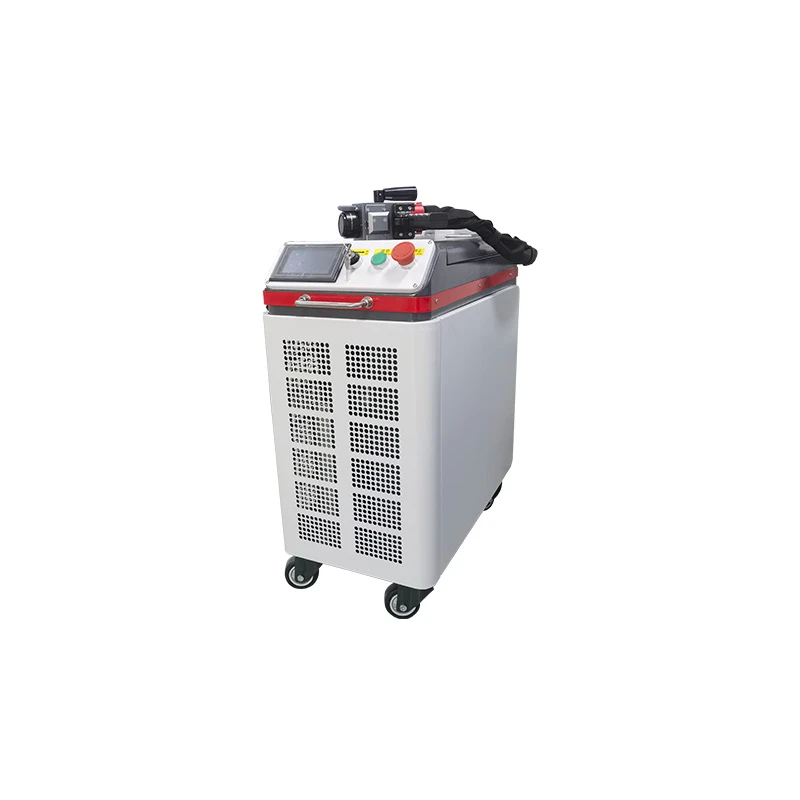
Buyer Note: While $3,500 can buy an entry-level 50W pulsed unit, industrial throughput typically requires the 200W+ range found in the $8,000+ tier.
The Physics of Non-Contact Cleaning
Laser cleaning works on the principle of the Ablation Threshold. Every material requires a specific energy density to vaporize.
- Selective Vaporization: Organic coatings (paint, epoxy) and oxides (rust) have a much lower ablation threshold than iron.
- Self-Limiting Process: We tune the laser to exceed the paint’s threshold but stay below the iron’s damage threshold. The laser vaporizes the paint and effectively “bounces” off the shiny, bare metal underneath.
- Result: This achieves ISO 8501-1 Sa 2.5 or Sa 3 cleanliness levels (near-white metal) without the surface profiling (pitting) caused by grit blasting.
Safety Critical: Managing Lead Fumes and Hazardous Waste

In the restoration of pre-1978 ironwork, safety is a YMYL (Your Money, Your Life) issue. Laser cleaning fundamentally changes the hazard profile of lead paint removal from “chips and dust” to “fume and vapor.”
The Nanoparticle Threat
Laser ablation vaporizes lead into nanoparticles (<1 micron). These particles are invisible and can bypass standard dust masks, entering the bloodstream directly.
- Filtration Requirement: Standard shop vacuums are dangerous as they blow nanoparticles back into the room. You must use fume extractors with ULPA (Ultra-Low Particulate Air) filters, which capture 99.999% of particles down to 0.12 microns.
- Chemical Filtration: Because paint binders release Volatile Organic Compounds (VOCs) like benzene when vaporized, an activated carbon filter stage is also required.
Regulatory Compliance
Industrial projects must adhere to OSHA 29 CFR 1926.62. This requires assuming exposure above the Permissible Exposure Limit (PEL) until air monitoring proves otherwise. Always establish a controlled Optical Hazard Zone (OHZ) to protect bystanders from reflected laser light.
Operational Protocol: From Setup to Flash Rust Prevention
Implementing laser cleaning requires a specific workflow to avoid the most common failure: flash rust.
- Degreasing: Always remove surface oil/grease before lasing. Oil absorbs laser energy and can splatter, damaging the expensive laser lens.
- Cleaning Strategy: Work top-down. Position the fume extraction nozzle immediately adjacent to the laser impact point to capture the plume at the source.
- The Flash Rust Crisis: Laser cleaning strips iron to its purest, most reactive state. In humid environments, “flash rust” (a ginger-colored bloom) can appear within 15–30 minutes.
- Immediate Action: Do not leave cleaned iron exposed overnight. Wipe the surface with a residue-free solvent (like denatured alcohol) and apply a rust-inhibitive primer or passivation coating immediately after cleaning.
ROI Analysis: Laser vs. Traditional Sandblasting
When calculating ROI, look beyond the hourly equipment cost to the Total Project Cost.
| Cost Factor | Laser Cleaning | Sandblasting |
| Consumables | Electricity & Lens Protectors (Low) | Grit Media (High volume/cost) |
| Cleanup Labor | Near Zero (Fume extraction) | High (Sweeping/hauling media) |
| Waste Disposal | Low volume (Hazardous filters) | High volume (Contaminated sand + paint) |
| Substrate Risk | Zero (Non-contact) | High (Erosion/Pitting) |
| Project Speed | Moderate cleaning rate | Fast cleaning, slow setup/teardown |
Verdict: For intricate railings where containment of sand is difficult or where preserving the metal detail is paramount, laser cleaning offers a superior ROI despite higher upfront equipment costs.
Frequently Asked Questions (FAQ)
Q: Can I rent a laser cleaning machine from a local supply store?
A: Generally, no. Due to Class 4 laser safety regulations, standard rental houses (like Home Depot) do not rent these to the public. Rentals typically require a specialized B2B contract and proof of a certified Laser Safety Officer (LSO).
Q: Does laser cleaning remove the mill scale?
A: Yes. High-power pulsed lasers can remove mill scale, though it requires higher energy density than simple rust removal.
Q: How fast can it clean a railing?
A: A 200W pulsed laser typically cleans heavily painted iron at a rate of 10–20 square feet per hour. While slower than blasting on flat surfaces, the lack of setup/cleanup time often makes the overall job faster for complex railings.
Next Steps for Your Facility
Before investing in capital equipment, we recommend scheduling a sample cleaning test. This allows you to verify the cleaning speed on your specific coatings and ensure the surface finish meets your adhesion standards.
