
To prevent warping and thermal distortion in Low-Pressure Die Casting (LPDC), foundries must transition from traditional drilled cooling to laser-driven additive manufacturing and thermal management. Research shows that implementing 3D-printed conformal cooling channels eliminates the “thermal dead zones” that cause part warpage, reducing cycle times by 20% to 40%. By using laser technology to build and maintain tools, foundries can extend the service life of H13 and L-40 steel molds by up to 500% while maintaining tight tolerances for automotive and aerospace components.
The Root of LPDC Warping: Why Traditional Cooling Fails
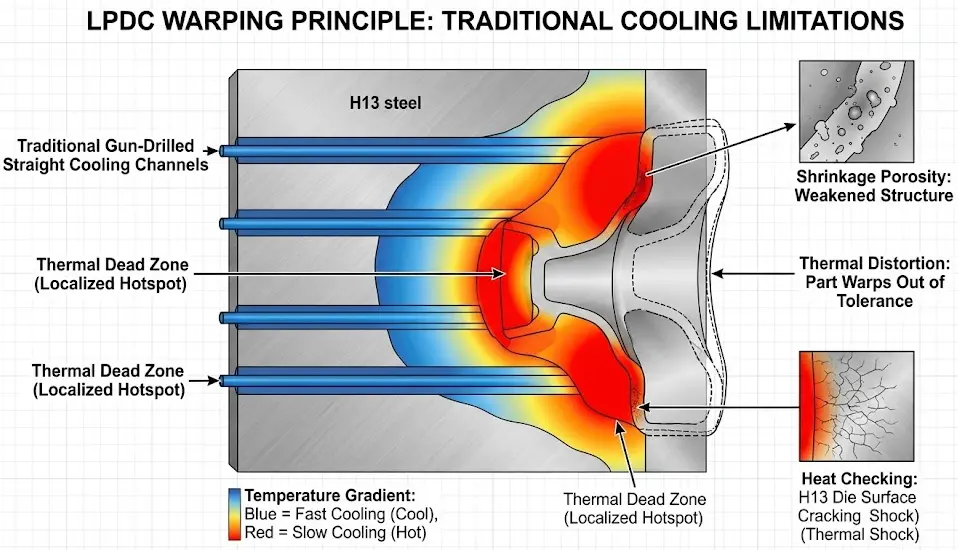
Warping in LPDC occurs when a part cools at different rates across its geometry. Traditional toolmaking relies on gun-drilling straight cooling channels into forged blocks of H13 hot-work steel. Because these lines are straight, they cannot reach the complex curves and deep cavities of modern aluminum wheels or engine housings.
This limitation creates “thermal dead zones”—localized hotspots that lead to:
- Shrinkage Porosity: Trapped gases and slow cooling weaken the structural integrity.
- Thermal Distortion: Uneven cooling pulls the part out of tolerance, leading to high scrap rates.
- Heat Checking: Repeated thermal shock (cycling between 700°C and 180°C) causes H13 steel to develop a network of micro-cracks, eventually failing the die.
Conformal Cooling: The 3D Printing Solution
The most effective method for LPDC warping prevention is the use of Laser Powder Bed Fusion (PBF-LB/M). This technology builds the die layer-by-layer from metal powder, allowing engineers to design internal cooling channels that “conform” to the part’s shape.
Key Conformal Cooling Benefits
Unlike straight drilled lines, conformal channels can spiral and weave within millimeters of the mold surface. This provides:
- Thermal Homogeneity: Uniform heat extraction prevents the temperature gradients that pull metal out of shape.
- L-40 Steel Integration: Foundries now use L-40 tool steel for additive manufacturing. It offers superior hot-hardness and crack resistance compared to H13.
- Faster Solidification: In a Toyota Yaris Hybrid transmission housing study, a 3D-printed tool inlay with conformal cooling significantly reduced cycle times and improved part density.
| Feature | Drilled Cooling | Conformal (3D Printed) |
| Geometry | Straight lines only | Follows 3D part topography |
| Cycle Time | Standard baseline | 20–40% Reduction |
| Tool Life | 1.0x (Baseline) | Up to 4.0x Longer |
| Thermal Stresses | High (Hotspots) | Minimal (Uniform cooling) |
Robotic Laser Cladding: Precision Tool Repair
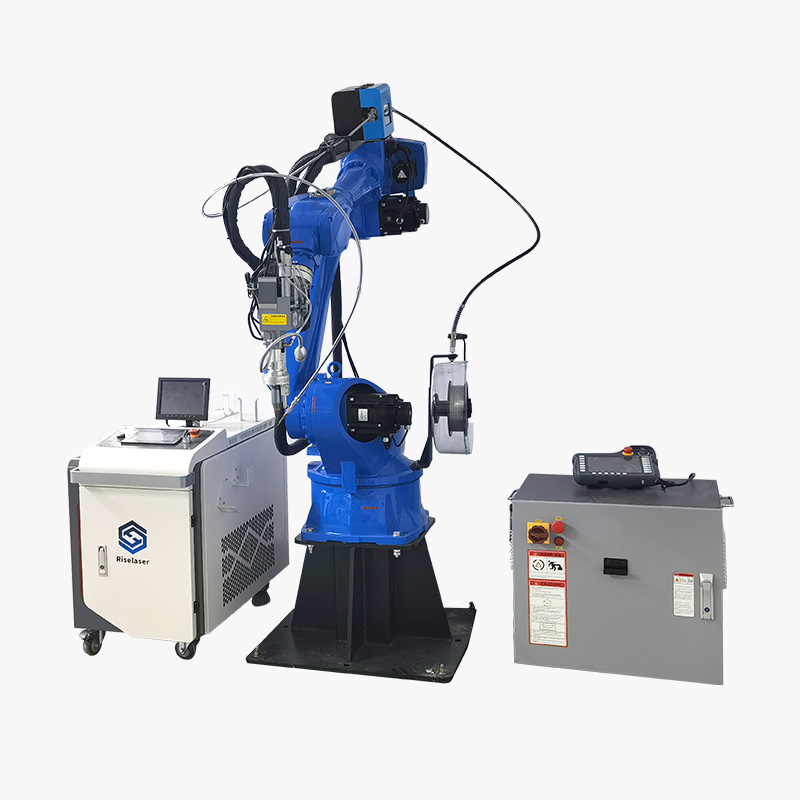
When a mold surface begins to wear or crack, traditional TIG welding often introduces too much heat, causing further warping of the tool itself. Robotic laser cladding repair (or Laser Metal Deposition – LMD) offers a low-heat alternative for digital remanufacturing.
The laser beam creates a small, precise melt pool (typically 3 mm diameter) and feeds metal powder into it. Because the heat is localized, the Heat-Affected Zone (HAZ) is nearly non-existent.
- Weld Strength: The process creates a true metallurgical bond stronger than the base material.
- In-Situ Capability: 6-axis robots can perform repairs while the tool is still in the foundry, depositing wear-resistant alloys like Inconel or Stellite at speeds up to 15 mm/s.
- ROI: A laser-clad repair can double the operational lifespan of a die for a fraction of the $500,000 cost of a new “megacasting” tool.
3D Laser Scanning: Monitoring Quality Drift
To prevent warping before it happens, foundries use 3D laser scanning for molds to track wear and dimensional accuracy.
Handheld scanners, such as the Creaform MetraSCAN, capture millions of data points per second with accuracy down to 0.025 mm. By scanning the mold cavity periodically, QA managers can create a Digital Twin—a digital replica used to:
- Quantify Heat Checking: Identify micro-cracks before they are visible to the human eye.
- Virtual Cubing: Virtually assemble scanned cast parts with mating components to check for gaps and flushness.
- Predictive Maintenance: Foundries like Nemak use this data to schedule repairs during planned outages, preventing catastrophic “die crashes”.
Industrial Quality and Safety Standards
Implementing laser technology requires adherence to strict industrial protocols to ensure both quality and operator safety.
- Surface Preparation: Laser cleaning is now the standard for removing release agents and oxides. It achieves removal rates up to 22 m²/h without the silica dust hazards of sandblasting.
- Safety Compliance: Most automated systems are Class 1 laser rated, meaning they require no special PPE for surrounding staff when the interlocks are active.
- Standards: Laser-hardened and additive tools must meet ISO 11553 safety requirements and DIN EN standards for porosity in aluminum alloys like A356.
Summary: The Economic Impact of Laser Integration
Transitioning to a laser-first strategy in LPDC is an investment in OEE (Overall Equipment Effectiveness). By solving the thermal issues that lead to warping, foundries achieve:
- 25% reduction in total tool manufacturing costs by eliminating “hard milling”.
- 57% reduction in non-pass rates (NPR) through vision-based laser inspection.
- Zero consumable waste by replacing chemical stripping with laser ablation.
Ready to Optimize Your Foundry?
Contact our engineers for a 3D scan analysis of your current die sets to identify warping risks.
Use our TCO tool to compare the 5-year costs of laser cleaning versus traditional media blasting.
FAQ: Frequently Asked Questions
he HAZ is the area of the base metal that has its microstructure altered by heat. Laser cladding minimizes this zone to microns, preventing the tool distortion common in arc welding.
Laser hardening typically reaches depths of 1.0 to 2.0 mm, providing a thick martensitic layer that resists the erosive flow of molten aluminum.
No. Laser cleaning is a selective process. By adjusting the wavelength and pulse duration, it can vaporize aluminum build-up without affecting the underlying ceramic substrate.