
In 2026, the jewelry laser welder price spectrum ranges from approximately $3,000 for a capable direct-import unit to over $18,000 for a premium European workstation.
For shop owners and jewelers, the market has shifted from a question of “Can I afford one?” to “Which business model fits my shop?” You no longer need to spend $20,000 to get a machine that fuses platinum correctly. Today, the price gap is primarily driven by convenience, support infrastructure, and duty cycle, rather than raw welding capability alone.
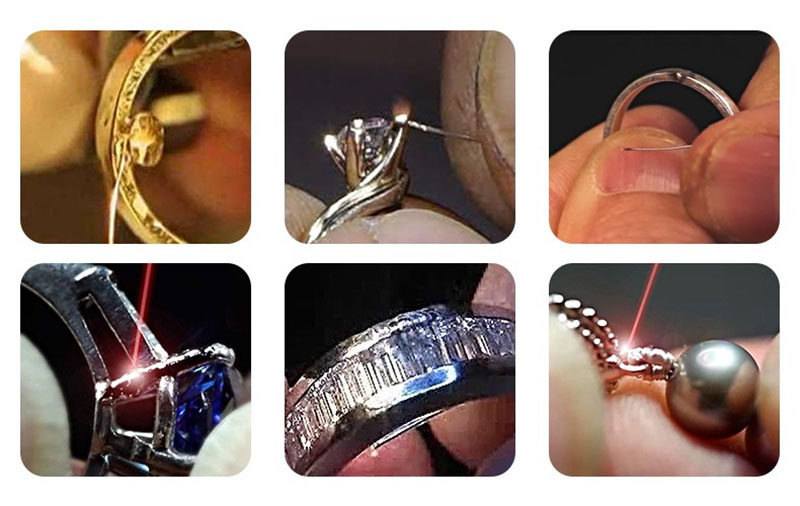
This guide breaks down the three distinct price tiers, analyzes the hidden costs of ownership, and helps you decide if the premium for a domestic brand is worth the investment for your specific business.
2026 Price Tiers: What Do You Get?
The market is currently bifurcated into three categories: Direct Import (Value), Compact Retail (Prosumer), and Industrial Workstation (Professional).
1. The Value Kings: Direct Import ($3,000 – $6,000)
- Target Audience: Independent jewelers, repair shops on a budget, and those comfortable with DIY maintenance.
- Key Players: MaxWave, Riselaser, SFX (often sold via Alibaba, eBay, or direct websites).
- Typical Specs: 60W–200W, Water-Cooled (often external chiller), 1064nm Nd:YAG.
The Quality Reality: The stigma that “Chinese lasers are toys” is outdated. In 2026, machines like the Riselaser RL-Y Series or MaxWave QW utilize standardized ceramic cavities (often imported from the UK) and reliable power supplies that deliver sufficient peak power (40J–100J) for 90% of daily jewelry tasks. They can resize rings, retip prongs, and repair eyeglass frames effectively. Many now come with CE and FDA certifications, validating their safety standards.
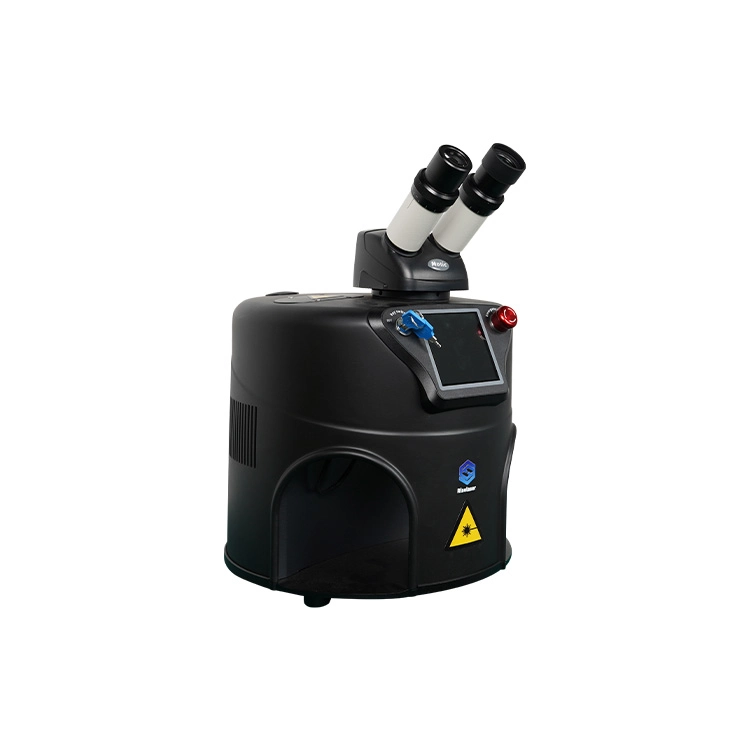
The Trade-Off: You are paying for the hardware, not the handshake. These machines are excellent value, but they require you to be your own technician (see the “Service” section below).
2. The Retail Standard: Compact Units ($5,200 – $8,000)
- Target Audience: Retail stores with limited bench space, mall kiosks, and Permanent Jewelry (PJ) artists.
- Key Models: Sunstone Dado ($5,200), portable fiber units.
- Typical Specs: 30W–60W, Air-Cooled, Compact Footprint.
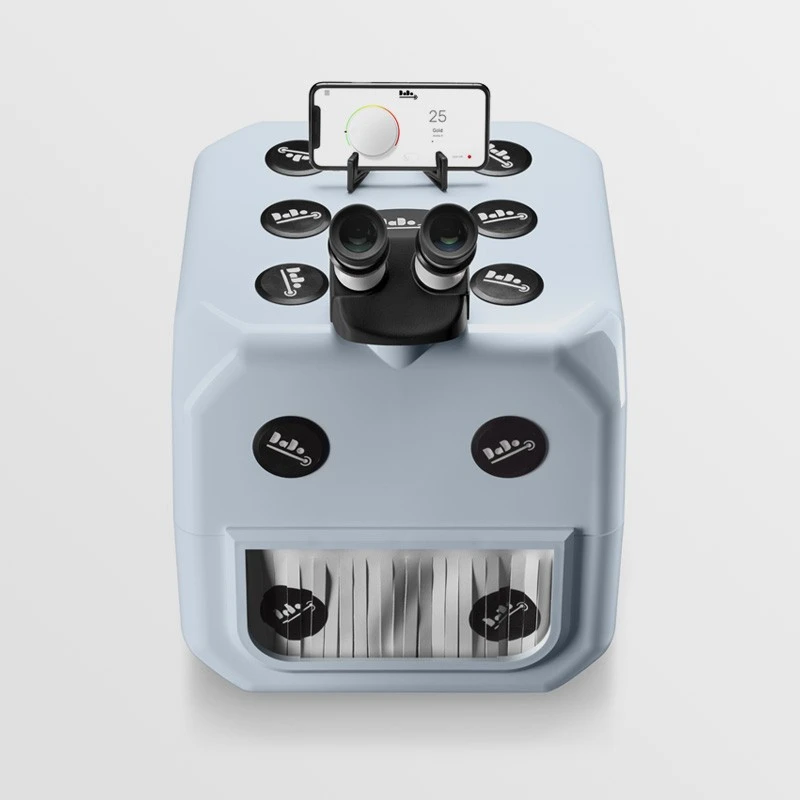
The Bridge:
These units offer a middle ground: branded Western support and safety certifications (CDRH/FDA), packaged in an aesthetically pleasing, small chassis. They are ideal for shops that need a laser for quick, intermittent repairs in front of customers.
Limitations:
To achieve the compact size, these units are often air-cooled. This means they cannot sustain high-speed shooting (e.g., 10Hz) for long periods without thermal throttling (pausing to cool down). They also typically use binocular viewers or digital screens instead of high-end stereo microscopes.
3. The Industrial Workhorses ($12,000 – $18,000+)
- Target Audience: High-volume trade shops, casting houses, and manufacturers where downtime equals lost revenue.
- Key Models: LaserStar iWeld, Orotig Evo X, Sisma LM-D.
- Typical Specs: 100W–200W, Internal Water Cooling, Leica/Olympus Optics.
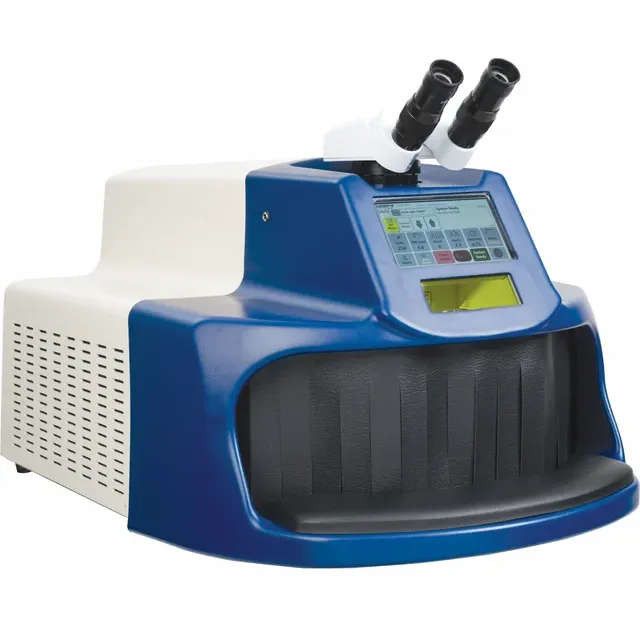
The Value Delta:
At this price point, you are paying for ergonomics and uptime.
- Optics: Standard inclusion of Leica or Olympus stereo microscopes eliminates eye strain during 8-hour shifts—a critical factor for career bench jewelers.
- Beam Shaping: Advanced DSP (Digital Signal Processing) allows for “soft” voltage profiles essential for welding silver without spatter, and “sharp” profiles for deep penetration in platinum.
The Real Cost Driver: Convenience vs. Cash
The most significant difference between a $3,500 machine and a $15,000 machine is not the weld—it is the After-Sales Service.
The Local Experience (High Price)
When you purchase a LaserStar or Orotig from a domestic distributor (e.g., Stuller, Rio Grande, Gesswein), you are buying an insurance policy.
- Support: Technical support is available during US/EU business hours.
- Repair: If a component fails, a technician can often be at your shop within 24-48 hours, or a loaner machine is shipped overnight to keep you operational.
The Import Experience (Low Price)
When you buy a MaxWave or Riselaser direct:
- Support: Troubleshooting is typically conducted via WhatsApp or WeChat, often requiring you to account for a 12-hour time zone difference.
- Repair: If a control board fails, the manufacturer will ship you a new one (3-7 days shipping). You are responsible for opening the machine and swapping the board.
- Verdict: If you are mechanically inclined and have a backup torch, the $10,000 savings is massive. If your business halts completely without the laser, the premium for local support is mandatory.
FAQ: Common Buyer Questions
Yes. For any jeweler performing more than 5 repairs a week, a laser welder is the highest ROI tool on the bench.
Stone Safety: Unlike a torch, a laser allows you to retip prongs on heat-sensitive stones (emeralds, opals, pearls) without un-setting them. This saves hours of labor and reduces the risk of breaking stones during removal.
Speed: A simple ring sizing that takes 20 minutes with a torch (due to pickling, polishing, and stone protection) takes 5 minutes with a laser.
New Revenue: You can repair costume jewelry, watches, and glasses—jobs most jewelers have to turn away.
The “best” machine depends entirely on your business model:
For Budget-Conscious Shops: The MaxWave QW or Riselaser RL-Y series are the best value. They provide professional-grade power for 25% of the cost of legacy brands.
For High-Volume Trade Shops: The LaserStar iWeld or Orotig Evo are the best choice. Their water-cooling systems support 24/7 operation, and their superior optics reduce operator fatigue.
For Permanent Jewelry: The Orion mPulse or Sunstone Dado. These are optimized for portability and safety in retail environments.
Many buyers confuse “Pulse Arc” (Micro TIG) welders with Laser Welders.
Technology: Pulse Arc welders (like the Lampert PUK 6 or Orion mPulse) use an electrified tungsten electrode to create an arc. The electrode must physically touch the workpiece.
Price: High-end Pulse Arc units cost $2,300 – $7,000.
Comparison: Pulse Arc: Excellent for silver (no reflectivity issues) and closing jump rings. Low maintenance (no flashlamps).
Laser: Superior for deep cavity repair (e.g., inside a filigree ring) because it is non-contact.
Verdict: A Pulse Arc welder is a fantastic, lower-cost complement to a laser, but it cannot replace a laser for 100% of repairs (specifically deep retipping).
Total Cost of Ownership (TCO) Calculator
The sticker price is just the entry fee. You must account for consumables.
| Expense | Import Machine (Tier 1) | Professional Machine (Tier 3) | Notes |
| Flashlamp | $50 – $100 | $300 – $400 | Replaced every 1-3 years depending on volume. |
| Protective Lens | $10 – $20 | $50 – $80 | Protects the optics from smoke/spatter. |
| Argon Gas | ~$100/yr | ~$100/yr | Essential for preventing oxidation on white gold. |
| Resale Value | Low (20-30%) | High (50-60%) | Brand names hold value; imports are sunk costs. |
Conclusion
In 2026, the barrier to entry for laser welding has collapsed. A $4,000 machine today is a capable production tool, not a toy.
- If you value cash flow and are comfortable using a screwdriver, the import market offers unbeatable value.
- If you value security and need a machine that is guaranteed to run 40 hours a week with local support, the premium brands remain the industry standard.
Recommendation: Assess your weekly repair volume. If a laser welder saves you just 3 hours of labor per week (at a $50/hr shop rate), even a $15,000 machine pays for itself in under two years.