
Robotic laser welding is a huge change for manufacturing. It works by mixing the power of a focused light beam with the steady hand of a robot arm. This isn’t just a small improvement; it’s a key part of the future of factories, known as Industry 4.0. It makes welds that are stronger, cleaner, and always the same, at speeds that old methods can’t touch. This technology makes it possible to build next-generation products like electric car batteries and lighter airplanes. This guide will explain what robotic laser welding is, how it stacks up against older methods, and what the future holds.
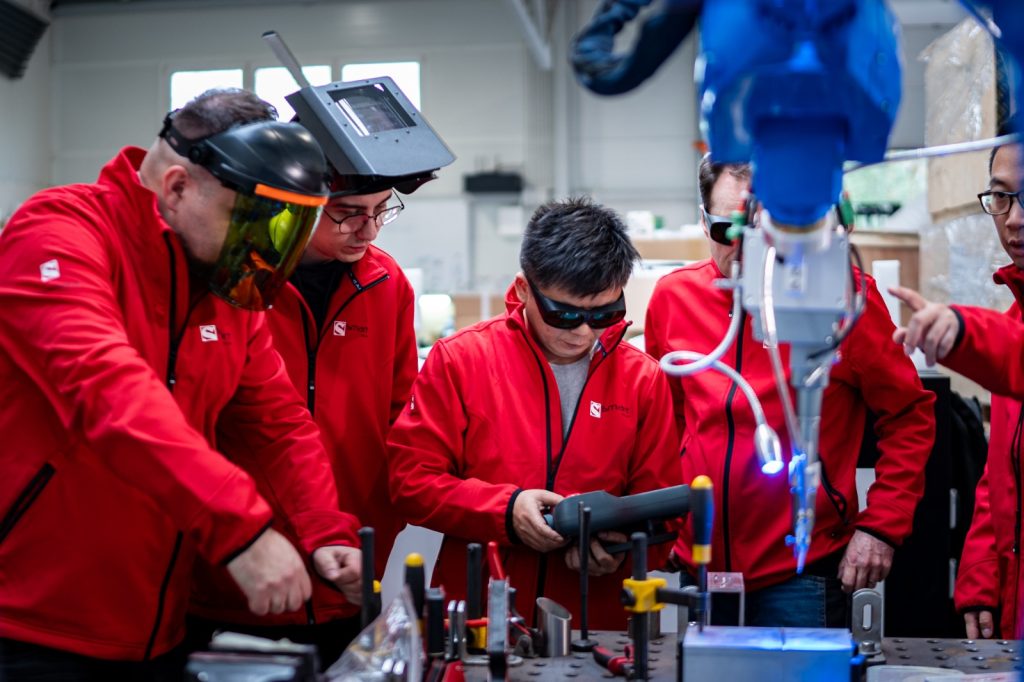
What is Robotic Laser Welding? A Simple Explanation
Robotic laser welding is an automated process that uses a robot to guide a high-powered laser beam to join pieces of metal. The main benefit is that it makes very precise welds with very little heat. This is important because it stops the metal parts from bending or warping out of shape. The whole process is run by a computer, which means the quality is perfect every time, 24/7, without a human getting tired or making mistakes.
How It Works: The Core Components of a Robotic Laser Welding Cell
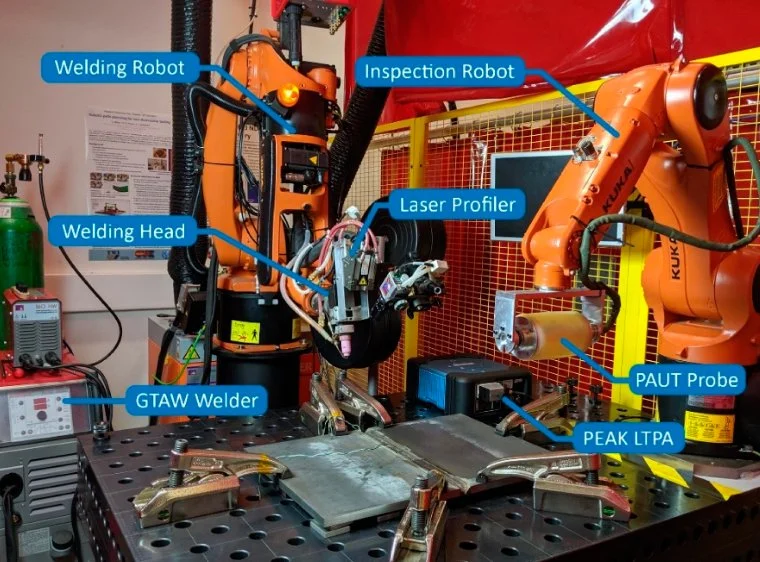
A robotic laser welding system is an integrated cell where several key components work together seamlessly.
The Robotic Arm
The centerpiece is typically a six-axis robotic arm that provides the flexibility to reach complex joints from any angle. A major advancement is the rise of collaborative robots, or “cobots.” These smaller, more flexible robots are designed with built-in safety features that allow them to work safely alongside human employees without large physical barriers.
The Laser Source and Optics
The heart of the system is the laser source, which generates the high-energy beam. Fiber lasers are the most common type due to their efficiency, reliability, and compact size. For challenging materials like the highly reflective copper and aluminum used in EV batteries, specialized green or blue lasers are used to ensure the material absorbs the energy properly.
The Control System & Vision
The “brain” of the cell is the control system, which manages the robot’s movement and the laser’s parameters. Many modern systems integrate advanced 3D vision systems, which act as the robot’s “eyes.” These cameras can locate a part, identify the weld seam, and allow the robot to adjust its path in real-time to account for minor variations.
Safety Systems
Safety is critical. Due to the high-powered laser, these systems are housed within Class-1 laser safety enclosures. These enclosures have interlocked doors that prevent the laser from firing if opened, ensuring operators are protected from the beam.
Laser Welding vs. Traditional Methods: A Head-to-Head Comparison
For engineers and managers evaluating new technology, understanding the trade-offs is key. Here’s how robotic laser welding stacks up against conventional methods.
Robotic Laser Welding vs. MIG & TIG Welding
Compared to traditional arc welding methods like Metal Inert Gas (MIG) and Tungsten Inert Gas (TIG), laser welding offers distinct advantages.
- Speed: Laser welding is significantly faster—up to 4 times faster than MIG and as much as 10 times faster than TIG welding.
- Quality & Distortion: The laser’s focused energy creates a very small Heat-Affected Zone (HAZ). This minimizes the heat that spreads into the surrounding material, virtually eliminating the warping and distortion common with MIG and TIG. The resulting welds are clean and spatter-free, often requiring no post-weld grinding.
- Materials: It excels at joining a wide range of materials, including dissimilar metals like aluminum to copper, which is a critical need in EV manufacturing.
Robotic Laser Welding vs. Resistance Spot Welding (RSW)
RSW has long been a staple in automotive manufacturing, but laser welding provides a more advanced alternative.
- Process: Laser welding is a non-contact process. The laser head works from a distance, which means there are no electrodes to wear out or maintain. It can also create a continuous, hermetically sealed seam, which is stronger and more leak-proof than the series of individual spots made by RSW.
- Strength & Design: A continuous laser seam distributes stress more evenly, which can improve structural rigidity. This allows engineers to design stronger parts with thinner, lighter materials.
| Feature | Robotic Laser Welding | Robotic MIG Welding | Robotic TIG Welding | Resistance Spot Welding (RSW) |
| Welding Speed | Very High (up to 10x TIG) | High | Low | Very High (for spots) |
| Precision/Accuracy | Excellent | Good | Very Good | Good |
| HAZ/Warping | Almost None | High | Medium to High | Medium |
| Material Versatility | Excellent (even different metals) | Good (mostly steel) | Very Good (many metals) | Limited (mostly steel) |
| Weld Quality | Excellent (clean, no mess) | Fair (messy spatter) | Excellent (clean) | Fair (leaves marks) |
| Automation Potential | Excellent | Excellent | Good | Excellent |
Real-World Impact: Industries Being Transformed Today
Robotic laser welding is not a theoretical improvement; it is a critical enabling technology for major industrial sectors.
Automotive
This technology is key to the electric vehicle (EV) revolution. It’s used to weld the battery cases that hold hundreds of cells, safely joining copper and aluminum parts without creating too much heat. It’s also used to weld the lightweight metal frames of modern cars, which helps improve their battery range and safety.
Aerospace
In the aerospace industry, every ounce matters. Robotic laser welding is used to replace heavy rivets on airplane bodies and engine parts. This can cut the number of fasteners by up to 80%, making planes lighter and more fuel-efficient. It’s perfect for welding strong but lightweight metals like titanium.
Medical Devices
The medical field needs super-tiny and exact welds for life-saving devices. Laser welding is used to make the airtight seals on pacemakers and to join the tiny parts inside surgical tools. The welds are so clean they don’t cause problems inside the human body.
The Bottom Line: Is Robotic Laser Welding a Good Investment?
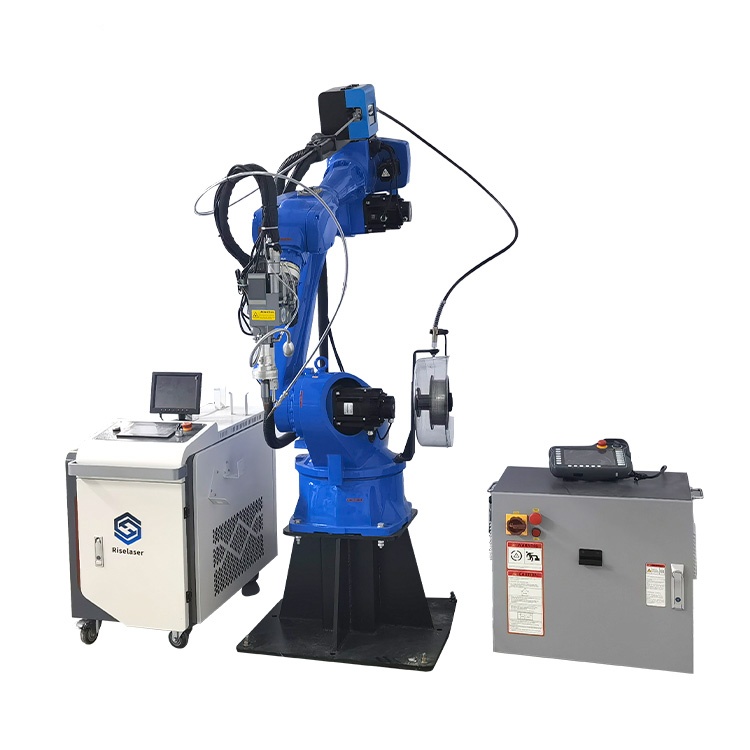
While the initial capital cost is high, the return on investment (ROI) for robotic laser welding is driven by major gains in productivity and reductions in operational costs.
Calculating the ROI
- Increased Productivity: Robots can work 24/7 without getting tired, making a lot more products in the same amount of time. General Motors said its productivity went up by 30% after using welding robots.
- Reduced Costs: While the machine costs a lot at first, it saves money in the long run. You need fewer workers for the welding itself, and since the robot makes fewer mistakes, you waste less material. The farm equipment company John Deere cut its labor costs by 35% with robotic welding. Many companies find the system pays for itself in just one or two years.
The Challenges: What to Know Before You Invest
Adopting this technology requires careful planning. The primary hurdles include:
- High Initial Cost: A complete system can cost anywhere from $10,000 to over $1 million. This can be a big challenge for smaller companies.
- The Skills Gap Transformation: You may not need as many manual welders, but you will need people who know how to program and maintain the robots. This changes the kinds of skills your team needs.
- The “High-Mix, Low-Volume” Problem: Traditional automation excels at making millions of the same part. For job shops that produce small, varied batches, the time spent reprogramming a robot for each new job can outweigh the speed benefits.
The Next Frontier: Future Trends in Automated Welding
Innovation is rapidly addressing these challenges, making the technology smarter and more accessible.
Smarter Welding with AI
Artificial Intelligence (AI) and machine learning are creating systems that can monitor the weld in real-time, predict defects before they happen, and automatically adjust laser parameters to ensure perfect quality on every part.
The Rise of Cobots
Collaborative robots (cobots) are a game-changer. They are easier to program—often via simple “teach-by-touch” methods—and are designed to work safely alongside humans. This flexibility makes it economically viable to automate even small production runs, lowering the barrier to entry for SMEs.
Advanced Vision Systems
The “eyes” of the robot continue to improve. Advanced 3D vision systems allow robots to adapt to real-world part variations, ensuring perfect welds even if a part isn’t positioned perfectly.
Conclusion: The Future of Manufacturing is Forged with Light and Logic
Robotic laser welding offers a mix of speed, precision, and quality that old methods can’t beat. It’s a key technology for the future of cars, planes, and medicine. While the cost and need for new skills are real challenges, new advances in AI and cobots are making this technology easier for more companies to use. For any manufacturer who wants to stay ahead, robotic laser welding is a smart investment in the future.
Ready to see if robotic laser welding fits your application?
Schedule a complimentary application audit with one of our automation engineers. We’ll analyze your parts, production volume, and quality requirements to provide a clear, data-driven assessment of your potential ROI.
FAQs
Robotic laser welding has big advantages in precision, speed, and consistency. It causes very little heat distortion, which is important for thin materials. This helps protect the nearby material’s strength. MIG and TIG welding can be better when filling larger gaps between parts. But laser welding shines when high accuracy, fast work, and clean finishes are needed. It often requires less fixing afterward. Whether it is “stronger” depends on the joint design. Still, laser welding makes very high-quality and reliable welds.
A: The initial investment in a robotic laser welding system can be higher compared to some traditional welding setups. However, it often yields significant long-term savings through reduced labor costs, faster production speeds, less material waste due to high precision, minimal rework, and often lower consumable costs (as filler material isn’t always needed). The overall cost varies widely based on the robot, laser power, features, and level of automation required.
Laser welding has many benefits but usually needs parts to fit very closely. It requires tighter tolerances and smaller gaps than methods like MIG welding. The equipment can be expensive at first. Safety is very important because the laser beam is very strong. Operators need special protective eyewear and safety enclosures. The optical parts must be handled carefully and maintained regularly.
Automated laser welding is usually much faster than manual TIG welding. It is often much quicker than robotic MIG welding for many common manufacturing jobs. High-speed laser welding lets robots work fast without losing accuracy. This means production cycles are much shorter. Overall, it boosts the total output compared to most traditional methods.