
Robotic laser welding automotive manufacturing has become a cornerstone technology, enabling automakers to build lighter, stronger, and safer vehicles with unprecedented efficiency. This advanced process is critical for navigating the industry’s two most significant transformations: the shift to lightweight materials like aluminum and the mass production of electric vehicles (EVs). By offering superior speed, precision, and design flexibility, robotic laser welding outperforms traditional methods like spot welding, making it a strategic necessity for any manufacturer looking to stay competitive.
What is Robotic Laser Welding? A Simple Explanation
Robotic laser welding combines the power of a focused light beam with the precision of a multi-axis robot. The system uses three core components to function:
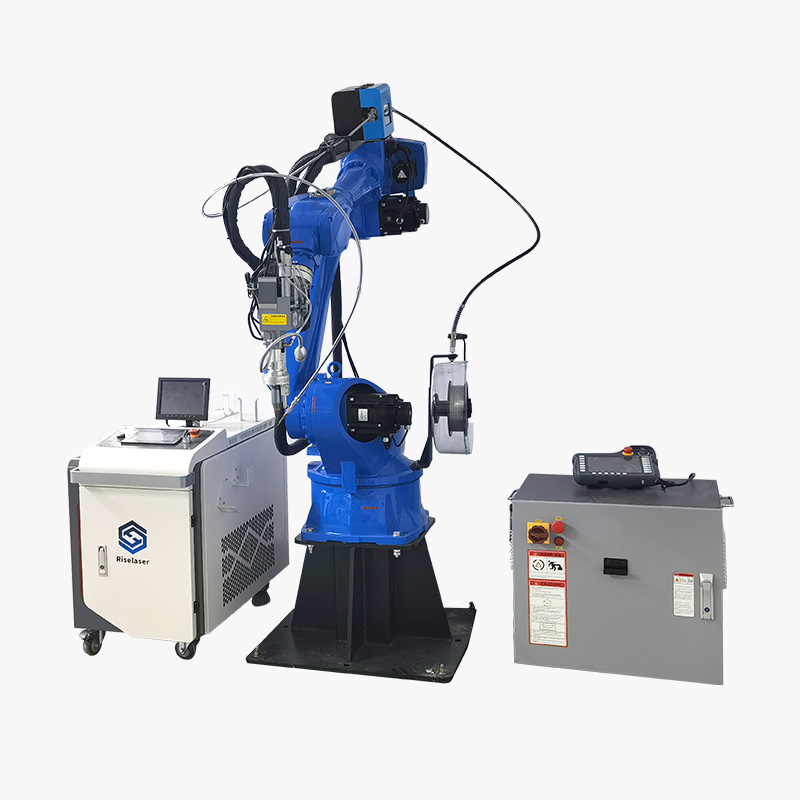
- The Robotic Arm: A six-axis articulated arm that precisely moves the welding head along complex paths on a car body or component.
- The Laser Source: A high-power generator, typically a fiber laser, that creates the energy needed for welding.
- The Welding Head: An optical package attached to the robot’s arm that focuses the laser beam into a tiny, high-energy spot to melt and fuse metal parts together.
The process works by directing this concentrated heat source onto a joint, melting the material in a highly controlled manner. Because the heat input is minimal and localized, it prevents the part distortion common with other welding methods.
The Top 5 Benefits of Robotic Laser Welding in Car Manufacturing
For engineering and operations leaders, the advantages of adopting robotic laser welding translate directly to improved productivity, quality, and innovation.
1. Unmatched Speed and Production Throughput
In high-volume automotive manufacturing, cycle time is critical. Robotic laser welding is significantly faster than traditional methods, operating up to 4 to 10 times the speed of Metal Inert Gas (MIG) or Tungsten Inert Gas (TIG) welding. Advanced “welding on the fly” systems, also known as remote laser welding, can replace up to five conventional resistance spot welding (RSW) stations, reducing production time by as much as 80%.
2. Superior Precision and Weld Quality
Robotic systems deliver exceptional repeatability, ensuring every weld is consistent and strong. The process creates a very small Heat-Affected Zone (HAZ), the area of base material that has had its properties altered by heat. This minimal heat input drastically reduces part warping and distortion, which means less time and money spent on post-weld grinding, finishing, or scrapped parts.
3. Greater Design Freedom for Lighter, Stronger Cars
Unlike RSW, which requires clamping from both sides, laser welding only needs single-sided access. This allows engineers to design with closed, hollow profiles (like tubes) that are inherently stronger and stiffer. It also enables the use of tailor-welded blanks, where steel sheets of different thicknesses and strengths are welded together before being stamped. This technique optimizes material use, reduces vehicle weight, and improves crash safety.
4. A Critical Enabler for the Electric Vehicle (EV) Revolution
The rise of EVs has created new manufacturing challenges, particularly for EV battery welding. Robotic laser welding is essential for the high-volume production of battery enclosures, busbar connections, and electric motor components. It excels at joining the highly conductive and reflective materials common in EVs, such as copper and aluminum.
5. Enhanced Safety and Flexibility
Automating the welding process moves human operators away from high-heat, hazardous environments, improving workplace safety. Furthermore, a robotic cell can be quickly reprogrammed to handle different vehicle models or parts. This flexibility is a major advantage over hard-tooled production lines, especially in a market with short product lifecycles.
Laser Welding vs. Traditional Methods: A Head-to-Head Comparison
For procurement and operations teams evaluating new equipment, understanding how robotic laser welding stacks up against incumbent technologies is key.
| Feature | Robotic Laser Welding | Resistance Spot Welding (RSW) | Robotic MIG/TIG Welding |
| Welding Speed | Very High (0.4s per weld) | Medium (2s per weld) | High (MIG), Low (TIG) |
| Heat-Affected Zone (HAZ) | Very Small | Medium | Large (MIG), Small (TIG) |
| Part Distortion | Minimal | Moderate | High (MIG), Low (TIG) |
| Joint Strength (Tear) | High | Low to Medium | High |
| Gap Tolerance | Low (Requires precise fit-up) | Medium | High (MIG is very forgiving) |
| Access Requirement | Single-Sided | Double-Sided | Single-Sided |
| Initial Cost | High | Low | Moderate |
| Operational Costs | Medium (Low consumables) | Low | High (Wire, gas, electrodes) |
The Challenges: Hurdles to Implementing Robotic Laser Welding
While powerful, the technology is not a simple drop-in replacement. A successful implementation requires careful planning.
- High Initial Investment: A complete industrial robotic laser welding cell is a significant capital expenditure, with costs ranging from $100,000 to over $500,000 depending on the system’s complexity and power.
- Material Constraints: Highly reflective metals like copper and aluminum can be difficult to weld with standard infrared lasers because they reflect much of the beam’s energy. Similarly, the zinc coatings on galvanized steel can vaporize and disrupt the weld pool, requiring special techniques to manage.
- Strict Process Control: Laser welding demands precise part fit-up. Gaps between components must be minimal, often less than 10% of the material’s thickness, which requires high-quality upstream forming and robust clamping fixtures.
- Demanding Safety and Training: The high-power lasers used are typically Class 4, the most hazardous classification. This mandates the use of light-tight safety enclosures, interlocks, fume extraction, and specialized Personal Protective Equipment (PPE) like laser-safe goggles. Operators and technicians also require specialized training beyond traditional welding skills.
The Future of Automotive Welding is Here
Innovation continues to push the boundaries of what’s possible, addressing current challenges and unlocking new levels of efficiency.
Blue Lasers: Solving the Copper Conundrum for EVs
A major breakthrough is the development of blue laser technology. Copper absorbs blue laser light far more efficiently than infrared light—up to 20 times better. This creates a stable, controlled process that produces strong, spatter-free welds on copper components. For EV battery and motor manufacturing, this is a game-changing development that solves a critical production bottleneck.
AI and Machine Learning: The “Smart” Welding Cell
The next frontier is the integration of Artificial Intelligence (AI) and Machine Learning (ML). “Smart” welding cells use sensors and cameras to monitor weld quality in real-time. AI algorithms can detect potential defects as they form and automatically adjust welding parameters—like laser power or speed—to prevent them entirely. These systems can also predict when equipment needs maintenance, reducing unplanned downtime and moving factories toward a zero-defect paradigm.
Conclusion: A Strategic Imperative for Modern Automakers
Robotic laser welding is more than just an alternative joining method; it is a transformative technology that enables the production of next-generation vehicles. It provides the speed, precision, and flexibility needed to work with advanced materials and meet the demands of electrification. While the initial investment and process requirements are significant, the long-term returns in productivity, quality, and design innovation are clear. For automotive manufacturers aiming to lead in a competitive market, adopting a strategic approach to robotic laser welding is no longer an option—it’s a necessity.