
When investing in a fiber laser machine, the single most important component to consider is the laser source. It is the heart of the machine—the engine that generates the laser beam. The capabilities, precision, and limitations of your entire system are fundamentally defined by the source you choose. Everything else, from the scanning head to the software, serves to control the beam that the source creates.
In the world of fiber lasers, particularly for marking, engraving, and cutting applications, two names consistently dominate the market: Raycus and JPT. These manufacturers have become the go-to choices for machine builders and end-users alike, known for their reliability and performance. However, they are not interchangeable, and choosing the wrong one can be a costly mistake that limits your business’s capabilities.
The goal of this guide is to provide a clear, direct analysis of the Raycus VS JPT laser source comparison. We will move beyond simple brand loyalty to analyze the core technology, real-world performance, and cost differences. This will help you choose the right fiber laser source based on your specific needs, the materials you work with, and your long-term business goals.
Understanding the Core Technology: Q-Switched vs. MOPA
Before comparing the brands, it’s crucial to understand the two main types of pulsed laser technology used for marking and engraving: Q-switched and MOPA. This technological difference is the primary reason for the variation in performance, material compatibility, and price, and it sits at the very heart of the Raycus VS JPT laser source debate.
Core Technology at a Glance: Q-Switched vs. MOPA
| Feature | Q-Switched Laser | MOPA Laser |
|---|---|---|
| Pulse Duration | Fixed (~100-130ns) | Adjustable (~2-500ns) |
| Frequency Range | Limited (~20-80 kHz) | Wide (~1-4000 kHz) |
| Primary Advantage | High Peak Power | Fine Parameter Control |
| Best Analogy | A Powerful Hammer | A Set of Precision Chisels |
The Workhorse: Q-Switched Lasers
Q-switched technology is the established, traditional standard for fiber laser marking. It operates by using an acousto-optic modulator to block the laser resonator, allowing a massive amount of energy to build up. This energy is then released in a single, powerful pulse of light.
The key characteristic of a Q-switched laser is its fixed, and relatively long, pulse duration, typically in the range of 100ns to 130ns. While you can change the power and the frequency (pulses per second, from ~20-80 kHz), you cannot change the length of the pulse itself. This results in a very high peak power, excellent for blasting into metals.
- Best for: Deep engraving in metals, general-purpose marking where speed and power are priorities.
- Analogy: Think of a Q-switched laser as a powerful hammer. It strikes hard and is incredibly effective for tasks that require force, but it lacks the finesse for delicate work on heat-sensitive materials.
The Precision Tool: MOPA Lasers
MOPA stands for Master Oscillator Power Amplifier. This is a more advanced and significantly more versatile technology. The “Master Oscillator” creates the initial laser beam with specific, controllable properties, and the “Power Amplifier” then boosts its power to the desired level.
Its defining feature is the ability to independently control a wider range of parameters, most importantly an adjustable pulse duration. High-end MOPA sources, like the JPT M7 series, can produce pulse durations from an ultra-short 2ns up to 500ns or more, with a much wider frequency range (~1-4000 kHz). This means you can control not only the power and frequency but also how long each laser pulse lasts. This control allows for a completely different interaction with the material at a surface level.
- Best for: High-contrast marking on plastics, creating controlled colors on stainless steel, fine, detailed engraving with minimal heat transfer, and black marking on anodized aluminum.
- Analogy: If a Q-switched laser is a hammer, a MOPA laser is a complete set of precision chisels. It allows the user to apply energy with surgical finesse, enabling a much broader range of high-value applications.
Deep Dive: Raycus Laser Sources
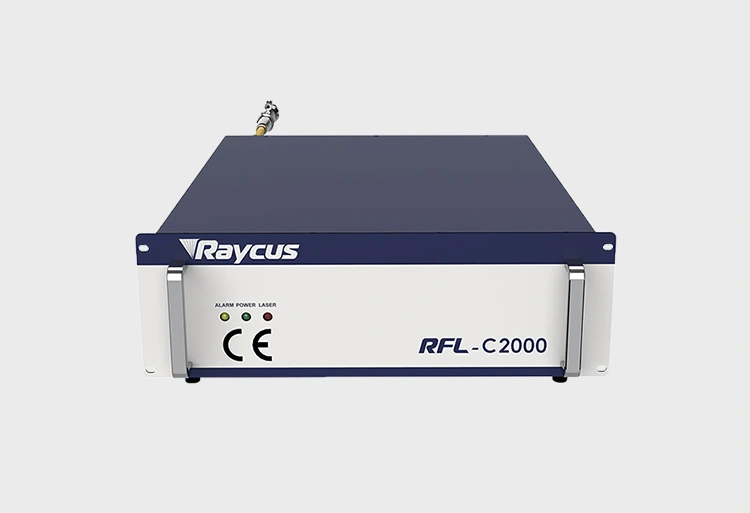
Wuhan Raycus Fiber Laser Technologies is one of the largest and most influential fiber laser manufacturers globally. They are known for mass-producing reliable and powerful laser sources, making them a dominant force in the industrial laser market. Their reputation is built on delivering solid performance at a highly competitive price point, effectively democratizing access to fiber laser technology.
Key Product Lines
- Raycus Q-Switched Series (e.g., QB models): This is Raycus’s flagship product line and the industry standard for affordable metal marking. When people refer to a “Raycus source” in a general-purpose marking machine, they are almost always talking about one of these Q-switched models (e.g., 20QB, 30QB, 50QB). They are workhorses designed for high-speed, high-power applications on metals.
- Raycus MOPA Series: As MOPA technology became more popular, Raycus developed its own line to compete with JPT. While capable, they are less common than their Q-switched counterparts. Our research indicates that these sources offer a more limited parameter window compared to JPT’s premium offerings, positioning them as a budget-MOPA option.
- Raycus CW Series: In the high-power realm of cutting and welding, Raycus is a market leader. They produce continuous wave sources ranging from 1,000W to well over 30,000W, prized for their raw power and value in heavy industrial settings.
Pros
- Unbeatable Cost-Effectiveness: The primary advantage of Raycus is its price. For general metal marking, their Q-switched sources provide the best performance-per-dollar. This has been a major driver of their market share.
- High-Power Dominance: Raycus is a go-to choice for high-wattage CW applications. Their sources are known for delivering raw power suitable for cutting thick steel efficiently.
- Robust and Reliable: Raycus lasers are built to last in demanding industrial environments. Their proven Q-switched technology is simple, robust, and has been refined over millions of production hours.
Cons
- Limited Versatility (Q-Switched): The fixed, long pulse duration of the standard Q-switched models makes them a poor choice for heat-sensitive materials. They struggle to mark plastics without foaming or burning and cannot perform controlled color annealing on stainless steel. The high thermal energy input can also lead to a larger Heat Affected Zone (HAZ).
Deep Dive: JPT Laser Sources
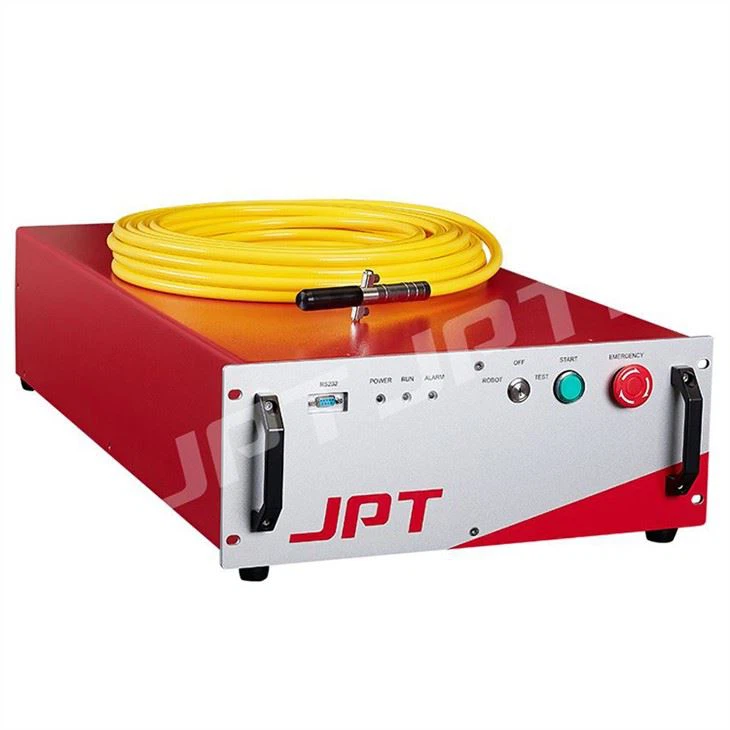
Shenzhen JPT Opto-electronics Co., Ltd. has carved out a reputation as the specialist in precision and versatility. While also a major player, JPT’s focus has been on refining MOPA technology to provide users with an unparalleled degree of control over the laser output. They are widely regarded as the market leader for high-performance MOPA sources.
Key Product Lines
- JPT MOPA Series (M7, LP series): This is JPT’s signature offering. The M7 series is the gold standard, famous for its extremely wide range of adjustable pulse durations (2-500ns) and frequencies (1-4000 kHz), making it the top choice for complex applications. The LP series is a more cost-effective MOPA line that still offers significantly more versatility than any Q-switched source.
- JPT CW Series: JPT also competes directly with Raycus in the continuous wave market. Their CW sources are often praised for their high stability and superior beam quality (M² value), though they sometimes come at a higher price point.
Pros
- Superior Versatility (MOPA): This is JPT’s main selling point. The wide parameter window allows for excellent, high-contrast results on a massive range of materials without causing damage.
- Exceptional Beam Quality: JPT sources are known for producing a very fine and stable laser beam. This results in sharper, cleaner marks with a smaller HAZ, which is critical for delicate and high-resolution work in the medical and electronics industries.
- The King of Color Marking: For creating vibrant, repeatable colors on stainless steel and titanium, JPT MOPA sources are the undisputed best choice. Their precise control over heat input allows for the creation of consistent oxide layers, which produce the colors. This is a high-value service that is nearly impossible with Q-switched lasers.
- High Stability: JPT lasers are renowned for their consistent power output, both from a cold start and during long, continuous jobs. Our data shows a power stability of <3%, which is crucial for repeatable results in a production environment.
Cons
- Premium Price Point: The advanced capabilities of a JPT source come at a cost. They are consistently more expensive than their Raycus equivalents, which can be a significant factor for new businesses.
- Less Dominant in High-Power CW: While their CW sources are excellent, Raycus often has a stronger hold on the multi-kilowatt market for industrial cutting simply due to their aggressive pricing.
Head-to-Head Comparison: Which is Better for YOUR Job?
So, how do we settle the Raycus VS JPT laser source question? The answer depends entirely on the application. This section directly compares them in a head-to-head breakdown of common laser tasks to see which comes out on top.
Scenario 1: General Metal Engraving (e.g., serial numbers, logos on steel)
- Winner: Tie / Raycus (for speed and budget). If your priority is fast, deep marks and maximum value, a Raycus Q-switched source is the clear choice. It excels at removing material quickly. A JPT MOPA source can achieve a finer, cleaner result with a darker black or smoother finish by using different parameter settings, but the Raycus will often be faster for deep engraving.
Scenario 2: Marking on Plastics & Polymers
- Winner: JPT (by a large margin). This is not a fair fight. The high, fixed-duration pulse of a Raycus Q-switched laser overheats plastic, causing it to foam, melt, or burn. The adjustable, shorter pulse durations of a JPT MOPA allow for “cold” marking, creating a high-contrast mark by changing the material’s surface without burning it. This is essential for medical devices and electronic components.
Scenario 3: Color Annealing on Stainless Steel
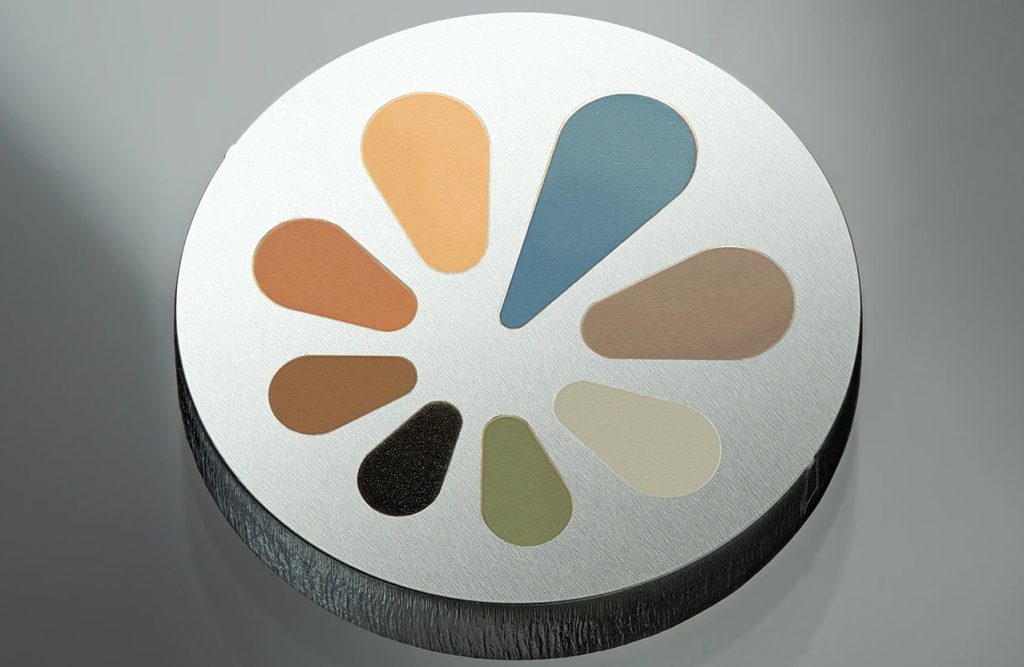
- Winner: JPT. A JPT MOPA source (especially the M7 series) is the industry standard for color marking. A Raycus Q-switched source cannot do this. While a Raycus MOPA might achieve some color, it lacks the control, vibrancy, and repeatability of the JPT. This application alone can justify the price premium for a JPT source.
Scenario 4: Fine, High-Resolution Engraving (e.g., jewelry, electronics)
- Winner: JPT. When working on delicate items or requiring microscopic detail, the superior beam quality and lower heat input of a JPT source are critical. It produces sharper lines with a minimal HAZ, preventing damage to sensitive components or precious materials.
Scenario 5: Black Marking on Anodized Aluminum
- Winner: JPT. A common application is creating a crisp, black mark on anodized aluminum (like a phone case or business card). A Q-switched laser simply blasts the anodization away, leaving a bright white/silver mark. A JPT MOPA, with the correct parameters, can dye the anodized layer black without removing it, resulting in a much more premium finish.
The Final Verdict: Who Should Buy Which?
The final verdict on the Raycus VS JPT laser source decision is a classic trade-off between price and versatility.
Choose a Raycus laser source if:
- You are primarily working with metals.
- Your main tasks are deep engraving and fast marking, where raw power is more important than finesse.
- Budget is your primary concern, and you need the best possible performance for the lowest initial cost.
- You are setting up a high-power cutting or welding operation and need a cost-effective multi-kilowatt CW source.
Choose a JPT laser source if:
- You need maximum versatility to work on a wide variety of materials.
- Quality, precision, and fine detail are non-negotiable for your products.
Frequently Asked Questions (FAQ)
Yes, this is physically possible. However, it requires technical skill and, crucially, a new driver board and software correction file (.ezd file) compatible with the JPT source. It is often more cost-effective to purchase the machine with the desired source from the beginning.
Maxphotonics is another major manufacturer, often positioned as a direct competitor to Raycus. Generally, their Q-switched sources are comparable to Raycus. Their MOPA sources compete with JPT but are often seen as a middle-ground option, not quite reaching the wide parameter range of the JPT M7.
Both Raycus and JPT typically offer a manufacturer’s warranty of 1-2 years. However, your primary support contact is the machine seller. It is crucial to buy from a reputable vendor with good support, regardless of the laser source inside.