
Choosing between YAG vs CO2 laser welding technologies is a critical decision that directly affects production speed, weld quality, automation, and operating costs. More specifically, comparing Nd:YAG and CO2 laser welding helps manufacturers determine which wavelength, beam delivery method, and application range best fits their production needs.. While both are powerful industrial tools, they are designed for fundamentally different tasks. This guide provides a direct comparison to help you confidently select the superior technology for your specific material, application, and manufacturing environment.

YAG vs CO2 Laser Welding: Key Differences at a Glance
For those in the consideration stage, the choice boils down to two primary factors: the material you are welding and your need for automation.
- For Metals, Robotics, and Precision, Choose Nd:YAG. The Nd:YAG laser’s shorter wavelength (1.064 µm) is more readily absorbed by metals, especially reflective ones like aluminum and copper. Its most significant advantage is its ability to use flexible fiber-optic cables for laser beam delivery, making it the clear winner for robotic and complex 3D welding applications.
- For Non-Metals and Simple, High-Power Welds, Choose CO2. The CO2 laser’s longer wavelength (10.6 µm) is highly absorbed by organic materials, making it the ideal choice for laser welding for plastic, wood, and ceramics. It remains a cost-effective workhorse for high-power seam welding on thick steel, particularly for simple, straight, or rotary weld paths where automation is less complex.
Quick Comparison Table
| Feature | Nd:YAG Laser | CO2 Laser |
| Primary Use Case | Metals, especially reflective alloys | Non-metals (plastics, wood, acrylics) |
| Wavelength | 1.064 µm (Near-Infrared) | 10.6 µm (Far-Infrared) |
| Beam Delivery | Flexible Fiber-Optic Cable | Rigid Mirrors (“Hard Optics”) |
| Automation Friendliness | Excellent for robotics | Limited to simple motion paths |
| Key Advantage | Precision, low heat input (pulsed mode) | High power for non-metals & thick steel |
How They Work: Understanding the Core Laser Technology
The differences in performance originate from how each laser generates its beam.
The Nd:YAG Laser: Solid-State Power for Metal Welding
Nd:YAG laser welding uses a solid crystal as its source, or gain medium. Neodymium ions are embedded in a Yttrium Aluminum Garnet (YAG) crystal. This crystal is energized (“pumped”) by high-intensity flashlamps or, in more modern systems, highly efficient laser diodes. This solid-state design is compact and versatile.
The CO2 Laser: Gas-Powered Performance for Non-Metals
A CO2 laser uses a mixture of gases as its gain medium. An electrical current excites a carefully balanced mixture of carbon dioxide (CO2), nitrogen (N2), and helium (He) inside a sealed tube. Each gas plays a critical role: N2 transfers energy efficiently to the CO2 molecules, which produce the laser light, while He helps cool the system and maintain stability.
Laser Beam Delivery: The Decisive Factor for Automation
How the laser beam travels from the generator to the workpiece is one of the most practical differences between the two systems and heavily influences factory floor integration.
Nd:YAG’s Flexibility with Fiber Optic Laser Beam Delivery
The Nd:YAG laser’s near-infrared light travels efficiently through flexible fiber-optic cables. This allows the bulky laser generator to be placed far from the welding station. A lightweight focusing head is then mounted on a robotic arm, enabling complex, multi-axis welding with ease. This simplifies setup, reduces maintenance, and is the reason Nd:YAG technology dominates automated assembly lines.
CO2’s Rigidity with Hard Optics and Mirrors
The far-infrared light from a CO2 laser cannot pass through standard fiber optics. Instead, it must be guided by a series of mirrors, known as “hard optics”. This creates a rigid, inflexible beam path. While suitable for stationary or simple two-axis welding, integrating it with a robot requires a cumbersome, mechanically complex articulated arm that is sensitive to alignment and contamination.
Comparing Welding Performance and Quality
Welding Speed and Penetration Depth
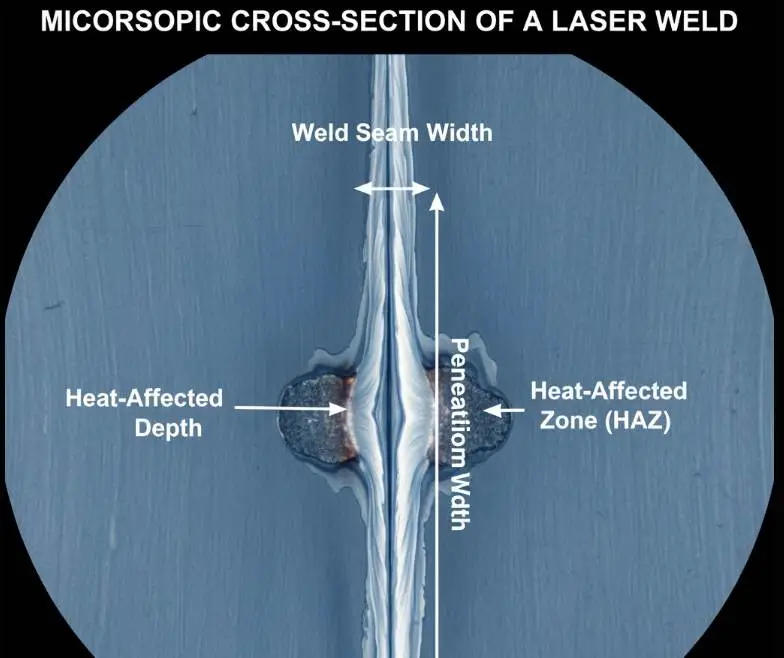
For laser welding for metal, the Nd:YAG laser’s better wavelength absorption often results in faster penetration speeds, particularly when initiating a weld on reflective materials. A theoretical study showed an Nd:YAG laser could penetrate zinc and aluminum over 8.5 times faster than a TEA-CO2 laser under realistic conditions.
However, for very thick sections (e.g., greater than 6 mm), a high-quality CO2 laser can sometimes be more energy-efficient at delivering energy deep into the material, potentially due to how the longer wavelength interacts within the keyhole.
Heat Input and the Heat-Affected Zone (HAZ)
The Heat-Affected Zone (HAZ) is the area around the weld that is weakened by heat. Minimizing the HAZ is critical for maintaining material strength and preventing distortion.
Here, the pulsed Nd:YAG laser has a distinct advantage. It can deliver extremely high peak power in short bursts, melting the metal with very low total heat input. This makes it the superior choice for welding heat-sensitive electronics, medical devices, and other precision components where thermal damage is not an option.
CO2 and Nd YAG Laser Welding Applications
The technical differences lead to clear use cases in specific industries.
Automotive Sector: From Powertrains to Body-in-White
- CO2 Lasers: Traditionally used for robust powertrain components like gears and transmissions, where simple, circular welds are common.
- Nd:YAG Lasers: The modern standard for robotic “body-in-white” assembly, welding roof panels, door frames, and components for electric vehicles like battery enclosures and hairpin motors.
Medical Devices & Electronics: The Realm of Precision Welding
This is a stronghold for Nd:YAG laser welding. Its precision and minimal heat are essential for hermetically sealing cardiac pacemakers, welding delicate catheters and surgical tools, and joining micro-components on circuit boards without causing damage.
Plastics, Wood, and Organics: The CO2 Laser’s Domain
This is the exclusive domain of CO2 laser welding applications. The 10.6 µm wavelength is efficiently absorbed by these materials, making it the go-to technology for welding, cutting, and engraving a wide range of non-metals.
The Financial Equation: Analyzing the Laser Welding Cost
Initial Capital Investment
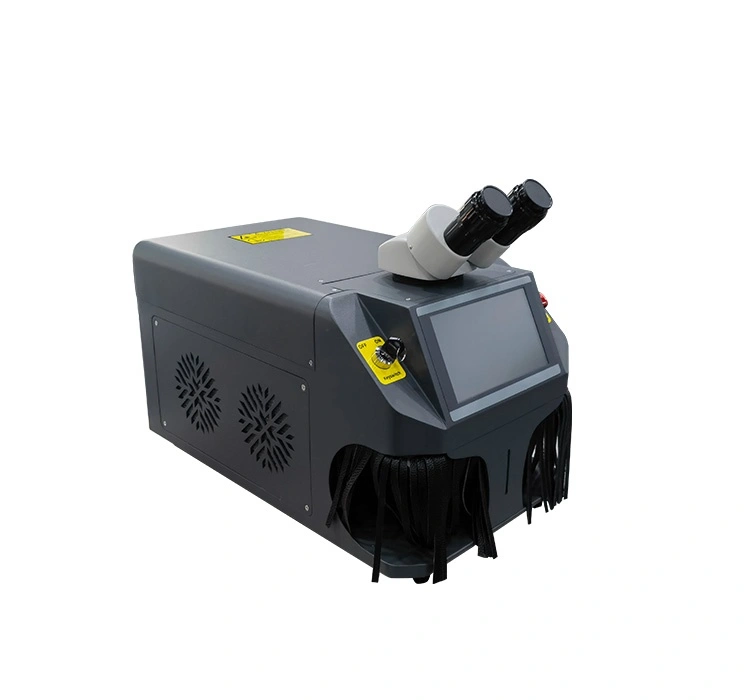
The initial laser welding cost varies by power and features. Generally, CO2 laser systems may have a lower upfront purchase price for a given power level. Desktop Nd:YAG welders for small parts can range from $3,600 to over $20,000, while high-power industrial systems are significantly more.
Operational Costs: Efficiency and Consumables
Total Cost of Ownership (TCO) is a more critical metric.
- Energy Efficiency: Flashlamp-pumped Nd:YAG lasers are the least efficient at 3-4%. CO2 lasers are better at 7-12%.
- Consumables: Traditional Nd:YAG lasers require periodic replacement of expensive flashlamps. CO2 lasers require replenishment of the lasing gas and frequent cleaning and alignment of mirrors, which can lead to significant downtime and maintenance costs.
A Note on Fiber Lasers: The Modern Successor
For most new metal welding applications, the fiber laser has become the industry standard. It offers the fiber-optic delivery and metal-welding advantages of Nd:YAG but with far greater efficiency (25-30%), reliability, and virtually no maintenance, making it the successor to both technologies in the metals space.
Conclusion: Making Your Final Decision
Your decision should be guided by a clear-eyed assessment of your operational needs.
- For welding metals, especially with robotics or for heat-sensitive parts, the Nd:YAG (or its modern successor, the fiber laser) is the clear winner.
- For welding non-metals or for simple, high-power welds on thick steel without complex automation, the CO2 laser remains a viable and cost-effective tool.
Before making a final investment, it is crucial to consider the total cost of ownership, including maintenance, consumables, and the demands of your specific production environment. Always adhere to proper safety protocols, including the use of appropriate personal protective equipment (PPE) for the specific laser class and wavelength.
Ready to Validate Your Application?
The best way to ensure you’re choosing the right technology is to see it in action on your parts. Our engineers can analyze your materials, joint design, and throughput requirements to provide a data-backed recommendation and weld samples for your evaluation.
Frequently Asked Questions (FAQ)
A: The main difference is their wavelength and what it can process. Nd:YAG’s 1.064 µm wavelength is best for metals, while CO2’s 10.6 µm wavelength is best for non-metals like plastic and wood. This also dictates the laser beam delivery method—flexible fiber for YAG, rigid mirrors for CO2.
A: Yes, CO2 lasers can weld metals like steel, but they are less efficient than Nd:YAG lasers because metals are highly reflective to the CO2 wavelength, making the initial energy transfer difficult. They are generally not suitable for highly reflective metals like aluminum or copper.
A: An Nd:YAG laser is significantly better for welding aluminum. Aluminum is highly reflective and conductive, making it very difficult to weld with a CO2 laser. It absorbs the Nd:YAG’s shorter wavelength much more effectively, leading to a more stable and efficient process.