
A jewelry laser welding machine replaces the broad, risky heat of a traditional soldering torch with a microscopic, highly concentrated beam of light. In a fraction of a second, this Class 4 laser melts and fuses precious metals together without the need for lower-karat solders or corrosive chemical flux. Because the photonic energy (typically operating at a 1064 nm wavelength) is delivered in precisely timed milliseconds to a spot as small as 0.2 millimeters in diameter, the heat-affected zone (HAZ) is remarkably minimal.
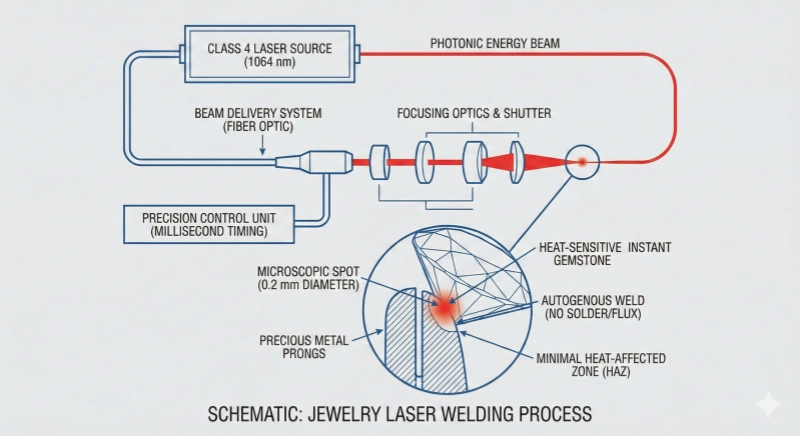
For a professional bench jeweler, this means you can perform structural repairs—like safely retipping prongs right next to heat-sensitive stones—without ever having to unset the gems. By transitioning to micro laser welding, repair shops can speed up approximately 75% of their daily jobs while creating autogenous (metal-to-metal) welds that are up to 260 times stronger than traditional capillary solder joints.
If you’re considering adding one to your workshop, you may also want to understand the typical jewelry laser welder price range before choosing a machine.
What Can a Jewelry Laser Welder Actually Do?
If you process 10 to 30 repairs a day, time is your most valuable asset. Here is exactly how a benchtop laser welder handles the daily tasks on your tray.
Retipping Prongs Near Heat-Sensitive Stones
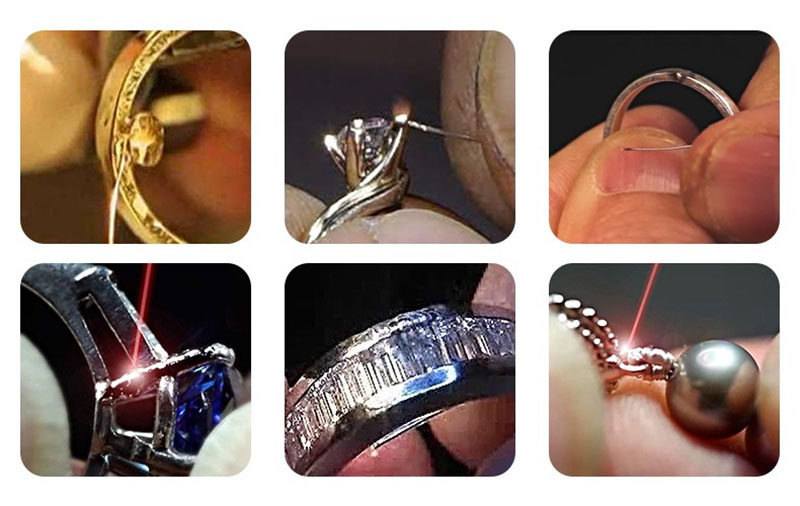
Unsetting and resetting fragile gems costs time and carries immense liability. With a laser’s localized heat control, you can seamlessly retip gold and platinum prongs directly next to emeralds, opals, tanzanite, and pearls without frosting or fracturing the stones. To further protect facets from errant laser pulses, operators often use physical masks like wet cotton swabs, dark polymer clay, or thermal refractive gels.
Fixing Casting Porosity Permanently
Instead of simply burnishing over a surface pit—which merely hides the problem temporarily—a laser offers a permanent structural cure. The process involves firing the laser directly into the porous pit to melt the bottom and expose solid base metal. Next, you feed a matching 0.3mm wire (like 18k yellow gold or 950 palladium) into the void. Using a controlled “zigzag” pulse pattern and argon shielding gas, you fill the hole and compress the weld with a hammer handpiece for a flawless, invisible finish.
Micro-Chain Repair & Complex Assemblies
Soldering hollow or tightly woven microscopic chains often results in accidentally freezing the links together. A laser precisely targets and fuses a single broken link without the thermal energy spreading. It also allows you to successfully execute mixed-metal assemblies, such as joining a platinum bezel to a sterling silver band, or repair heat-sensitive costume jewelry that a torch would instantly melt.
Ring Resizing and Gold/Silver Laser Repair
Resizing rings with a laser prevents heat from traveling up the shank. Because the upper gemstone settings remain cool, you preserve the structural integrity of the piece and reduce the need for extensive post-weld repolishing and chemical rhodium plating by up to 78%.
Jewelry Laser Welder vs. Torch Soldering: The Honest Truth
While traditional torches will always have a place on the jeweler’s bench, the structural and workflow differences are significant.
| Feature | Laser Welding | Torch Soldering |
| Joint Strength | Up to 260x stronger; uses parent metal | Weaker capillary joint; uses low-karat solder |
| Cleanliness | No flux needed; zero fire scale with Argon gas | Requires flux; creates oxidation and fire scale |
| Finishing Time | 60% less polishing time; no acid pickling | Heavy pickling, filing, and polishing required |
| Stone Safety | Safe for most stones left in place | Requires unsetting for heat-sensitive stones |
Are there things a torch does better? Yes. For large-scale fabrication or heavy full-shank replacements, flowing solder with a torch can sometimes be faster. A laser sizing might take 50% longer to perfectly stitch and blend the filler wire. However, jewelers often charge a 50% premium for the labor on laser sizings because the resulting seam is perfectly color-matched, structurally identical to the virgin metal, and will never tarnish over time.
Benchtop Laser Welder vs. Pulse Arc Welder (Micro-TIG)
For shops on a strict budget, a pulse arc welder (Micro-TIG) is a common alternative. Pulse arc welders use controlled bursts of electrical energy and a sharpened tungsten electrode to create a weld.
If your repair shop works primarily with highly conductive metals like 925 sterling silver, brass, or copper, a pulse arc welder achieves excellent, deep penetration and is highly cost-effective. However, if you primarily handle high-end gold, platinum, intricate prong retipping, or require absolute pinpoint accuracy near fragile gemstones, an Nd:YAG jewelry laser or fiber laser is the superior choice due to its highly controlled, narrow beam.
Essential Specs to Evaluate Before Buying
When purchasing a machine, prioritize these vital performance details:
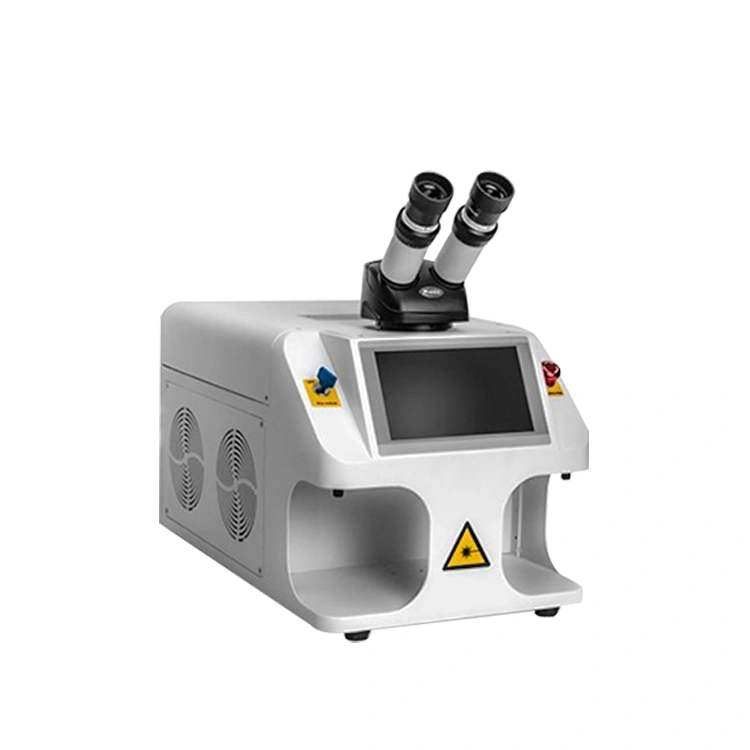
- Optics: Ensure the machine uses premium stereo microscopes, such as Leica or Motic, offering 10x to 15x magnification with precise crosshair alignment to reduce eye fatigue.
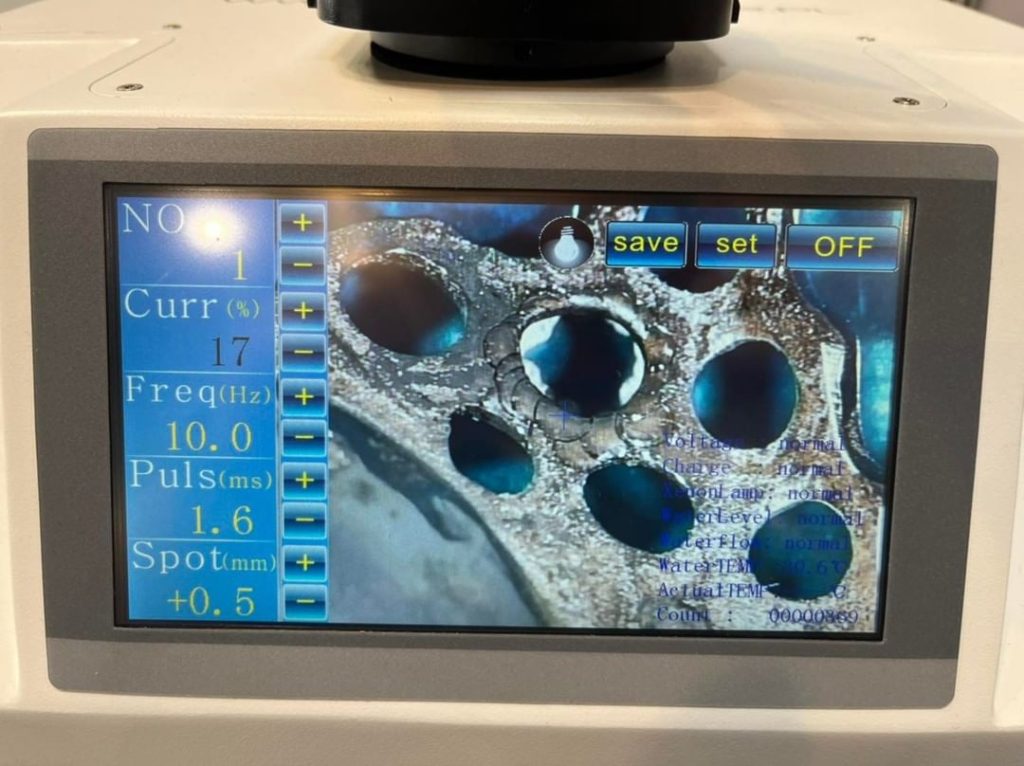
- Performance: Look for machines offering adjustable pulse energy (typically 12 to 35 Joules for jewelry), peak power in kW, and customizable pulse shaping. Advanced pulse shaping allows you to “slope down” the energy at the end of a weld, which acts as a micro-annealing process. This is crucial for preventing heat tears and micro-cracks in notoriously brittle metals like nickel white gold and 950 palladium.
- Usability: Consider whether you prefer internal joystick controls or traditional foot pedals to actuate the pulse. Evaluate the cooling system: traditional high-power Nd:YAG systems require strict water cooling and filter replacements, while newer, highly efficient fiber lasers often rely on simple air cooling.
Prioritizing Safety, Maintenance, and Training
A laser welder is a major capital investment and a powerful industrial tool. Treating it with respect ensures equipment longevity and operator safety.
- Safety Protocols: These machines utilize a 1064 nm near-infrared wavelength, which is completely invisible and can bypass the human blink reflex, causing permanent ocular damage. Operators must rely on the microscope’s integrated, high-speed safety shutters. If operating an open-style dental laser welder or handheld unit, specialized optical density (OD) laser safety glasses are strictly mandatory—standard auto-darkening welding helmets offer zero protection against this specific wavelength. Additionally, always use a dedicated HEPA fume extraction system to safely capture toxic heavy metal vapors.
- Maintenance: Routine maintenance prevents catastrophic internal failures. The protective glass shield inside the chamber must be inspected daily and replaced annually. For water-cooled Nd:YAG systems, water filters must be replaced every 3 to 6 months, and the internal flashlamps generally have a lifespan of 2,000 to 5,000 hours (roughly 2 to 5 years of standard bench use).
- Training: Proper education bridges the gap between traditional metalsmithing and modern photonics. Reputable manufacturers offer specialized iWeld training courses, and accredited programs like the GIA Graduate Jeweler diploma provide extensive hands-on laser certification to ensure you maximize your machine’s capabilities.
Is a Laser Welder Worth the ROI for a Repair Shop?
The upfront sticker price of a professional laser welder can be intimidating for an independent shop. However, modern leasing and financing options often break down to $300 to $450 a month. That is significantly less than paying a skilled bench jeweler for just 20 hours of labor.
Your rapid return on investment (ROI) is generated by raw speed and unlocking entirely new revenue streams. By eliminating un-setting charges, skipping the acid pickle, drastically reducing polishing time, and confidently accepting high-margin jobs on heat-sensitive antiques that your competitors turn away, the machine rapidly pays for itself. Furthermore, standard warranties in the industry cover parts for 12 to 24 months, with some premium manufacturers offering extended lamp protection up to four years, securing your investment for the long haul.
Conclusion
Evaluate your daily repair log. How many jobs did you have to pass on last month because of fragile stones or hollow assemblies? How many hours were lost to cleaning fire scale and resetting diamonds? Upgrading your bench with a jewelry laser welder is a structural game-changer for your throughput and craftsmanship.
FAQs
A: Yes. A laser weld creates a monolithic bond by melting the parent metal itself, resulting in a joint that is as strong and pure as the original material. Solder introduces a different, lower-melting alloy, which can be a point of weakness.
A: Absolutely. While sterling silver’s high thermal conductivity and reflectivity can be challenging, modern laser welders have specific parameter settings to create clean, strong welds on silver pieces.
A: It is extremely unlikely. The key advantage of a laser is its tiny Heat-Affected Zone (HAZ). The laser’s energy is so focused that you can weld a prong right next to a diamond, emerald, or opal without transferring heat to the stone.
A: Flashlamps are consumable parts. Their lifespan is measured in pulses, with most modern lamps lasting between 5 to 10 million pulses, depending on the power settings used.