
For decades, manufacturing has been limited by the slow, skill-intensive processes of traditional welding. In 2026, that’s changing. Handheld laser welding machines are revolutionizing industries from automotive to aerospace, offering unprecedented speed, precision, and efficiency.
This guide explores the booming market, core technologies, and critical applications defining the industry today.
How Fast is the Handheld Laser Welding Market Growing?
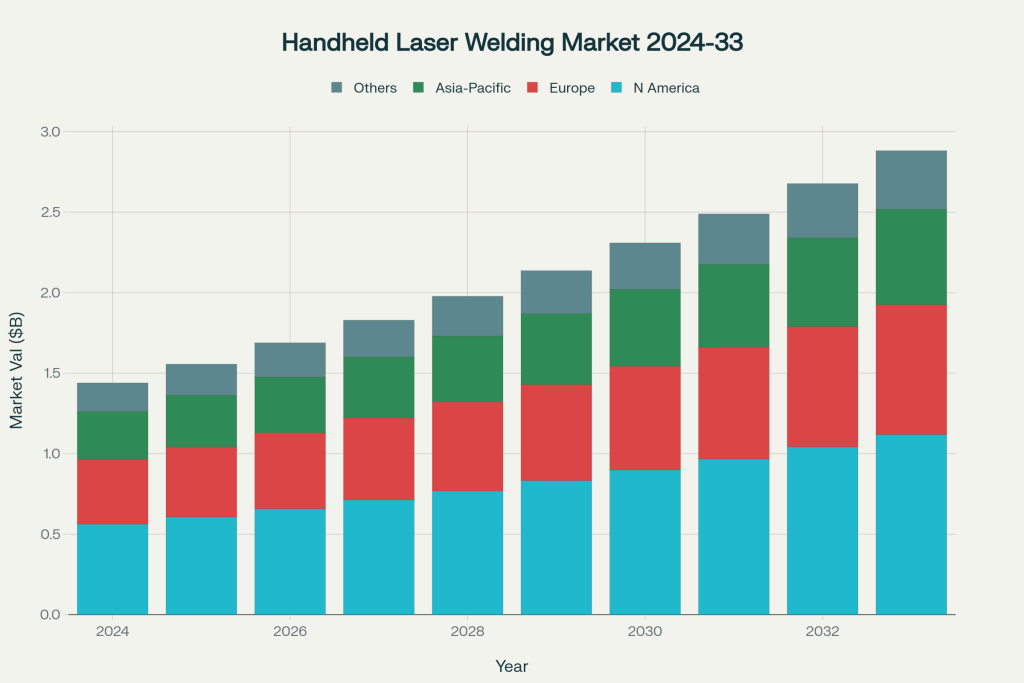
The global market for handheld laser welders is demonstrating remarkable momentum. Valued at $1.44 billion in 2024, it is forecasted to double, reaching $2.88 billion by 2033. This represents a strong compound annual growth rate (CAGR) of 8.2%, with some analyses projecting growth as high as 9.2% in key segments.
Who Leads the Global Market? A Regional Breakdown
Market dominance is concentrated in key industrial regions, each with unique drivers.
- North America (38.9% Share): Valued at $561 million, North America leads the pack. This dominance is fueled by the explosive growth of electric vehicle (EV) battery manufacturing, with states like Georgia and Michigan projected to reach 97-136 GWh of capacity by 2030. This creates massive demand for handheld laser welding in the USA and across the continent.
- Europe (27.9% Share): The laser welding market in Europe, worth $403 million, is a cornerstone of advanced manufacturing. Germany is the region’s powerhouse, home to industry giants like TRUMPF and EMAG. The automotive sector alone accounts for over half of European demand.
- Asia-Pacific (20.6% Share): As the fastest-growing region, Asia-Pacific is projected to expand by 37% between 2024 and 2029. The market is led by top China laser manufacturers like Han’s Laser and HGTECH, with the booming electronics sector driving relentless demand for precision welding.
How Much Does a Handheld Laser Welder Cost? Technology and Price in 2026
A primary consideration for buyers is the handheld laser welder price. In 2026, the cost is directly tied to the machine’s power and capabilities.
- Entry-level (1500W): $2,000 – $5,000. Ideal for light fabrication and repair work.
- Mid-range (2000W-3000W): $4,000 – $10,000. Offers a balance of power and portability for applications like automotive bodywork.
- High-power (3000W+): $10,000 – $30,000+. Built for heavy-duty, continuous industrial use.
Why Fiber Lasers Dominate
Fiber laser technology is the undisputed standard for modern handheld welders. In simple terms, fiber lasers are vastly more energy-efficient than older CO2 lasers.
A 4kW fiber laser system requires only about 17kW of electrical power, whereas a CO2 laser with the same output needs up to 56kW. This efficiency, combined with a highly focused beam (1064nm wavelength), makes it the best handheld laser welder for aluminum, stainless steel, copper, and other reflective metals that are challenging for traditional methods.
Which Industries Use Handheld Laser Welders?
The versatility of this technology has driven its adoption across numerous high-stakes sectors.
- Automotive and Electric Vehicles: This sector drives over 50% of demand. Handheld laser welders are essential for assembling EV battery packs, where precise welds on thin materials are required without causing heat damage.
- Aerospace: In aerospace, every gram and every perfect weld matters. The technology is crucial for joining lightweight aluminum and titanium alloys in fuselage frames, wing assemblies, and engine components.
- Electronics and Medical Devices: The minimal heat-affected zone makes laser welding perfect for joining sensitive electronic components, sensors, and battery tabs. In medical manufacturing, it provides the sterile, precise welds needed for surgical tools and implants.
- Construction and Metal Fabrication: Portability is a game-changer. These machines enable on-site repairs for shipbuilding, pipeline work, and custom fabrication in locations inaccessible to traditional, stationary welders.
Who Are the Key Manufacturers in 2026?
The competitive landscape features established global leaders and innovative regional players:
- TRUMPF (Germany): A dominant force with a 22% market share in high-power industrial lasers.
- IPG Photonics (USA): A pioneer in fiber laser technology, known for its LightWELD handheld systems.
- Han’s Laser (China): A leader in scale, producing over 80,000 laser systems annually.
- LaserStar Technologies (USA): Focuses on high-precision solutions for specialized industries.
- Coherent (USA): Offers specialized systems like the ExactWeld and StarFiber series.
What Are the Pros and Cons? Laser Welding vs. TIG/MIG
Key Advantages
When comparing a handheld laser welder vs. TIG or MIG systems, the advantages in productivity and quality are significant:
- Speed: Drastically reduces project timelines. Handheld laser welding is 4-10 times faster than traditional TIG/MIG welding, boosting overall productivity by 30-50%.
- Precision: Creates clean, aesthetically pleasing welds with minimal heat distortion, reducing the need for post-processing like grinding.
- Quality: Produces strong, consistent welds on a wide range of materials.
- Versatility: Capable of welding stainless steel, aluminum, copper, and dissimilar metals with ease.
- Ease of Use: While training is required, operators can often become proficient much faster than with TIG welding.
Potential Downsides and Limitations
- High Initial Cost: The upfront investment is significantly higher than for traditional welding equipment.
- Positioning Requirements: Workpieces must be precisely fitted, as laser welding is less forgiving of gaps than MIG welding.
- Strict Safety Requirements: The high-intensity Class IV laser beam necessitates stringent safety requirements for handheld laser welding. This includes certified eye protection (OD 6+), controlled, non-reflective work environments, and proper fume extraction.
- Operator Fatigue: Despite being lightweight, extended handheld operation can still cause fatigue.
Is a Handheld Laser Welder a Good Investment? An ROI Analysis
The financial justification is strong, with typical payback periods ranging from 5 to 24 months.
Example ROI Calculation:
- Initial Investment: $150,000 (includes machine, setup, training)
- Annual Labor Savings: $50,000 (from faster welding speeds)
- Annual Scrap Reduction: $20,000 (from higher quality welds)
- Annual Maintenance & Consumables: -$10,000
- Net Annual Savings: $60,000
- Payback Period: 2.5 years
Beyond labor, operational savings come from lower energy consumption and reduced spending on consumables like rods, tips, and gases.
The Future of Laser Welding: 2026-2030 Trends
The market’s growth will be accelerated by several key technological trends:
- AI Integration: Smart systems will offer real-time weld quality monitoring and automatic parameter adjustments.
- Improved Portability: Advances in battery technology will lead to truly cordless, more portable solutions.
- IoT Connectivity: Machines will connect to the cloud for remote diagnostics, predictive maintenance, and performance tracking.
- Advanced Beam Shaping: Beams will be further optimized for specific materials and joint types, increasing quality and speed.
Frequently Asked Questions (FAQ)
It has a steeper learning curve than MIG but is generally considered easier and faster to master than TIG welding. Operators need specialized training on laser safety and setting parameters, but can often produce high-quality welds within days.
It is highly versatile and can weld stainless steel, carbon steel, galvanized steel, aluminum, titanium, copper, and many other alloys. It is also excellent at welding dissimilar metals, like copper to aluminum.
When performed correctly, laser welding produces a very strong, deep-penetrating weld that is often stronger and more durable than its traditional counterparts due to the fine-grained metallurgical structure it creates.
The primary risks are damage to eyesight from the intense laser beam and inhalation of fumes. Proper Personal Protective Equipment (PPE) is non-negotiable, including laser-safe glasses (rated OD 6+ for the specific wavelength), flame-retardant clothing, and a fume extraction system.