
Laser welding is no longer a niche process; it has become a key technology in modern manufacturing. It allows companies to build products with greater speed, precision, and quality. This powerful combination is driving innovation in demanding industries, including automotive, aerospace, medical devices, and electronics.
This article serves as a clear guide for decision-makers. We’ll cover what laser welding is, how it compares to traditional methods like MIG and TIG, its real-world applications, and the economic reasons for investing in this technology.
What is Laser Welding and Why Is It a Game-Changer?
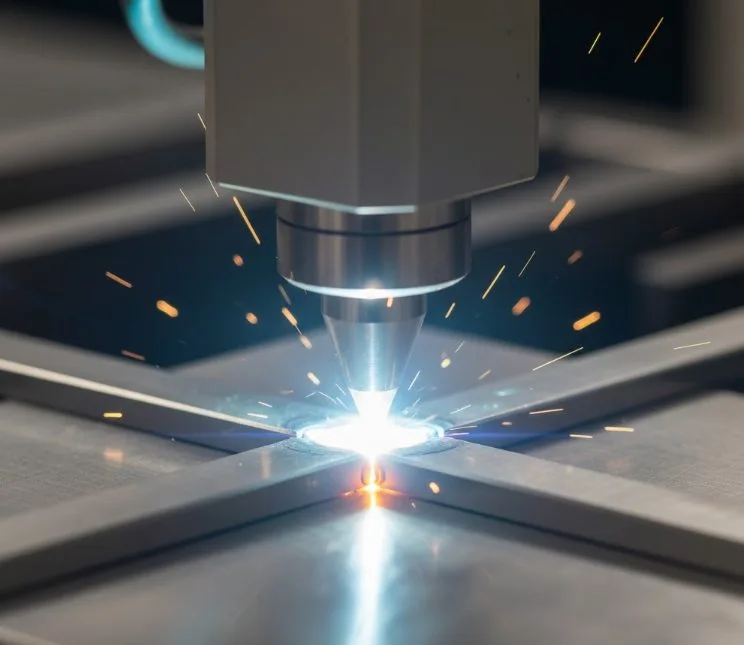
At its core, laser welding is a process that uses a highly focused beam of light to join materials. This concentrated energy melts the material in a precise, controlled manner, and as it cools, it forms a strong, clean weld.
What makes it a game-changer are three key advantages over traditional methods:
- Unmatched Speed: It operates at speeds far exceeding conventional welding.
- Microscopic Precision: The beam can be focused on a tiny spot, allowing for intricate work on delicate components.
- Low Heat Input: It introduces minimal heat into the surrounding material, drastically reducing warping and distortion.
These benefits are not just incremental improvements; they unlock new design possibilities and create more efficient, reliable production lines.
The Core Benefits: Laser Welding vs. Traditional Methods (MIG, TIG)
For engineers and procurement managers, a direct comparison to traditional methods like MIG and TIG welding is critical. Laser welding offers clear advantages in several key areas, including dramatically faster speeds, unmatched precision, and significantly less heat distortion. It also requires fewer consumables and is easier to automate, which impacts long-term operational costs. For a detailed breakdown of these differences, please see our complete comparison: Laser Welding vs. Argon Arc (TIG) Welding.
Real-World Impact: How Key Industries Use Laser Welding
The practical applications of laser welding demonstrate its transformative impact on modern manufacturing.
Automotive
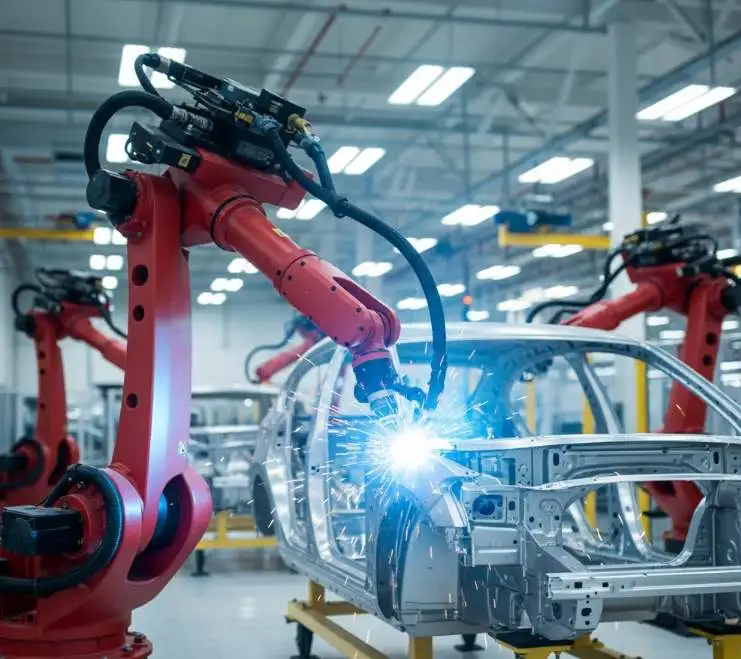
The automotive industry relies on laser welding for lightweighting and the electric vehicle (EV) transition.
- Body-in-White (BiW): Lasers create “tailored blanks” by welding steel sheets of different thicknesses or grades together before stamping. This optimizes strength and reduces weight.
- EV Batteries and Motors: Laser welding is essential for joining the thousands of connections in an EV battery pack, often involving copper and aluminum tabs. It is also used to weld the copper “hairpins” in high-efficiency electric motors.
Aerospace
In aerospace, where every gram matters and safety is non-negotiable, laser welding is critical.
- Advanced Alloys: It provides the precise control needed to weld high-strength, heat-resistant materials like titanium and nickel-based superalloy used in jet engines.
- Lightweighting: By replacing thousands of heavy rivets with continuous laser welds on fuselage panels, manufacturers significantly reduce aircraft weight, improving fuel efficiency.
Medical Devices
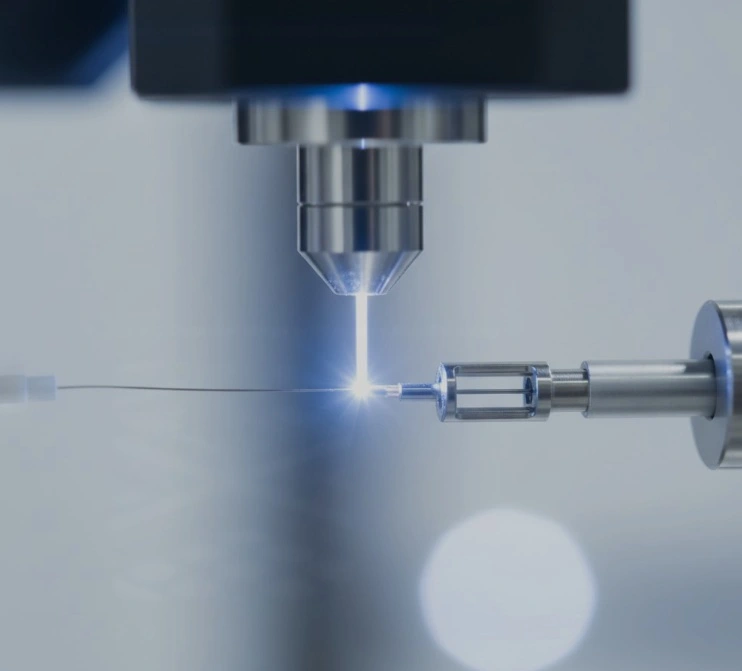
The trend toward miniaturization in medical technology is made possible by laser welding.
- Micro-Welding: With a beam spot under 50 microns, lasers can join microscopic components in minimally invasive surgical tools, such as the pull-wires in steerable catheters.
- Hermetic Sealing: It creates airtight (hermetic) seals on titanium pacemaker casings and other implantable devices, protecting sensitive electronics from the body’s environment.
Electronics
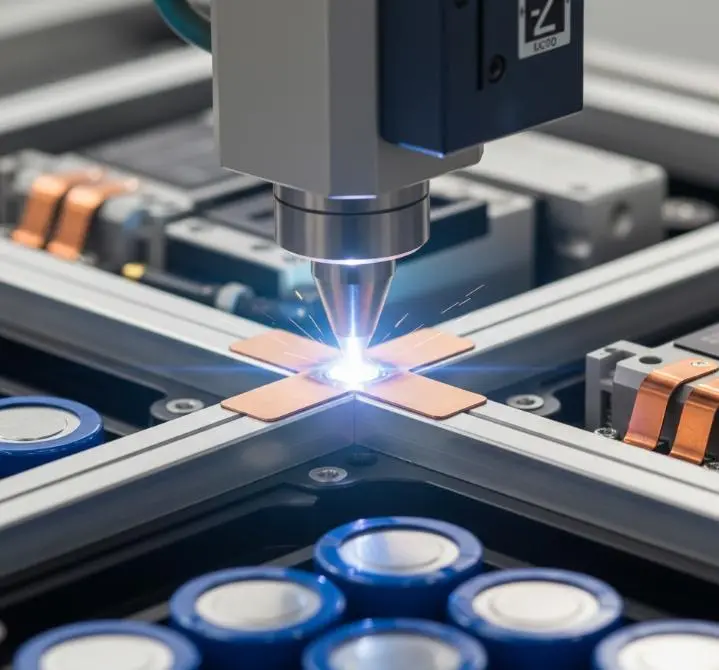
In electronics, laser welding provides the delicate touch needed for micro-fabrication.
- Micro-Connections: It creates precise electrical connections on sensors and connectors where components are too closely spaced for soldering.
- Battery Manufacturing: It is the standard for assembling batteries in consumer electronics, providing strong, low-resistance connections without damaging the cell’s internal chemistry.
Understanding the Technology: How Does Laser Welding Work?
For those evaluating the process, understanding the fundamentals is key.
The Basic Principle
A laser source generates a high-intensity beam of light. This beam is guided by optics and focused onto a tiny spot on the workpiece. The concentrated energy instantly melts the material, creating a molten pool. As the laser moves along the joint, the molten material fuses and solidifies behind it, forming a strong bond.
Conduction vs. Keyhole Welding
Laser welding operates in two primary modes, determined by the power density of the beam.
- Conduction Mode: At lower power densities, the laser heats the surface of the material without vaporizing it. The heat “conducts” into the material, creating a shallow, wide, and smooth weld. This mode is ideal for aesthetic joints or hermetically sealing thin electronic enclosures.
- Keyhole (Deep Penetration) Mode: At very high power densities, the laser beam vaporizes the metal, creating a deep, narrow cavity called a “keyhole.” This keyhole allows the laser energy to penetrate deep into the material, producing strong, narrow welds with a high depth-to-width ratio. This is the mode used for structural components in automotive and aerospace applications.
A Guide to Industrial Lasers Used in Welding
The type of laser source determines the system’s capabilities and best applications.
Fiber Lasers
Fiber lasers are the current industry standard for metal welding. They generate the laser beam within a flexible, doped optical fiber.
- Advantages: High energy efficiency (35-40%+), excellent beam quality for high precision, low maintenance, and easy integration with robotics.
- Best For: General metal fabrication, automotive, aerospace, and medical devices.
CO2 Lasers
These gas lasers were once the industry workhorse. They generate a beam by exciting a CO₂ gas mixture.
- Advantages: Can deliver very high power and are effective on non-metals like plastics, wood, and ceramics.
- Disadvantages: Less energy efficient and have a longer wavelength that is poorly absorbed by reflective metals. They have largely been replaced by fiber lasers for metal welding.
Diode Lasers
Also known as semiconductor lasers, these generate a beam directly from a diode.
- Advantages: Highest energy efficiency (>50%), compact, and cost-effective.
- Best For: Plastic welding, brazing, and surface heat treatments. Their lower beam quality makes them less suitable for deep penetration welding.
The Economics: Is Laser Welding Worth the High Cost?
This is a critical question for any business considering adoption. The answer requires looking beyond the initial price tag.
The Initial Investment
The primary barrier to entry is the high capital cost. A complete automated laser welding system can cost an order of magnitude more than a traditional MIG or TIG setup.
The Long-Term ROI
Despite the high upfront cost, laser welding often delivers a strong Return on Investment (ROI), especially in high-volume production. The payback period can be as short as one to three years, driven by:
- Higher Throughput: Faster welding speeds mean more parts produced per hour.
- Reduced Labor Costs: Automation reduces the need for skilled manual welders.
- Minimal Consumables: Many processes don’t require filler wire, and there are no consumable electrodes.
- Elimination of Post-Processing: Clean welds eliminate the time and cost of secondary grinding or straightening operations.
Challenges and the Future of Laser Welding
While powerful, the technology has limitations, but ongoing innovation is rapidly addressing them.
Current Limitations
- Joint Fit-Up: Laser welding requires precise alignment and minimal gaps between parts, necessitating high-quality part manufacturing and fixturing.
- Material Thickness: While capable of deep welds, it can be less economical than traditional methods for very thick sections (e.g., over 25 mm).
- Reflective Materials: Highly reflective materials like copper and aluminum have historically been challenging, though this is changing.
What’s Next? AI, Beam Shaping, and New Wavelengths
The future of laser welding is smarter and more adaptable.
- New Wavelengths: The commercialization of blue and green lasers is fundamentally changing the welding of copper, as these shorter wavelengths are absorbed far more efficiently.
- Dynamic Beam Control: Technologies like beam “wobbling” (oscillating the beam in a controlled pattern) allow the laser to bridge larger gaps and improve weld quality on challenging materials.
- AI-Powered Monitoring: Integrating sensors with Artificial Intelligence (AI) allows for real-time process monitoring and adjustment. These “smart” systems can detect and correct defects on the fly, ensuring 100% quality control.
Conclusion: A New Era in Manufacturing
Laser welding has evolved from a specialized process into a foundational technology for modern industry. Its ability to deliver speed, precision, and versatility is not just improving existing products—it’s enabling the creation of next-generation vehicles, aircraft, medical devices, and electronics. While the initial investment is significant, the long-term gains in productivity, quality, and cost-efficiency present a compelling case for any manufacturer looking to gain a competitive edge. As the technology becomes smarter and more accessible, its transformative impact will only continue to grow.
Frequently Asked Questions (FAQ)
In many cases, yes. Laser welding can produce deep, narrow welds with a fine-grained microstructure, which often results in higher strength and fatigue resistance compared to the wider, higher-heat welds from MIG or TIG. However, the “strongest” weld always depends on the specific material, joint design, and application requirements.
Laser welding can be 4 to 10 times faster than TIG welding and significantly faster than MIG welding, especially on thin to medium-thickness materials. This speed advantage is a major driver of its adoption in high-volume production.
Historically, highly reflective and thermally conductive materials like copper and aluminum have been challenging. They reflect a large portion of the laser’s energy and quickly dissipate heat. However, modern advancements like high-brightness fiber lasers and new blue/green wavelength lasers have made welding these materials reliable and efficient.
The high initial cost comes from the advanced technology involved: the laser source itself, precision beam delivery optics, robotic automation, and mandatory safety enclosures. While the upfront investment is high, the long-term ROI is often favorable due to lower operational costs, including reduced labor, minimal consumables, and higher productivity.