
In the high-stakes world of precious metals, trust is your currency, but verification is your firewall. Whether you are operating a high-volume refinery, a pawn shop, or a jewelry showroom, the decision to invest in an X-Ray Fluorescence (XRF) analyzer is driven by one primary fear: buying a fake.
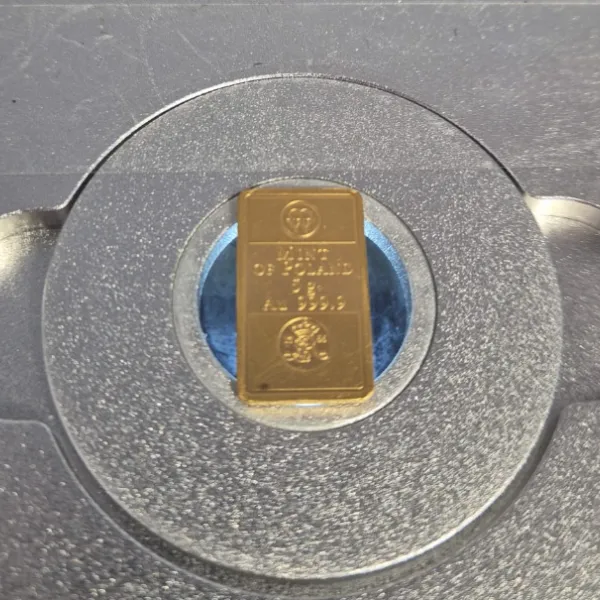
If you are looking for the best XRF gold tester, you aren’t just looking for a machine; you are looking for insurance against the advanced counterfeits flooding the market—from thick gold plating to tungsten cores.
However, the market is confusing. You have “big brand” units costing $20,000+, and you have suspicious unbranded imports for $4,000. For the smart business owner, the solution lies in understanding where the value actually comes from: the physics, not the logo.
The Bottom Line Up Front: Desktop vs. Handheld
The most common mistake buyers make is assuming “more expensive means better” or “handheld is more modern.” In reality, the form factor you choose dictates your accuracy and your bottom line.
The Verdict for Jewelry Stores: Buy a Desktop Unit
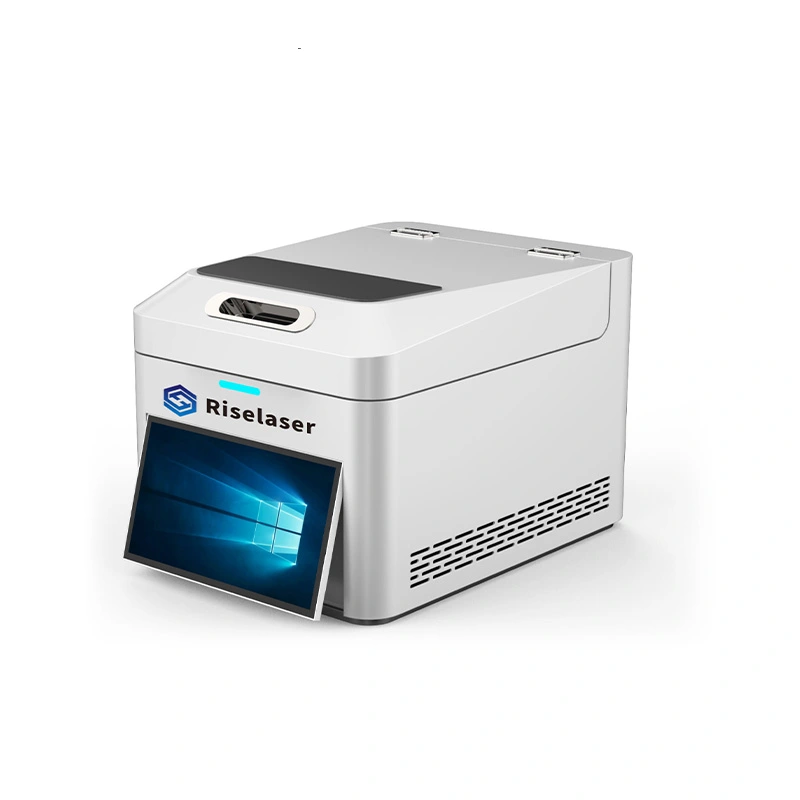
For 90% of retail jewelers and pawn shops, a Desktop (Benchtop) XRF Gold Tester is the superior choice over a handheld “gun.”
- Superior Accuracy (The “Hand Tremor” Factor): XRF physics requires a precise, constant focal distance between the X-ray tube and the sample. When using a handheld unit, even imperceptible hand tremors can alter the geometry of the shot, degrading signal stability on small items like rings or earrings. A desktop unit’s fixed stage eliminates this variable completely, ensuring higher precision. If your main concern is test precision rather than portability, read our guide to the most accurate gold tester
- Cost Efficiency: Desktop units are significantly cheaper than handhelds. With a handheld, you are paying a premium for miniaturized, military-grade ruggedization and battery technology. With a desktop, you pay only for the analyzer physics.
- Customer Trust: A desktop unit (like the Thermo Niton DXL) sits on the counter. The transparent, leaded-glass window allows the customer to watch their jewelry safely inside the lighted chamber. Pointing a “gun” at a customer’s jewelry—or taking it into a back room—can create suspicion.
Recommendation: If you operate a storefront, maximize your accuracy and budget by choosing a stationary unit. You can see a detailed comparison of specific models in our review of the top five benchtop gold testers.
The Verdict for Mobile Buyers: Buy a Handheld Unit

If your business model involves estate visits, coin shows, or flea markets, a Handheld XRF (like the Olympus Vanta or SciAps X-Series) is non-negotiable.
- Portability: You cannot plug a desktop unit into a wall at a storage locker auction.
- Versatility: Handhelds can analyze large objects that don’t fit in a box, such as silver tea sets, bronze statues, or industrial scrap piping.
The “Budget Trap”: The $4,000 Risk
Warning: The market is currently flooded with unbranded or “white label” XRF analyzers imported from overseas, often priced around $4,000. While the price is tempting compared to a $10,000+ brand-name unit, these devices pose a specific, documented risk to your business.
The 24K vs. 23K Error
Cheap analyzers frequently suffer from poor spectral resolution and calibration drift. Industry data indicates a common failure mode where these units cannot distinguish between high-purity grades.
- The Scenario: A customer brings in a 24K (99.9%) pure gold coin or bullion.
- The Error: Due to poor resolution, a cheap $4,000 unit often misreads the fluorescence, reporting it as 23K (approx. 95.8%).
- The Consequence: You unwittingly insult the customer by telling them their bullion is fake or impure. You lose the deal, and worse, you lose your reputation.
The Secondhand Gamble
Buying used can save 40–60%, but “cheap” used units often come with hidden costs:
- Tube Life: The X-ray tube is a consumable part, costing $3,500–$5,000 to replace. Always check the “Tube Hours” in the diagnostics menu.
- Drift: Older units lose detection sensitivity over time. Without factory recertification, a used device may drift enough to mistake 14K for 13.5K, costing you margin on every buy.
The Engine Room: Si-PIN vs. SDD Detectors
The XRF metal analyzer price difference between a standard model and a premium model is almost entirely dictated by the detector chip inside.
Si-PIN Detectors (The Retail Standard)
- Best For: Jewelry Stores, Pawn Shops, Cash-for-Gold.
- Performance: Slower (10–15 seconds per test). Resolution ~180 eV.
- Capabilities: Excellent for standard karat identification (10K, 14K, 18K).
- Economic Sense: Robust, lower cost, and cheaper to repair. If you are buying gold chains over the counter, Si-PIN is sufficient.
Silicon Drift Detectors – SDD (The Performance Standard)
- Best For: Refineries, Mining, Industrial Scrap.
- Performance: Fast (1–2 seconds per test). Resolution ~125 eV.
- Capabilities: Essential for detecting trace elements and light elements (Magnesium, Aluminum, Silicon).
- Why Buy It: If you are a refinery buying 500 lots a day, saving 10 seconds per test equals hours of labor saved. If you need to detect toxic contaminants like Cadmium or separate close elements like Platinum and Iridium, SDD is mandatory.
Detector Comparison Matrix
| Feature | Si-PIN Detector | Silicon Drift Detector (SDD) |
| Typical Application | Jewelry / Pawn | Refinery / Scrap Yard |
| Test Speed | 10 – 15 Seconds | 1 – 2 Seconds |
| Price Tier | Entry Level ($$) | Premium ($$$) |
| Resolution | ~180 eV | ~125 eV (High Definition) |
| Light Elements (Mg, Al, Si) | No | Yes |
What XRF Cannot Do: The Physics of Limitations
Even the best XRF gold tester has a physical limit: Depth.
The Penetration Barrier
XRF is a surface/near-surface technique. For gold alloys, the X-rays analyze only the top 10–20 microns (approx. 0.01 mm).
- The Threat: A counterfeit bar made of Tungsten (which shares the same density as gold) and plated with 50 microns of real gold will pass an XRF test as “100% Gold.” The X-rays physically cannot penetrate the thick plating to see the tungsten core.
The “Holy Trinity” of Verification
To be secure, professional buyers must use a layered defense:
- XRF: Verifies Surface Chemistry (Karat).
- Magnet: Filters out ferrous fakes immediately.
- Conductivity/Ultrasound (e.g., Sigma Metalytics): Verifies Volumetric Integrity. These tools shoot a signal through the bar to detect the tungsten core that XRF misses.
Safety, Compliance, and ROI
Owning an XRF makes you a radiation source owner.
- Radiation Safety: Modern units are safe if used correctly. However, you must never hold a sample in your fingers while testing (use pliers or a test stand).
- Regulations: In the US, most states require you to register the device within 30 days of acquisition. Failure to do so can result in fines.
- Return on Investment (ROI):
- Precision Buying: Instead of downgrading a 13.5K piece to 10K (to be safe), XRF allows you to pay for 13K, offering a better price to the customer than your competitors.
- Fraud Prevention: Identifying a single fake 100g gold bar saves you ~$8,000. Preventing just two such errors pays for a desktop unit.
Which Unit Should You Buy?
The “best” XRF tester is not the one with the highest specs, but the one that matches your daily workflow.
- For the Storefront: Prioritize a Desktop Si-PIN unit. It eliminates user error (hand tremors), costs less, and builds customer trust through transparency.
- For the Road: Invest in a ruggedized Handheld unit, but be prepared for the higher price tag. If you are comparing premium handheld options, see our guide to the best Niton XL5 alternatives.
- For the Budget-Conscious: Avoid the $4,000 “white label” trap. The risk of misidentifying 24K gold is too high. Stick to acid and magnets until you can afford a certified pre-owned unit from a major manufacturer.
FAQs
For professional jewelry stores and pawn shops, a Desktop XRF Analyzer is the best overall choice. Unlike acid tests, it is non-destructive and identifies advanced counterfeits like gold-plated tungsten. While handheld units are popular, a desktop model provides superior stability for testing small jewelry and typically offers the best Return on Investment (ROI) for a retail environment.
For a fixed location, Benchtop (Desktop) is better. It eliminates operator error caused by “hand tremors,” ensuring higher accuracy on small items like rings or earrings. Benchtop units are also safer (enclosed testing chamber), require less maintenance, and are significantly cheaper than handhelds. Handhelds are only necessary if you require mobility for off-site buying.
The most accurate method is Fire Assay (melting and weighing), but it destroys the jewelry. Among non-destructive electronic testers, an XRF Analyzer is the most accurate, capable of determining gold purity with precision up to 0.01% to 0.1% in seconds. Cheaper “electronic gold testers” (conductivity pens) are far less precise and struggle with non-standard alloys.