
For professionals in the precious metals industry, accuracy is not just a goal; it’s a requirement. Inaccurate gold testing can expose your business to significant financial risk from under-karated alloys and sophisticated counterfeits. Choosing the right technology is essential for protecting your bottom line.
So, what is the most accurate gold tester?
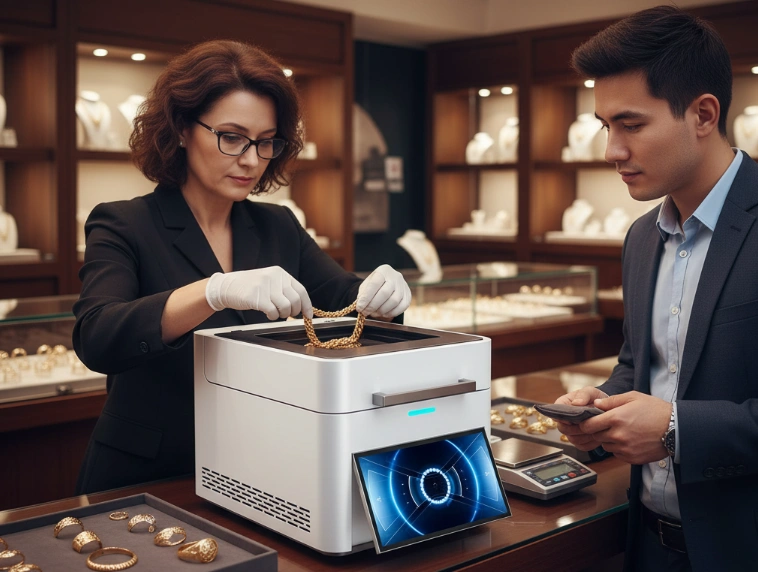
The answer depends on your specific application. For fast, reliable, and non-destructive analysis in daily operations, the X-Ray Fluorescence (XRF) analyzer is the most accurate and practical gold tester. To compare desktop and handheld options in more detail, see our guide on how to choose the best XRF gold testing machine.
However, the absolute benchmark for purity, used by refineries for official certification, is Fire Assay, a destructive laboratory method that provides the highest possible precision.
This guide will walk you through the different types of gold testing machines, compare their accuracy and applications, and help you select the right solution for your operational needs, from quality assurance to procurement.
The Solution for Daily Operations: X-Ray Fluorescence (XRF) Analyzers
For jewelers, recyclers, and quality control labs, X-Ray Fluorescence (XRF) analyzers have become the industry standard. These devices streamline workflows by delivering quantitative results in seconds, preserving the full value of the item being tested, and building customer trust through transparent verification. For buyers comparing countertop systems, see our guide to the top desktop XRF gold analyzers for jewelry stores and pawn shops.
How an XRF Gold Tester Machine Works
An XRF analyzer uses a low-level X-ray beam to excite the atoms in a metal sample. The atoms then release a unique energy signature, much like a fingerprint. The machine’s detector reads this signature to determine the exact elemental composition and purity of the alloy. This process is completely non-destructive and provides a detailed chemical breakdown in as little as 2 to 5 seconds.
A Critical Limitation for Risk Assessment: Surface-Level Analysis
In the past, a common criticism of XRF technology was its restriction to surface-level analysis. However, Riselaser’s latest XRF gold tester overcomes this with advanced Coating Thickness Measurement capabilities.

Unlike standard analyzers that might mistake a heavy gold plate for solid gold, our device utilizes a high-sensitivity Amptek SiPIN detector (USA) to analyze spectral peaks from both the surface layer and the substrate material.
- Detect Hidden Layers: The software utilizes a “Coating Mode” to identify if a base metal (like copper or nickel) exists beneath a gold layer.
- Measure Plating Thickness: It provides quantitative data on the plating thickness, essential for verifying jewelry quality and spotting sophisticated counterfeits.
While this technology effectively catches plated jewelry and coins, distinguishing a thick solid gold bar from a tungsten-filled counterfeit still requires checking the core density.
The Benchmark for Ultimate Purity: Fire Assay Gold Testing
Fire Assay, also known as cupellation, is the age-old “gold standard” for determining purity. It is the definitive method used for legal certification, refining, and settling large financial transactions where absolute accuracy is non-negotiable.
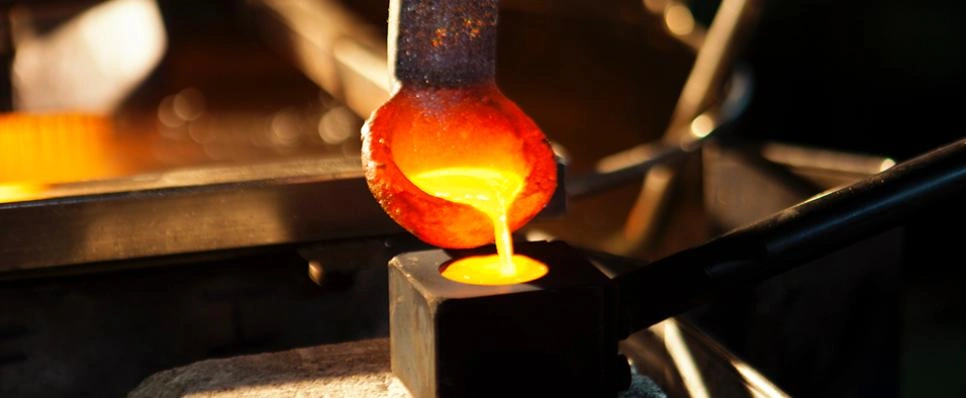
The process involves taking a sample of the metal and melting it in a furnace to physically separate the pure gold from all other metals and impurities. The remaining pure gold is then weighed to calculate its purity with exceptionally high precision, often to within 1 part in 10,000. The primary drawback is that the process is completely destructive, consuming the sample to yield its result.
A Multi-Technology Approach: Detecting Advanced Counterfeits
The widespread use of surface-level testing has led counterfeiters to develop fakes designed to defeat it. The most common threat in the bullion market is the tungsten-core counterfeit.
The Deep-Core Threat: Tungsten in Bullion
While our advanced XRF can detect surface plating, the most sophisticated threat in the heavy bullion market is the tungsten-core counterfeit. Because tungsten has a density nearly identical to gold, a thick gold bar drilled and filled with tungsten can sometimes deceive density tests and surface scans.
The Solution: Ultrasonic Testers for Bulk Analysis
The most effective non-destructive way to detect a tungsten core is with an ultrasonic tester. This device sends a high-frequency sound wave through the bar. Sound travels through gold and tungsten at significantly different speeds (3,240 m/s for gold vs. 5,174 m/s for tungsten). By measuring the speed of the sound wave, the machine can instantly expose an internal fake core.
For maximum security, professionals handling high-value bullion should use a two-step process:
- Verify surface purity with an XRF analyzer.
- Confirm internal integrity with an ultrasonic tester.
Gold Tester Machine Comparison: Accuracy, Cost, and Use Case
While XRF and Fire Assay represent the top tiers of accuracy, other machines are available. However, for professional B2B applications, their limitations often introduce unacceptable levels of risk.
Electronic Gold Tester Accuracy: A High-Risk for Professionals
Common electronic testers measure electrical conductivity, not elemental composition. Their accuracy is notoriously low, with inconsistent results on white gold alloys and, most critically, a documented failure to reliably detect gold plating. This flaw makes them unsuitable for professional transactions where financial accuracy is paramount.
The Gold Acid Test: Obsolete for Modern Quality Control
The traditional acid scratch test is destructive, subjective, and provides only a rough karat estimation. Furthermore, it involves handling hazardous corrosive acids, posing a safety and compliance risk in a professional environment.
Gold Tester Comparison Chart
| Method | Accuracy | Non-Destructive? | Use Case | Est. Cost (Equipment) |
| XRF Analyzer | Excellent (Quantitative) | Yes | Daily QA, Jewelry, Scrap, Bullion | $5,000 – $25,000+ |
| Fire Assay | Benchmark (Highest) | No (Total Destruction) | Refining, Legal Certification | $100 – $300+ (Per Service) |
| Ultrasonic Tester | N/A (Bulk Integrity) | Yes | Bullion (Detecting Core Fakes) | $500 – $2,000+ |
| Electronic Tester | Poor to Fair | Yes | Not Recommended for Professional Use | $350 – $600 |
| Acid Test | Poor (Estimate) | No (Minor Damage) | Not Recommended for Professional Use | $20 – $70 (Kit) |
Making the Right Investment to Protect Your Business
For any business buying, selling, or processing precious metals, an XRF analyzer is the essential tool for ensuring accuracy and operational efficiency. For organizations handling high-value bullion, pairing XRF technology with an ultrasonic tester provides a complete security protocol against sophisticated fraud. While the initial cost is a significant capital investment, it protects your business from the far greater cost of a single transactional error.
Protect your investments and ensure transactional integrity. Request a quote or speak with one of our technical specialists today to find the right gold testing solution for your business.
FAQs
A: An X-Ray Fluorescence (XRF) analyzer provides the most accurate results, including coating thickness analysis, to verify purity without harming the item.
A: The most reliable non-destructive method is an ultrasonic tester, which can detect differences in material composition deep inside a bar by measuring the speed of sound.
A: A professional-grade XRF analyzer is a capital investment, with prices typically ranging from $5,000 for entry-level benchtop models to over $25,000 for high-performance handheld units.
A: No. Due to their inability to reliably detect gold plating and their inconsistencies with various alloys, electronic testers are not recommended for professional transactions where financial accuracy is critical.
A: Yes. Unlike standard testers, our latest analyzer features an Amptek SiPIN detector with a specialized “Coating Mode.” It can identify base metals beneath the gold surface and measure the plating thickness, ensuring you don’t mistake plated jewelry for solid gold.