
For years, the gold analysis market was dominated by three expensive giants. In 2025, the landscape has shifted. While legacy brands still offer specific technological niches, the focus for many businesses has moved toward Return on Investment (ROI) and Cost-Effectiveness.
Here is our objective ranking of the top 5 desktop XRF analyzers based on value, performance, and specific use cases:
- Thermo Scientific Niton DXL: Best for Customer Trust. The industry standard “countertop” box known for its widely recognized gold-plating detection software.
- Evident (Olympus) Vanta GX: Best for High Speed. A premium choice for high-volume refiners requiring rapid data throughput and cloud connectivity.
- Bruker CTX: Best for Portability. The only closed-beam desktop unit capable of battery operation for mobile buying events.
- Fischer GoldScope SD: Best for Manufacturing. The precision specialist for measuring ultra-thin coating layers in plating production.
- Riselaser RL-RAY6000T: Best for Value & ROI. The practical choice for businesses that need accurate gold, silver, and platinum verification without the inflated price tag of legacy brands.
In-Depth Review of the Top 5 Models
1. Thermo Scientific Niton DXL
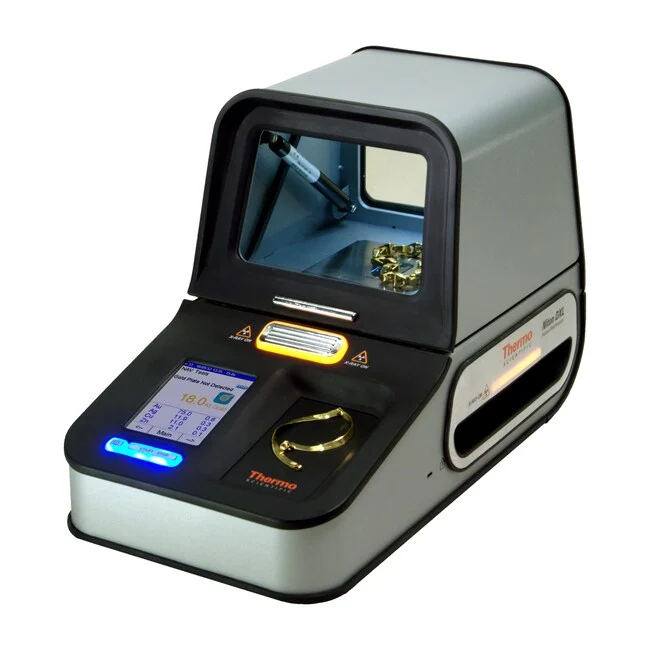
Category: Best for Brand Recognition
- Overview: The Niton DXL is ubiquitous in the industry. Its “shielded box” design is instantly recognizable to customers, which can help build trust during a transaction.
- Key Feature: AuDIT™ Technology. This proprietary software alerts the operator to the probability of gold plating, specifically targeting advanced counterfeits like gold-plated tungsten.
- Pros & Cons: It offers high reliability and a user-friendly interface, but it comes with a high initial capital expenditure and costly maintenance for X-ray tube replacements.
2. Evident (Olympus) Vanta GX
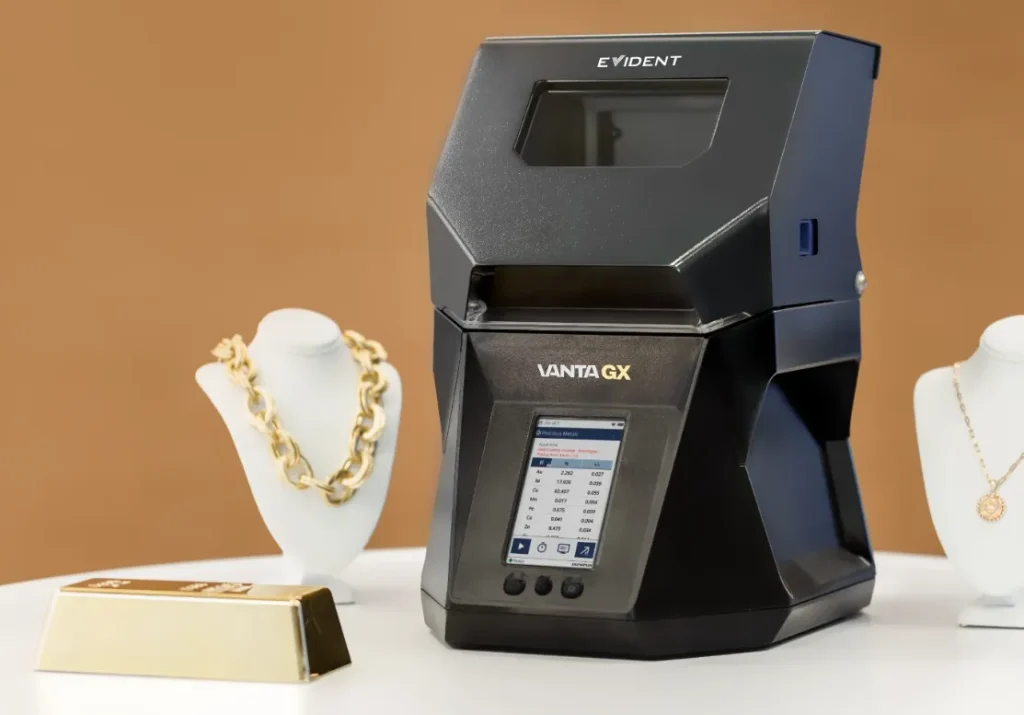
Category: Best for Speed and Throughput
- Overview: As the desktop successor to the handheld Vanta series, the GX is designed for speed. It utilizes advanced signal processing (Axon Technology™) to deliver results in seconds.
- Key Feature: Connectivity. It excels in modern retail environments by integrating seamlessly with cloud data and POS systems, allowing for instant digital certificate generation.
- Pros & Cons: Extremely fast and precise (often utilizing high-end SDD detectors), but priced at a premium that may be overkill for a standard retail jewelry store.
3. Bruker CTX
Category: Best for Mobile Operations
- Overview: The Bruker CTX bridges the gap between a handheld gun and a desktop unit. It is unique in that it offers a closed-chamber safety design but can run on a Lithium-Ion battery.
- Key Feature: Portability. Weighing roughly 7kg and battery-operated, it is the only viable option for dealers doing estate buys in hotels or private homes who still want the safety of a desktop unit.
- Pros & Cons: Excellent ruggedness and field utility, though the smaller chamber size can be limiting for larger silverware or tea sets.
4. Fischer GoldScope SD
Category: Best for Manufacturing QC
- Overview: Helmut Fischer is renowned for German engineering precision, specifically in the plating industry. This unit is less of a “buying tool” and more of a “quality control instrument”.
- Key Feature: WinFTM Software. Its ability to measure the thickness of coating layers (e.g., rhodium over gold) is unmatched, making it essential for manufacturers verifying their own products.
- Pros & Cons: Unrivaled precision for thin coatings, but the software interface is complex and requires more training than the “point-and-shoot” simplicity of the Riselaser or Niton models.
5. Riselaser RL-RAY6000T
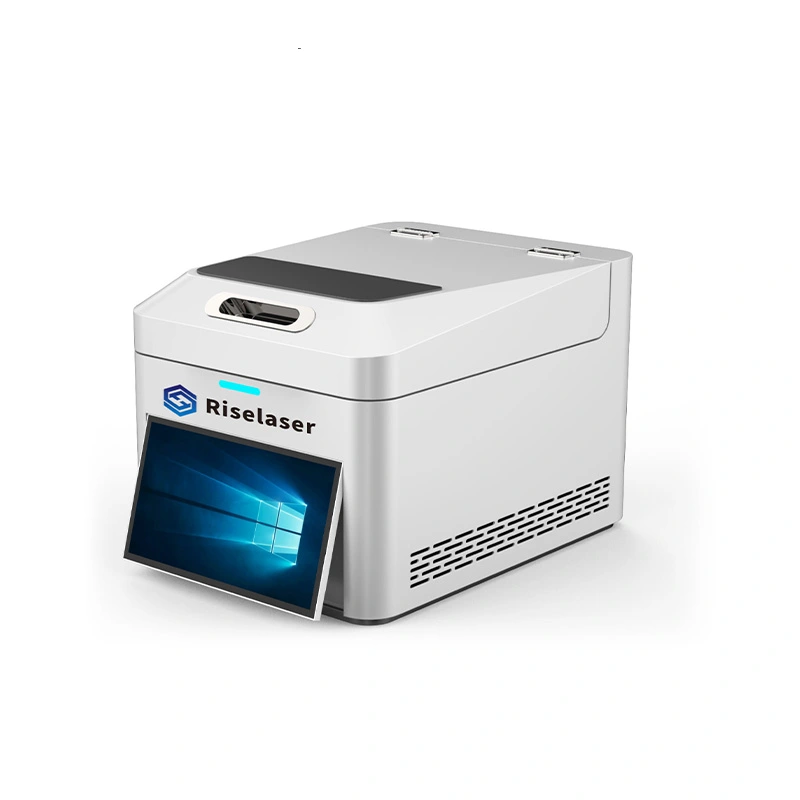
Category: Best Overall Value & ROI
- The Proposition: For independent jewelers, pawn shops, and cash-for-gold operations, the primary goal of an XRF is risk mitigation—stopping counterfeit buys. The RL-RAY6000T delivers this essential functionality at a significantly lower entry cost than its competitors.
- Objective Analysis: While it may lack the aggressive marketing of the “Big Three,” this analyzer focuses on the core elements required for daily trade: accurate karat assessment and elemental analysis of Gold (Au), Silver (Ag), and Platinum (Pt).
- Key Advantage: Cost-Effectiveness. By stripping away non-essential industrial features and focusing on precious metal verification, the RL-RAY6000T offers the fastest path to profitability. A business can recoup the machine’s cost in significantly fewer transactions compared to purchasing a $20,000+ unit.
How to Choose the Right XRF Gold Testing Machine
Understanding Detector Technology (Si-PIN vs. SDD)
- Si-PIN: Standard detectors found in value-focused models (like the Niton DXL and base configurations of others). They are perfectly adequate for identifying gold karat (10k, 14k, 18k, 24k) and silver.
- SDD (Silicon Drift Detector): Found in premium models like the Vanta GX. They offer faster count rates and better detection of trace elements but significantly increase the price. To see how detector choice influences budget, read our guide on how much detector type affects XRF gold analyzer cost.
- Advice: For 95% of jewelry buying, a standard detector is sufficient. Do not overpay for laboratory-grade SDD technology unless you are a refinery.
The ROI Calculation
- The Math: If you avoid purchasing just three fake heavy gold chains (often valued at $3,000–$5,000 each) because your XRF flagged them, the machine has essentially paid for itself.
- The Advantage: Lower-cost machines like the RL-RAY6000T reach this “break-even point” much faster than premium models, freeing up cash flow for buying more inventory.
Safety & Compliance
- Radiation Myths: XRF analyzers emit directed radiation only when the tube is energized. Desktop units are “closed-beam,” meaning the X-rays are fully contained within the shielded chamber, making them significantly safer for retail environments than handheld “guns”.
- Regulations: Always check with your local state or national radiation control board regarding registration requirements.
Frequently Asked Questions (FAQ)
A: Yes. Most modern desktop units, including the models listed above, can identify plating by detecting underlayer elements (like copper or nickel) or by recognizing spectral anomalies. For a broader comparison of testing precision and method limitations, see our guide on what is the most accurate gold tester.
A: Absolutely. XRF is non-destructive (no scratching or filing required) and eliminates the risk of acid burns, fumes, or chemical disposal issues.
A: Desktop units are stationary “closed-beam” systems, generally considered safer and more customer-friendly for a counter environment. Handheld units offer mobility but require stricter safety protocols.
Conclusion
Heading into 2026, the “best” analyzer is the one that protects your business without draining your bank account.
- If you need specific plating thickness for manufacturing, choose the Fischer GoldScope.
- If you need to travel to hotel buys, choose the Bruker CTX.
- But for the standard jewelry store or pawn shop looking for the smartest financial move, the Riselaser RL-RAY6000T offers the perfect balance of capability and cost-effectiveness.