
Laser cleaning technology is a high-value industrial solution that uses focused photonic energy to remove contaminants while leaving the base material completely untouched. For maintenance managers and production engineers, this technology is “worth it” because it often provides a full return on investment (ROI) within 12 to 18 months. While the initial purchase price is higher than traditional sandblasting, laser cleaning eliminates the need for consumables, generates nearly zero secondary waste, and prevents the substrate damage common with abrasive methods.
How Laser Cleaning Works: The Science of Ablation
At its core, laser cleaning is a process called laser ablation. This occurs when a laser beam strikes a surface, and the contaminant layer (such as rust, oil, or paint) absorbs the light energy. This energy breaks the molecular bonds of the contaminant, causing it to instantly vaporize or sublimate into a gas.
The success of this process depends on the Ablation Threshold. Every material has a specific energy level at which it begins to vaporize. Industrial metals like steel and aluminum have much higher thresholds than rust, oxides, or paint. By tuning the laser’s power, operators can vaporize the “dirty” layer while the beam reflects harmlessly off the underlying metal.

Three Primary Cleaning Regimes
- Vaporization: Light contaminants like oil or moisture absorb energy and turn directly into gas.
- Thermal Stress: The laser rapidly heats the coating, causing it to expand and “pop” off the substrate due to the difference in expansion rates.
- Plasma Shockwave: High-intensity pulses create a plasma plume that generates a mechanical shockwave, dislodging thick, brittle scale or heavy rust.
Technical Specifications: Pulsed vs. Continuous Wave (CW)
Choosing the right laser type is critical for production efficiency and substrate safety.
| Feature | Pulsed Laser Cleaning | Continuous Wave (CW) Laser |
| Mechanism | Short bursts of high peak power | Steady, uninterrupted stream of light |
| Heat Impact | Minimal Heat-Affected Zone (HAZ) | Higher heat; risk of substrate warping |
| Best For | Precision molds, aerospace parts, thin metals | Heavy steel fabrication, bridge rust, thick coatings |
| Cleanliness | Closer to original metal color | May leave slight surface residue |
| Speed | 2–7 m²/hr | Up to 15 m²/hr |

Beam Profiles: Gaussian vs. Top-Hat
- Gaussian Beam: Features high intensity at the center. It is ideal for high-precision cleaning and removing stubborn contaminants from small areas.
- Top-Hat (Flat-top) Beam: Distributes energy uniformly across the entire spot. This ensures consistent cleaning across large surfaces and prevents “hot spots” that might cause over-cleaning or damage to heat-sensitive materials.
Achieving Industrial Standards: ISO 8501 and Ra Values
For quality control, laser cleaning can meet and exceed international cleanliness grades.
- Cleanliness Grades: High-power fiber lasers can achieve a standard equivalent to Sa 2.5 (Near-White Metal) or even Sa 3.0 (White Metal) as defined by ISO 8501.
- Surface Roughness (Ra): Unlike sandblasting, which can increase surface roughness to 20–50 μm , laser cleaning preserves the original profile (Ra value). In some cases, it can improve paint adhesion by 32.7% by creating micro-textures that do not compromise structural integrity.
Economic Analysis
Is laser cleaning worth the capital expenditure (CAPEX)? As the market has matured, the cost of industrial pulsed laser systems has decreased significantly, making the technology accessible to a wider range of facilities.
Current Market CAPEX (Pulsed Systems):
- 500-Watt Pulsed System: $15,000 – $25,000.
- 1-Kilowatt Pulsed System: $25,000 – $50,000.
- High-End Automated Systems: Can still exceed $50,000 – $200,000 for robotic integration or aerospace-grade precision.
Operational Cost Comparison (Per Hour):
- Energy Consumption: A 1000W laser typically draws 5–6 kW, costing approximately $0.60 to $0.90 per hour.
- Consumables: The primary consumable is the protective lens, which costs approximately $ 7and is replaced every 40–100 hours of use.
- Maintenance: Routine maintenance for chillers and air filters averages roughly $2.00 per hour of operation.
Many laser cleaning vendors estimate that replacing sandblasting or chemical cleaning can save around $10,000–$30,000 per year in media, labor, and waste disposal costs, with payback periods often around 1–2 years, depending on utilization and application.
Frequently Asked Questions (FAQ)
No, when configured correctly, industrial laser cleaning is non-destructive. The process exploits the difference in ablation thresholds between the contaminant and the substrate. The laser energy vaporizes the rust or paint but reflects harmlessly off the base metal. However, improper settings—such as using excessive power on thin sheet metal—can cause surface melting or warping.
For thick, heavy rust, sandblasting remains faster, cleaning 15–30 m²/hr versus 2–10 m²/hr for most laser systems. However, the laser is faster for light oils or thin oxide layers. Furthermore, because it requires no masking or media cleanup, the total job time for a laser is often shorter than sandblasting.
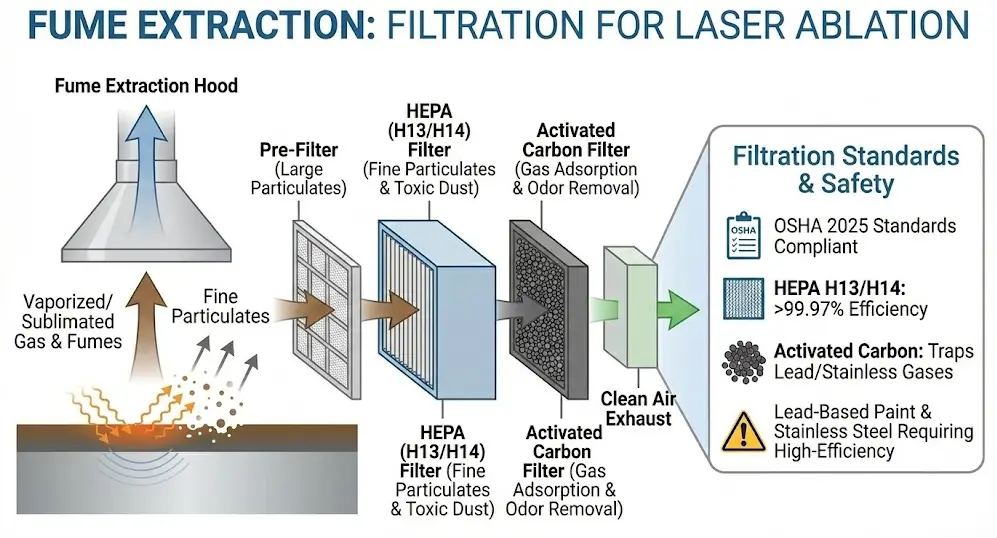
Most industrial cleaners are Class 4 lasers, which can cause permanent blindness or severe skin burns from direct or reflected beams. Additionally, vaporizing lead paint or stainless steel creates toxic nanoparticles (like hexavalent chromium) that must be captured by a medical-grade HEPA (H13/H14) fume extraction system.
Most operators can become confident in basic machine operation within one working day. However, specialized training for Class 4 safety and parameter tuning for delicate substrates is highly recommended and often takes 2–3 days of on-site instruction.
Laser cleaning is significantly quieter than abrasive blasting. A 200W pulsed laser typically produces noise levels around 70 dB, whereas a wire-wheel grinder or sandblaster can exceed 95–100 dB, requiring heavy hearing protection.
Laser Cleaner Safety and Compliance: Navigating 2026 Regulations
Laser cleaning systems are Class 4 devices, meaning they pose significant risks if not managed properly.
- Eye and Skin Protection: Operators must wear laser safety goggles rated for the specific wavelength (typically 1064 nm) and flame-resistant clothing.
- Fume Extraction: Vaporizing coatings releases fine particulates and toxic gases. Removal of lead-based paint or stainless steel requires high-efficiency HEPA (H13/H14) and activated carbon filtration to meet OSHA 2025 standards.
- HSE Training: Operators should undergo on-site certification to understand laser physics and emergency shutdown procedures.
Summary Checklist: Is It Right for You?
Choose Laser Cleaning if:
- You clean high-value parts (molds, engines, heritage artifacts) where substrate damage is unacceptable.
- Your current process generates high hazardous waste disposal costs (chemical sludge or contaminated grit).
- You need to integrate surface prep into an automated robotic production line.
Stick with Traditional Methods if:
- You are cleaning massive, low-value structures like ship hulls where raw speed is the only priority.
- You need to clean deep, non-line-of-sight internal geometries where a laser beam cannot reach.
Ready to calculate your potential savings?